
Empowering Privacy in Decentralized Social Networks: Fine-Grained WebID Profile Filtering
Customized Views on Profiles in WebID-Based Distributed Social Networks
The paper introduces a fine-grained access control mechanism for WebID-based Distributed Social Networks (DSNs) using the WebID Profile Filter Language (WPFL). By leveraging SPARQL-based graph transformations, the team enables users to create customized, agent-specific views of their identity profiles without the need to partition data across multiple resources.
TL;DR
In the world of Distributed Social Networks (DSNs), your identity is your data. However, the current WebID standard often exposes too much. This paper presents a solution that uses SPARQL-based filtering to create "Customized Views" of a profile. Instead of sharing your whole profile, you share only what a specific person—like a coworker or a friend—needs to see, all generated dynamically from a single source of truth.
The "All-or-Nothing" Dilemma in Decentralized Identity
WebID allows users to own their data by hosting a machine-readable RDF profile document. While this avoids the "data silo" problem of Facebook or LinkedIn, it introduces a privacy nightmare: the Coarse-Grained Access Control problem.
Most existing methods like Web Access Control (WAC) can only lock or unlock an entire file. If your public key (needed for login) is in the same file as your personal phone number, an anonymous requester might see both. To fix this, users previously had to split their profiles into many different files, making data management an absolute mess.
Methodology: The WebID Profile Filter Language (WPFL)
The authors propose a more elegant solution: don't move the data; change the view. By introducing the WebID Profile Filter Language (WPFL), they allow identity owners to attach "Filter Specifications" directly to their WebID.
How it Works:
- Request: An agent (requester) asks for a WebID profile.
- Filter Selection: The system identifies the requester and finds the corresponding SPARQL template.
- Graph Transformation: The master profile (RDF graph) is passed through a SPARQL
CONSTRUCTquery. This acts as a "whitelisting" mechanism, pulling only the allowed triples into a temporary graph. - Delivery: The requester receives a "filtered profile" that looks like a standard WebID document but contains only the permitted information.
 Figure 1: The architecture showing the graph-to-graph transformation based on requesting agent identities.
Real-World Implementation: The Sociddea Platform
To prove this isn't just theoretical, the authors integrated this logic into Sociddea, an identity management platform. They addressed the usability gap by providing two ways to manage privacy:
- The GUI Approach: A simple interface for non-technical users to check/uncheck which fields (like Email, FOAF interests, or Work history) are visible.
- The Expert Approach: Direct SPARQL input for complex logic, such as "only show my work email if the requester belongs to my organization."
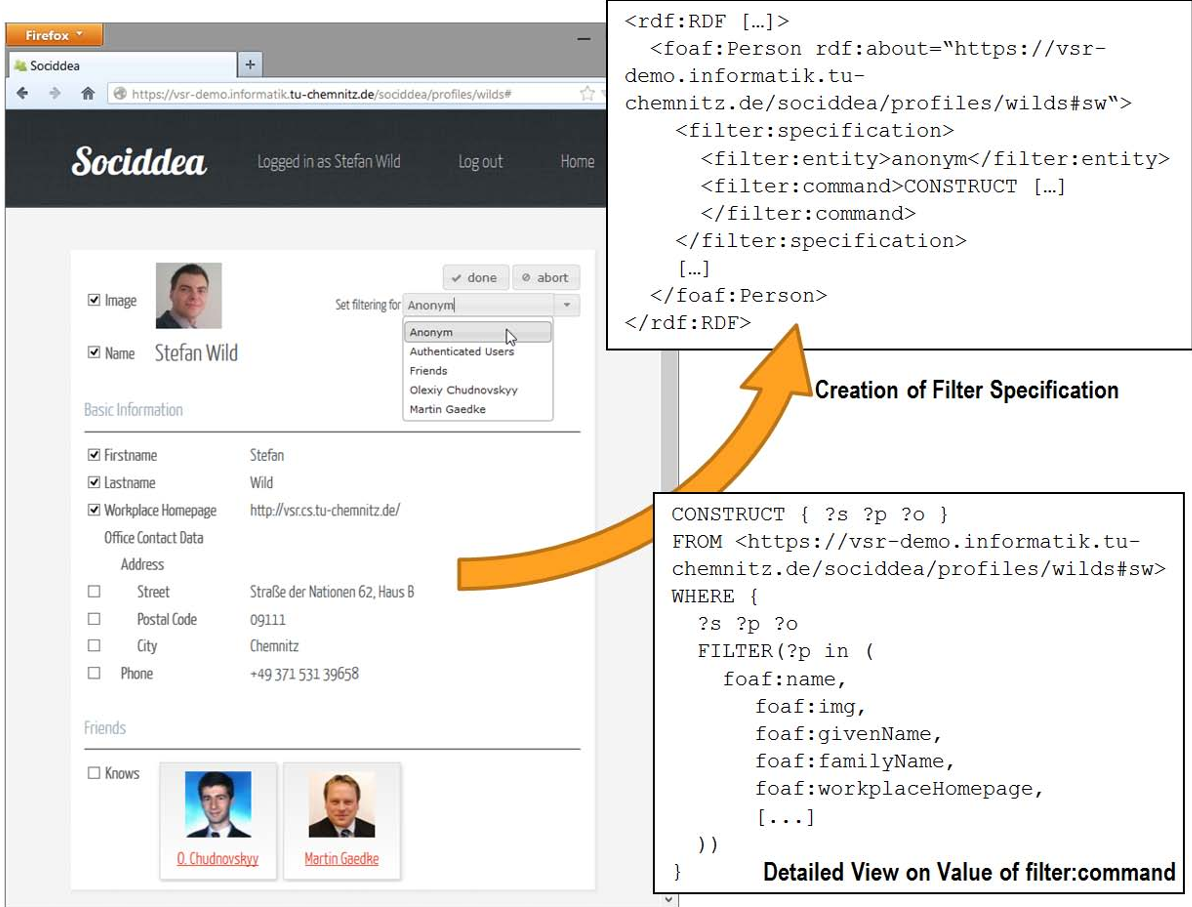 Figure 2: The Sociddea UI allowing users to define visibility constraints without writing code.
Critical Insight & Future Outlook
The brilliance of this approach lies in its Portability. Because the filter definitions are themselves RDF data using the standard SPARQL language, a user could move their profile from one hosting provider to another without losing their privacy settings.
Limitations: Currently, SPARQL filtering is computationally more expensive than serving a static file. In a high-traffic DSN, performance optimizations (like caching filtered views) would be necessary.
Conclusion: This paper provides a practical bridge between the open nature of the Semantic Web and the strict privacy requirements of a modern social network. It moves us closer to a "Global Social Graph" where the user truly holds the keys to what the world sees.