
Mapping Cyber-Collective Action: How Female Muslim Bloggers Fueled the "Women to Drive" Movement
Mapping Cyber-Collective Action among Female Muslim Bloggers for the Women to Drive Movement
This paper proposes a computational methodology to analyze how decentralized online individual actions transform into cyber-collective actions within the female Muslim blogosphere. Focusing on the "Women to Drive" movement in Saudi Arabia (2007-2012), it utilizes sentiment analysis (LIWC) and social network theory to track the evolution of collective sentiment.
TL;DR
Social media is often credited with sparking revolutions, but how exactly does a single blog post turn into a mass movement? This paper investigates the "Women to Drive" movement in Saudi Arabia by analyzing the blogosphere of female Muslim activists. By applying computational sentiment analysis to years of data, the researchers show how individual feelings of defiance transform into a unified "collective sentiment" that drives real-world action.
Problem & Motivation: Beyond the Hashtag
We often hear about the "Twitter Revolution" or "Facebook Activism," but most accounts remain anecdotal. The academic gap is significant: we lack a quantitative understanding of the mechanics of mobilization.
The authors focus on the female Muslim blogosphere because it represents a unique tension. In physical spaces, these women often face severe restrictions on freedom of expression. In the digital space, however, blogs become "digital recourses." The researchers sought to move beyond the theory of Homophily (the idea that "birds of a feather flock together") to explain why and how these clusters actually mobilize for change.
Methodology: Sentiment as a Proxy for Action
The researchers developed a pipeline to track the transformation of decentralized individual actions into collective movements.
- Data Collection: They crawled ~300 blog sites from 23 countries, focusing on English-speaking female Muslim bloggers.
- Sentiment Extraction: Using LIWC (Linguistic Inquiry and Word Count), they analyzed 80 variables, focusing on "Affective Processes" (positive vs. negative emotions like anger or support).
- Temporal Analysis: They mapped these sentiments against a timeline of key events, such as Wajeha al-Huwaider’s 2008 driving video and the 2011 Facebook campaign.
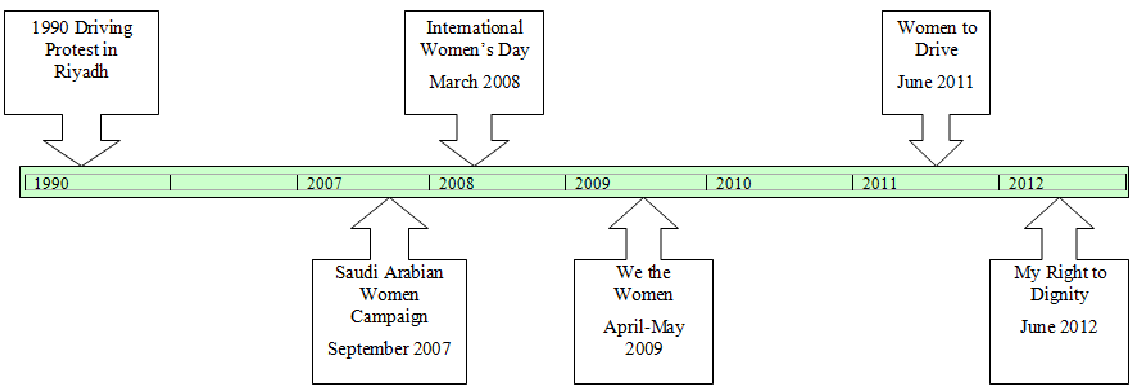 Figure 1: Timeline of major events in the Saudi Women to Drive movement.
Key Insights: The Anatomy of a Movement
1. The Power of Diffusion (2008-2009)
During the 2008 International Women’s Day protest, the researchers observed that blog post volume spiked before the event, acting as "awareness creation." Interestingly, the LIWC analysis showed that both bloggers and their commenters shared a synchronized rise in positive emotions (solidarity). This "sentiment diffusion" is the invisible glue that turns a network into a movement.
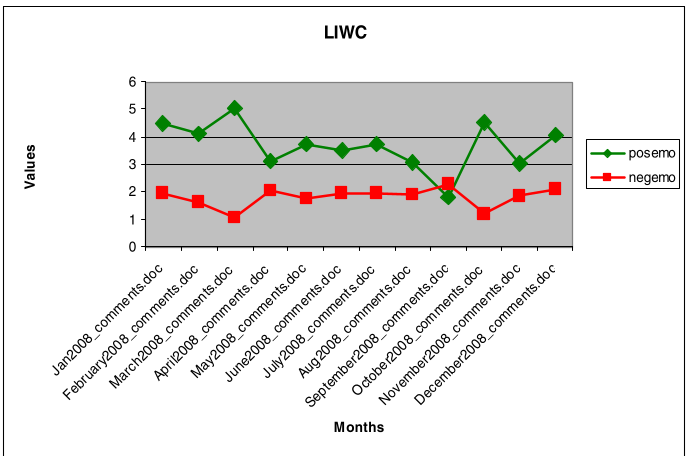 Figure 5: LIWC results showing high positive sentiment in 2008, indicating strong internal community support.
2. The Influence of Outsiders (2011)
The 2011 "Women2Drive" campaign presented a different profile. While the core bloggers remained highly positive and motivated, the overall sentiment in the comments actually turned negative.
The authors discovered a fascinating reason: demographic interference. Unlike previous years, the 2011 movement attracted significant attention from male users who posted "anti-Women2Drive" comments. This highlights a critical challenge for online movements: as they grow in visibility, they attract counter-sentiments that can dilute or discourage the collective action.
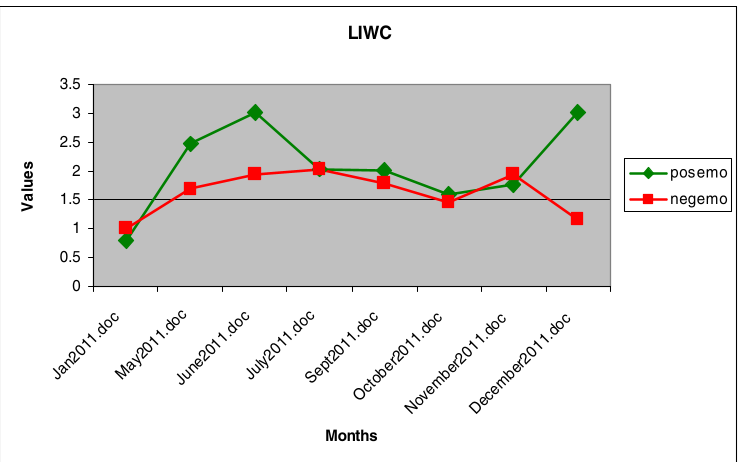 Figure 8: LIWC results for 2011 showing the divergence between blogger sentiment and commenter reaction.
Critical Analysis & Conclusion
This paper provides a robust framework for Computational Social Network Analysis (CSNA). It proves that collective action is not a random occurrence but a traceable evolution of sentiment.
Takeaways:
- Sentiment Convergence: A movement is most likely to succeed when the sentiment of "leaders" (bloggers) and "followers" (commenters) aligns.
- Digital Governance: For citizens in restrictive regimes, social media acts as a "corrective mechanism," allowing for high-speed, low-cost coordination that was impossible in the age of traditional media.
Limitations: The study primarily focused on English-language blogs. To truly map global movements, future research must perform cross-cultural analysis involving Arabic and other native languages to capture the full spectrum of the local grassroots dialogue.