
Cyber Migration: Why Users Abandon One Social Network for Another
Cyber Migration: An Empirical Investigation on Factors that Affect Users' Switch Intentions in Social Networking Sites
This paper introduces the concept of "Cyber Migration" to explain user switching behavior between Social Networking Sites (SNS). Leveraging the Push-Pull-Mooring (PPM) framework, it identifies "Dissatisfaction with Member Policy" and "Peer Influence" as the primary drivers for user turnover.
TL;DR
Why did users flee Friendster for MySpace, and later MySpace for Facebook? This paper argues that these shifts aren't just market competition—they are "Cyber Migrations." Using a framework borrowed from human geography, the study reveals that users don't switch because of bugs or slow speeds; they switch because they hate the platform's "laws" (Member Policy) and because their friends are already leaving (Peer Influence).
Background: The Sociology of the Web
In the volatile era of Web 2.0, platforms rose and fell with staggering speed. The authors posit that an SNS is more than just software; it is a "bounded system" where individuals traverse social links. When a user moves their primary activity from one site to another, it mirrors physical migration. This paper provides an empirical map of this movement using the Push-Pull-Mooring (PPM) framework.
The Problem: What Drives the "Cyber Migrant"?
Earlier research focused on general satisfaction or privacy concerns. However, these factors didn't fully explain the mass exodus events seen in the mid-2000s. The authors identified a gap: we didn't understand the competing forces of the original site (Push), the destination site (Pull), and the obstacles in between (Mooring).
Methodology: The PPM Framework
The study breaks down switching intention into three multidimensional constructs:
- Push Factors (Dissatisfaction): Technical quality, information quality, community support, and Member Policy.
- Pull Factors (Attraction): Alternative attractiveness and Peer Influence.
- Mooring Factors (Switching Costs): Setup costs (new profile) and Continuity costs (losing friends).
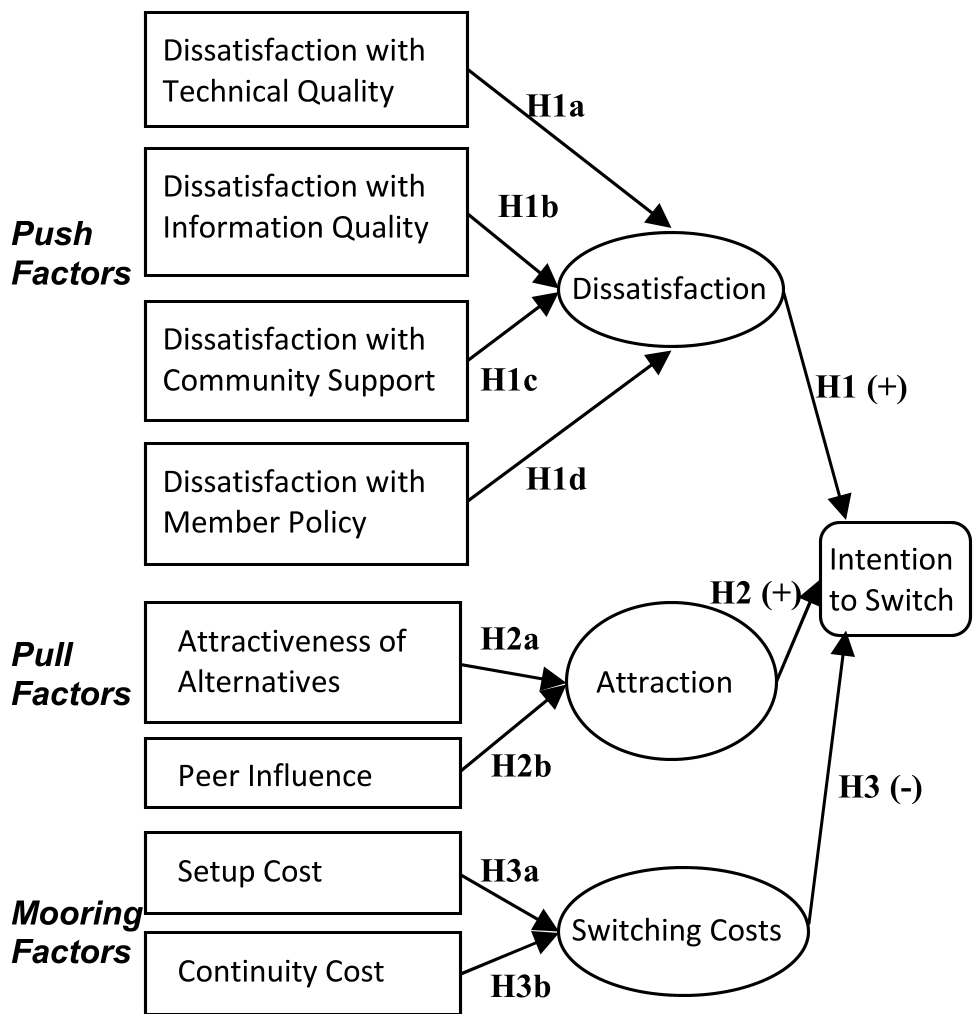
The researchers used Partial Least Squares (PLS) to analyze survey data from 170 active SNS users, primarily students in Singapore and China.
Key Insights: Policy and Peers Over Technology
The results were surprising. While we often think of tech products winning on "features," the data showed a different reality:
- Member Policy is the Ultimate Push: Dissatisfaction with technical or information quality had no significant impact. However, dissatisfaction with member policy (rules, bans, restrictions) was a massive driver for leaving.
- The Power of the Invite: Peer influence was the strongest pull factor. If your friends are dissatisfied and inviting you elsewhere, you leave.
- The Myth of Switching Costs: In traditional geography, moving is expensive (Mooring). In cyberspace, the study found switching costs to be an insignificant barrier. Modern users are happy to maintain multiple accounts or use automated tools to "migrate" their digital lives.

Critical Analysis & Conclusion
The core takeaway is that SNS providers are more like digital governments than software vendors.
Takeaway for Practitioners:
- Policy Sensitivity: Users are hyper-sensitive to changes in "Member Policy." Restrictive rules (like Friendster’s ban on "fakesters") can trigger a death spiral.
- Network Effects: You don't need to build a better app; you need to convince the influencers in a social group to move. Once the "peers" shift, the rest follow.
Limitations:
The study was conducted in 2008 on a student population. Today, "Platform Lock-in" (like ecosystem integration) might act as a stronger Mooring factor than it did then. Furthermore, the 27.6% variance explained suggests there are other "Pull" factors—perhaps related to algorithmic discovery or monetization—left to be explored.
Final Verdict: This work successfully bridges human geography and Information Systems, proving that the digital world follows many of the same "Laws of Migration" as the physical one.