
Cyber Politics: Re-Engineering the Feedback Loops of State Stability
Cyber Politics: Understanding the Use of Social Media for Dissident Movements in an Integrated State Stability Framework
2012-08-01
Summary
Problem
Method
Results
Takeaways
Abstract
The paper introduces an integrated state stability framework that combines traditional "real world" political dynamics with "cyber world" interactions. Using System Dynamics and causal loop diagrams, it analyzes how social media (specifically Twitter) amplifies dissident 'loads' and how regimes utilize cyber-tools to maintain 'capacity,' specifically applied to a case study of the 2011 Egyptian Revolution.
## TL;DR
While the "Arab Spring" is often romantically dubbed a "Twitter Revolution," this paper argues that cyberspace is just one layer of a complex, systemic feedback loop. By integrating cyber-effects into a traditional **State Stability Framework**, the authors demonstrate how digital tools amplify "loads" (dissident pressure) against a state’s "capacity" (resilience).
## Problem & Motivation: Beyond the "Digital vs. Real" Binary
For decades, political scientists viewed state stability through economic performance and institutional legitimacy. When the digital age arrived, a divide formed: **Cyber-Optimists** claimed the internet would democratize the world, while **Cyber-Skeptics** (like Malcolm Gladwell) argued that "the revolution will not be tweeted."
The authors bridge this gap. They argue that stability is a **dynamic process** of feedback loops. Cyberspace doesn't change the *goal* of revolution, but it fundamentally alters the **magnitude, timing, and coordination** of pressures applied to the state.
## Methodology: Mapping the Mechanics of Power
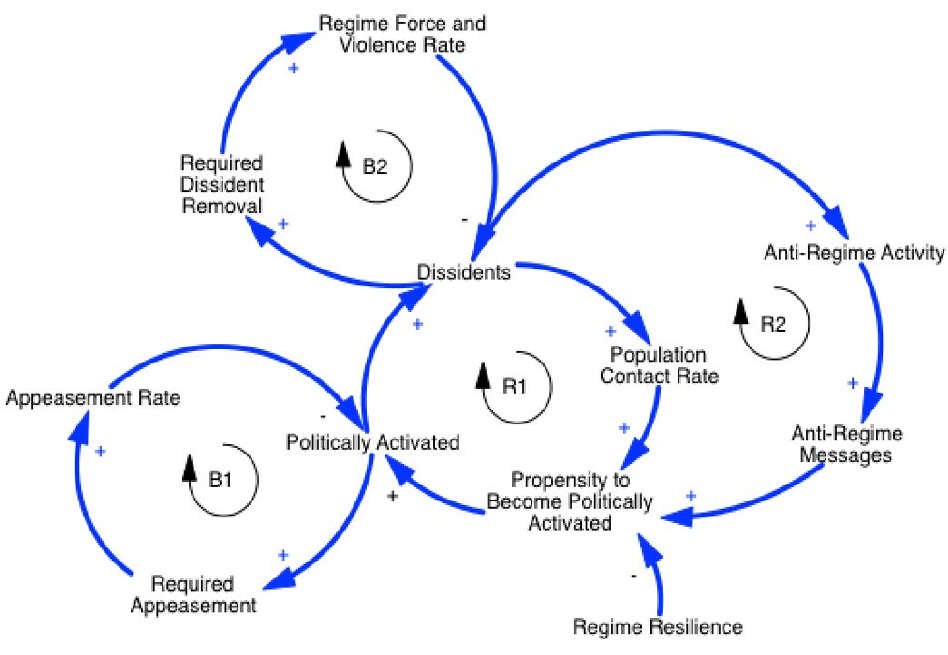
The paper uses **Causal Loop Diagrams (CLDs)** to visualize how different variables interact. They define state stability through two competing forces:
1. **Loads**: Pressures generated by dissident activities (protests, anti-regime messages).
2. **Capacity**: The state's ability to withstand loads, derived from economic performance, legitimacy, and force.
### The "Real World" Loops
The core of the model starts with **Loop R1 (Regime Resilience)**. If a state has high GDP, literacy, and legitimacy, the propensity for a citizen to become a "politically activated dissident" stays low.
### The "Cyber" Augmentation
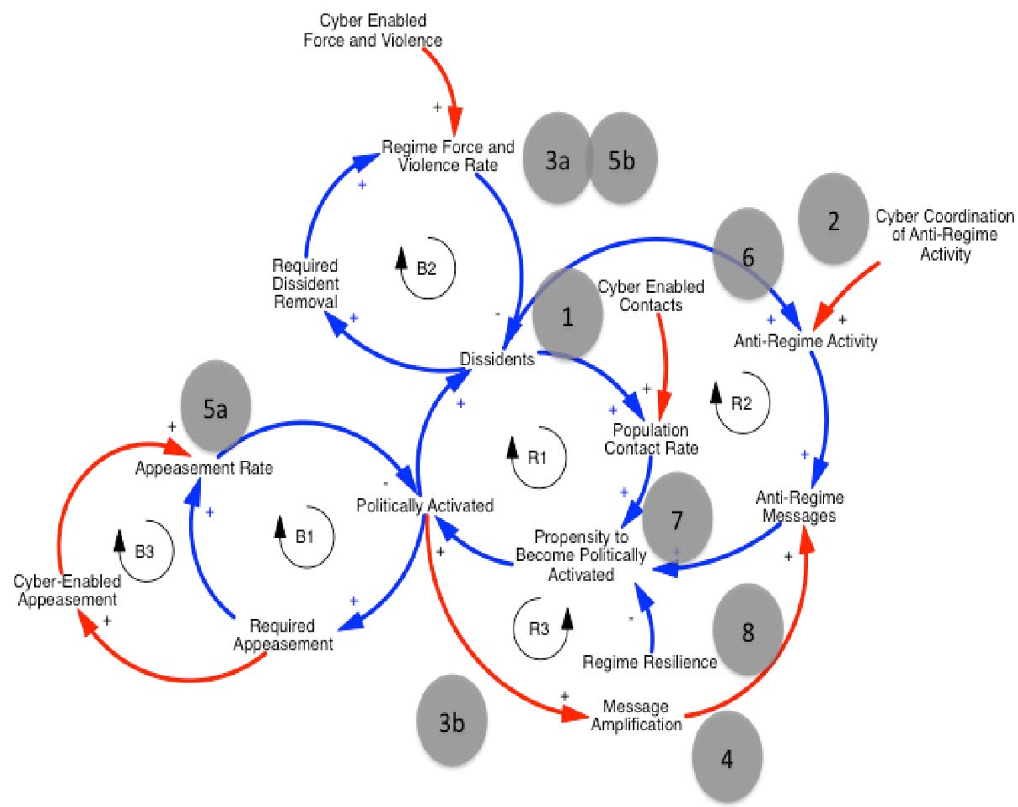
The authors then "drill down" by adding cyber-specific loops:
* **Loop R3 (Amplification)**: Cyber venues allow messages to spread without physical protests, creating a "low-cost" entry point for dissidents.
* **Cyber Coordination**: This is an exogenous factor that allows two equal-sized groups to have vastly different impacts based on their ability to synchronize actions in space and time.
## Case Study: The Egyptian Revolution (2011)
The authors apply their model to the 18 days of the Egyptian uprising. A critical insight is the **Regime Resilience Index** for Egypt.
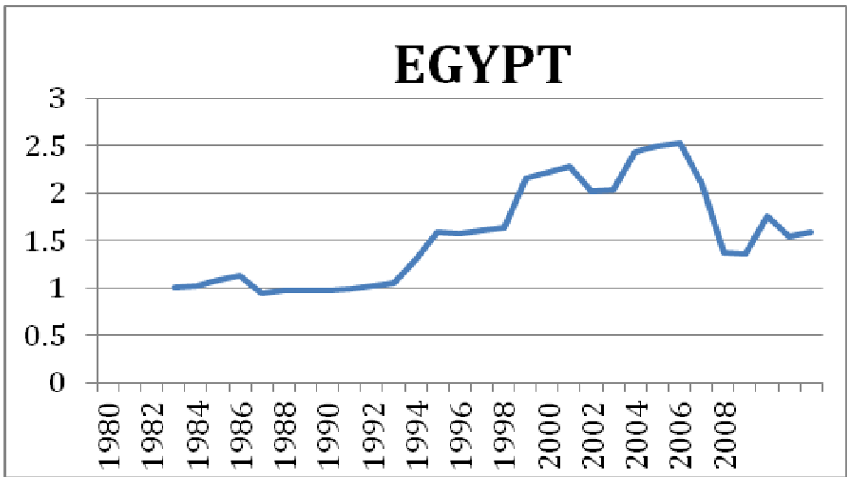
As shown above, Egypt's resilience was in steep decline years before the first tweet of 2011. The "Cyber" effects acted as a spark on a dry forest:
1. **Inspiration**: Tunisians’ success spread via Twitter, lowering the perceived risk for Egyptians.
2. **Coordination**: Hash-tags like #Jan25 created virtual platforms for organization.
3. **Regime Backfire**: When Mubarak shut down the internet (January 28), it actually increased "real world" loads as people took to the streets to find information, proving that cyber and real domains are inextricably linked.
## Critical Analysis & Conclusion
The value of this research lies in its **Systemic Realism**. It moves away from "technological determinism"—the idea that technology alone causes change. Instead, it shows that technology *accelerates* existing systemic failures.
**Key Takeaways:**
* **Cyber as a Multiplier**: Social media reduces the "cost" of collective action and increases the "visibility" of regime failure.
* **The Resilience Buffer**: A state with high resilience (strong economy, perceived legitimacy) can likely withstand cyber-amplified loads that would topple a fragile state.
**Limitations**: The paper's quantitative index for resilience is a "high-level" proxy. In modern contexts, we must also consider how regimes use **computational propaganda** and **AI surveillance** to reinforce their own balancing loops, a dynamic that has evolved significantly since the 2011 data used here.
## Future Outlook
As we move into an era of generative AI and deepfakes, the "Anti-Regime Message" loop (R2) will become even more volatile. Future models must account for the *authenticity* of messages as a variable in state stability.