
Beyond Prevention: Redefining Cyber Resilience in the Age of AI and IoT
Cyber resilience in firms, organizations and societies
This review article by Kjell Hausken provides a comprehensive taxonomy of cyber resilience across firms, organizations, and societies. It distinguishes between non-threat, threat, and hybrid actors, integrating literature from infrastructure, economics, and insurance to define a unified framework for operational continuity in the face of cyber incidents.
TL;DR
Cyber resilience is shifting from a "perimeter defense" mindset to a dynamic "survival and recovery" model. This review article maps the complex ecosystem of actors—ranging from benevolent governments to malicious hackers—and analyzes how resources, insurance, and the Internet of Things (IoT) dictate the modern battleground of operational continuity.
Background: Why "Security" is No Longer Enough
In the early days of computing, "security" meant building higher walls (firewalls, passwords). However, as our society becomes an interconnected web of digital and physical assets, these walls are guaranteed to breach. The core shift in this paper is from Security (Prevention) to Resilience (Recovery). Resilience acknowledges that "insults" (attacks) will happen; the goal is to absorb the shock and return to a functional state without total collapse.
The Actor-Based Framework
The author provides a crucial taxonomy that classifies players in the digital sphere:
- Non-threat Actors: Individuals and firms seeking to preserve their own and sometimes others' resilience.
- Threat Actors: Hackers and criminals seeking to compromise others.
- Hybrid Actors: Corporate or state entities that might preserve their own resilience while inadvertently (or strategically) compromising others to gain a competitive edge.
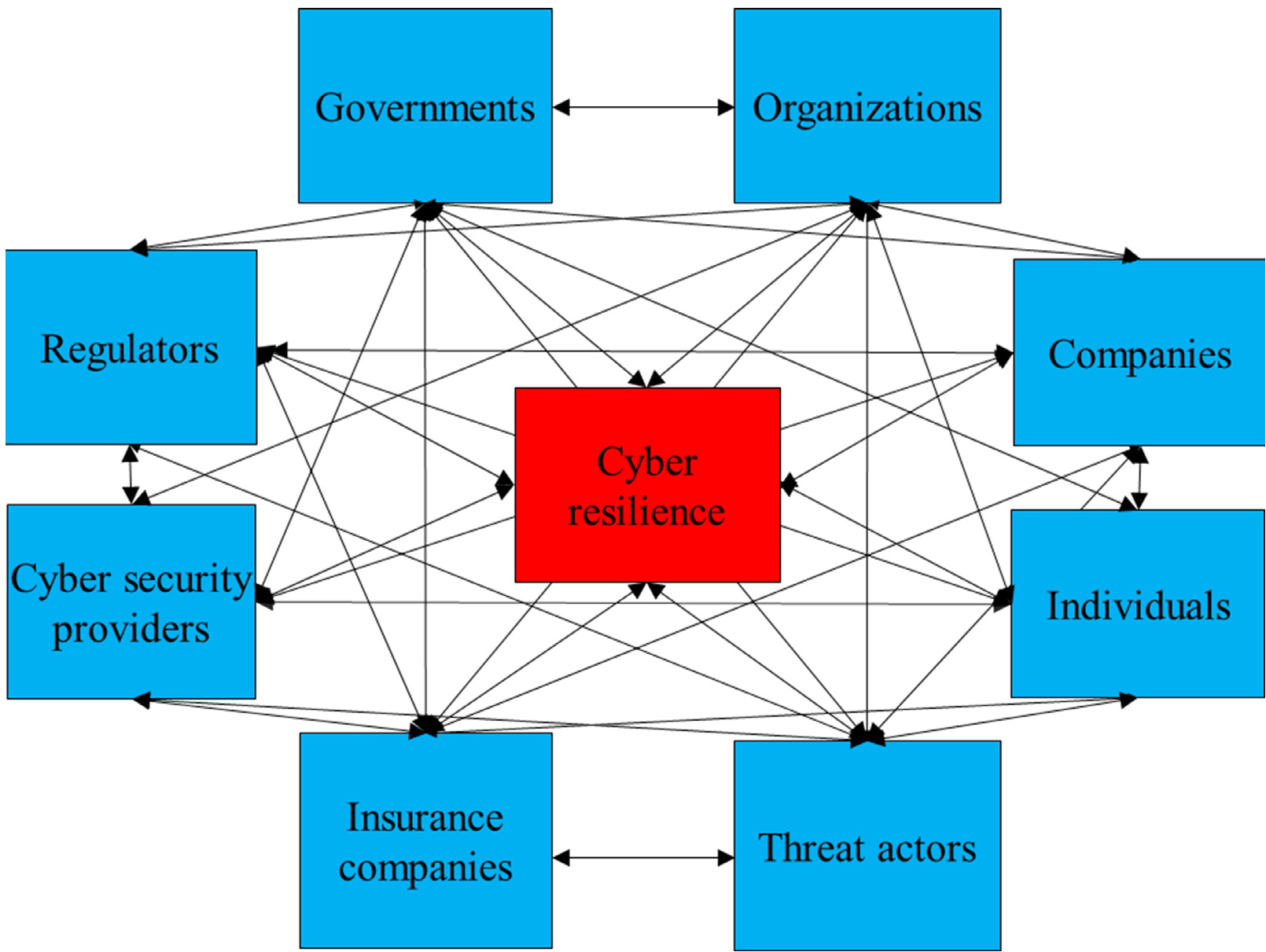 Fig 1: The web of interaction between governments, insurers, providers, and threat actors.
The "Double-Edged Sword" of IoT and AI
The article identifies the Internet of Things (IoT) as the primary frontier for future resilience challenges. While AI and Machine Learning can automate threat detection and optimize recovery, they also introduce systemic vulnerabilities:
- Colossal Attack Surface: Everything is reachable from everywhere. A regional power grid can be disabled from the other side of the globe.
- Insufficient Technology: We are currently in a "grand experiment" phase, deploying little-tested firmware in critical systems.
- The Ethics of Automated Defense: Excessive trust in algorithms (e.g., in autonomous vehicles or automated firefighting) can lead to catastrophic failures if the "contextual factors" (unusual weather, human behavior) aren't perfectly modeled.
The Role of Cyber Insurance
A standout insight of this review is the symbiotic relationship between resilience and insurance. Insurance companies are becoming "Compliance Managers." By setting entry requirements for policies, insurers force organizations to adopt best practices (like ISO/IEC 27002), effectively acting as a private-sector regulator for global cyber hygiene.
Key Quantitative Outlook
The paper cites expert surveys that paint a sobering picture of the future:
- Preparation Gap: Only 7% of security experts feel fully prepared for future IT security management developments.
- Attack Trajectory: A significant portion of experts expect attack growth to exceed 500% by 2025.
- Tech Reliance: 89% of experts are convinced that AI/ML and Cloud capabilities will be the backbone of future security efforts.
 Fig 2: Mapping the core ingredients of cyber resilience across societal levels.
Conclusion and Future Research
Resilience is a moving target. The author suggests that future research must move beyond "known unknowns" (Black Swans) and focus on building systems that can handle "unknown unknowns." This involves deep dives into human behavior, organizational trust, and the development of systemic recovery mechanisms that can function even when the primary network is compromised.
Takeaway: In the future, the most successful organizations won't be those with the strongest firewalls, but those that can "fail well" and recover fast.