
Social Media: The New Frontier of Cyber Warfare and How to Defortify the Digital Commons
Cyber Security in Social Media: Challenges and the Way Forward
This paper examines the evolving landscape of cyber security within social media platforms, identifying major attack vectors like social engineering and mobile-specific malware. It proposes a hierarchical six-layer security model based on cryptographic primitives to safeguard user data and maintain the integrity of online communities.
TL;DR
Social media has transformed from a simple communication tool into a high-stakes attack vector weaponized by cyber criminals. This paper explores why platforms like Facebook and Twitter are more vulnerable than traditional email, proposes a Six-Layer Security Model, and emphasizes that the "human firewall" (education and policy) is just as critical as cryptographic algorithms in preventing multi-million dollar data breaches.
The amplification of Risk: Why Social Media is Different
The transition from Web 1.0 to Web 2.0 moved the internet from a "read-only" archive to a "read-write" interactive space. This shift introduced a fatal flaw: Trust. Cyber criminals no longer need to find complex software bugs; they can simply exploit social norms.
The authors point out that social media amplifies existing threats. For instance, a malicious link on Twitter can be retweeted thousands of times in minutes, a speed at which traditional antivirus definitions struggle to keep pace. Furthermore, the rise of BYOD (Bring Your Own Device) policies means that an employee's lapse in judgment on a personal Instagram account can compromise sensitive corporate servers.
Methodology: The Six-Layer Hierarchical Model
To combat these threats, the paper suggests a structured approach to information security. Instead of viewing security as a single wall, it should be viewed as a vertical stack where each layer relies on the integrity of the one below it.
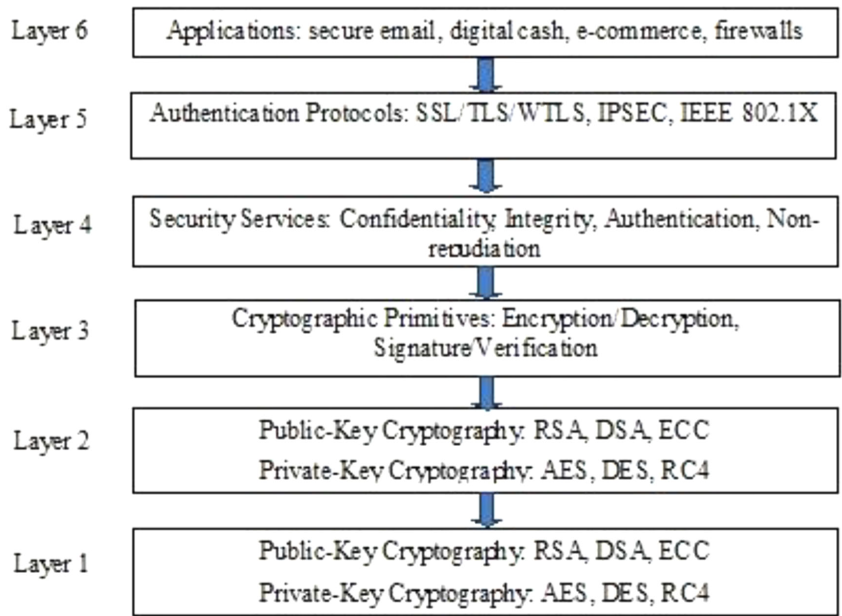
- Layer 1-3: The Foundation. Focuses on the "math" of security—arithmetic operations, private/public key algorithms (AES, RSA), and cryptographic primitives (Encryption/Digital Signatures).
- Layer 4-5: The Communication. Implements essential services like nonrepudiation and confidentiality through protocols such as IPSec and SSL/TLS.
- Layer 6: The Interface. This is where the user interacts with secure e-mail, digital cash, and firewalls.
Experimental Context: The Scaling Threat
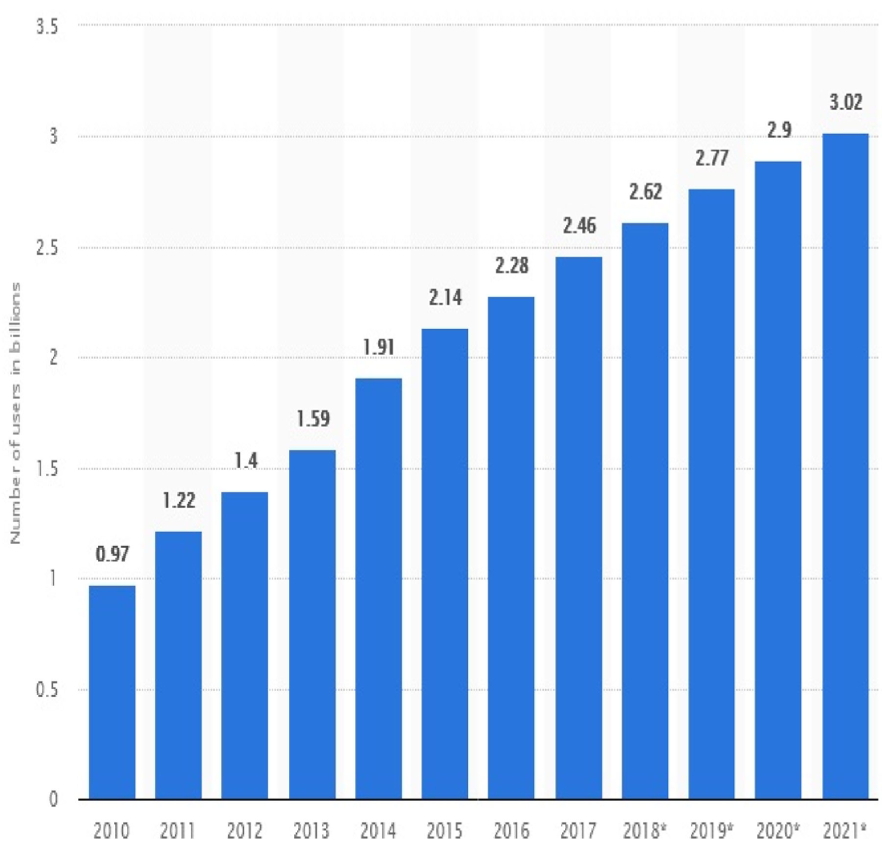
The urgency of this methodology is backed by the explosive growth of the social media user base. The paper highlights a trajectory where users were expected to surpass 3 billion by 2021, creating a massive "attack surface" for state actors and independent hackers alike.
The authors note that 70% of modern malware is distributed via social networks, specifically through:
- Spear-Phishing: Highly targeted attacks using "scraped" data from LinkedIn.
- Hammertoss: An innovative malware exploit that used Twitter as an integral command-and-control component.
- Cross-Site Scripting (XSS) & CSRF: Exploiting the web-based nature of social apps to steal session data.
Critical Insight: The Role of Policy and DLP
One of the most valuable takeaways from this research is the critique of corporate preparedness. Many organizations lack a formal Social Media Policy. The authors argue that technical tools like Data Loss Prevention (DLP) solutions should be integrated with mobile devices to provide real-time feedback.
Imagine an employee attempting to post a photo that inadvertently contains a whiteboard with sensitive project names; a DLP system could trigger a pop-up warning, preventing the leak before it happens. This "proactive" rather than "reactive" stance is the core recommendation of the study.
Conclusion & Future Outlook
The study concludes that cyber security is not an "optional add-on" but must be a fundamental part of the design of any digital product.
Key Action Items for Organizations:
- Personalized Training: Move away from generic security videos to scenario-based behavioral training.
- HTTPS Enforcement: Ensure all social interactions utilize encrypted connections to prevent "TCP sequence number inference" and session hijacking.
- External Risk Planning: Monitor for "Brand Impersonation" outside of internal IT controls.
While technology provides the encryption, the ultimate "Way Forward" lies in bridging the gap between user behavior and security protocols. As we move further into a hyper-connected era, the balance between sharing and shielding remains the most difficult challenge to master.