
Secure Modern Healthcare: Bridging the Gap Between Privacy and Social Connectivity in the Cloud
SPECIAL SECTION ON CYBER-THREATS AND COUNTERMEASURES IN THE HEALTHCARE SECTOR
The paper presents a hybrid security framework for Mobile Healthcare Social Networks (MHSNs) that integrates Identity-Based Broadcast Encryption (IBBE), Attribute-Based Conditional Proxy Re-Encryption (AB-CPRE), and Identity-Based Encryption with Equality Test (IBEET). This combination achieves efficient one-to-many data sharing, fine-grained access delegation, and privacy-preserving profile matching.
TL;DR
As mobile healthcare social networks (MHSNs) grow, the conflict between data utility and sensitive information privacy intensifies. This paper proposes a tripartite cryptographic solution that uses Identity-Based Broadcast Encryption (IBBE) for sharing, Attribute-Based Conditional Proxy Re-Encryption (CPRE) for specialist consultation, and Equality Tests for secure friend-finding, all while maintaining low overhead for mobile users.
Problem & Motivation: The Healthcare Security Paradox
In the era of cloud-assisted healthcare, Electronic Health Records (EHRs) are no longer static files; they are dynamic assets shared between patients, primary doctors, and specialists. However, two major hurdles persist:
- Efficiency vs. Control: Traditional Attribute-Based Encryption (ABE) offers great control but crushes mobile battery life with heavy computation. Conversely, Identity-Based Encryption (IBE) is fast but struggles with complex group sharing and conditional delegation.
- Privacy in Social Contexts: Patients often seek peers with similar conditions for support (Profile Matching). Doing this on encrypted data usually exposes the system to Keyword Guessing Attacks (KGA), especially when the vocabulary (medical symptoms) is limited.
Methodology: A Multi-Layered Cryptographic Shield
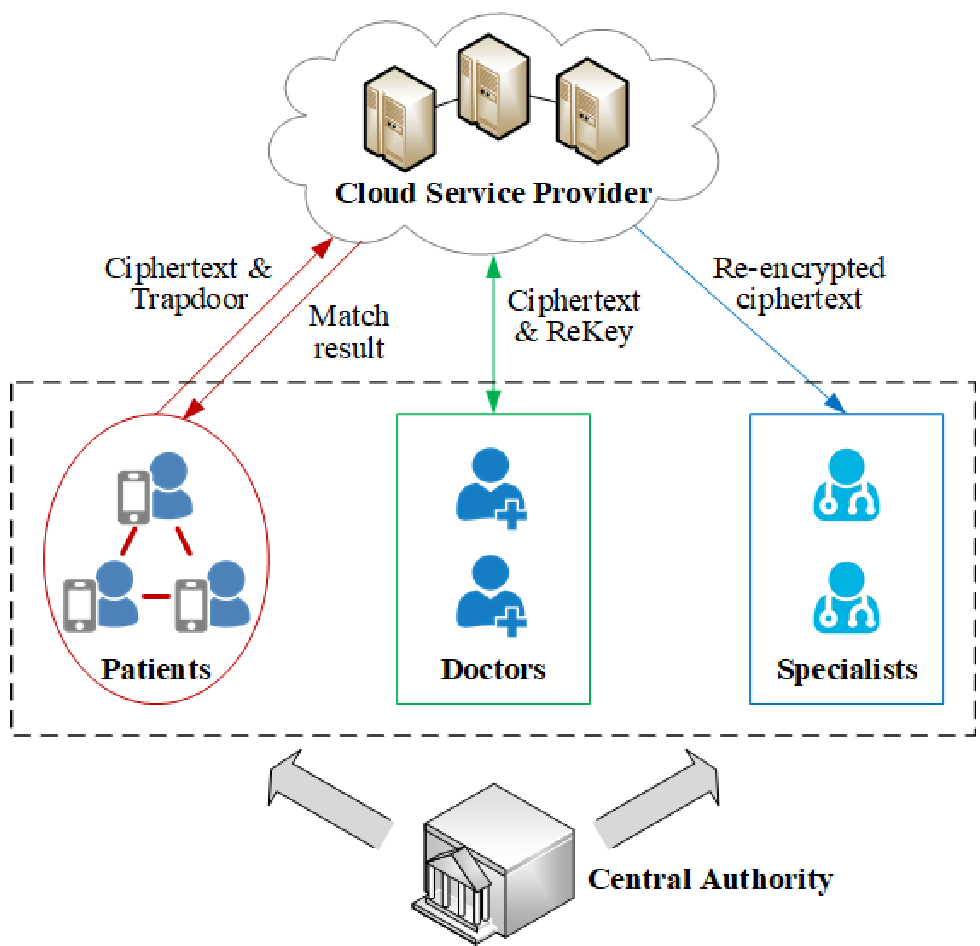
The proposed system architecture involves five key entities: Central Authority, Cloud Service Provider (CSP), Patient, Doctor, and Specialist.
1. Efficient Sharing (IBBE)
Instead of encrypting a record multiple times for different doctors, patients use IBBE. This creates a constant-size ciphertext that can be decrypted by a pre-defined group of doctors, significantly reducing the patient's upload bandwidth.
2. Conditional Delegation (AB-CPRE)
If a doctor needs a specialist's opinion, they cannot simply hand over the key. The authors use Conditional Proxy Re-Encryption. The cloud acts as a proxy to transform the ciphertext, but it can only do so if the doctor satisfies an "Access Tree" (Attribute-Based). This ensures that only qualified medical personnel can authorize the sharing of records with specific specialists.
3. Flexible Profile Matching (IBEET)
To find "illness friends" without revealing one's condition to the cloud, the scheme uses Identity-Based Encryption with Equality Test (IBEET). The innovation here is Flexible Authorization. Users can authorize the cloud to match:
- All their records (User-to-User)
- Specific records against a peer's profile (User-to-Ciphertext)
- Only two specific encrypted instances (Ciphertext-to-Ciphertext)
This granularity prevents attackers from performing brute-force keyword matching across the entire database.
Experimental Validation
The authors implemented the scheme using the Java Pairing-Based Cryptography (JPBC) library.
Encryption and Re-encryption Scalability
The tests confirm that encryption time scales linearly with both the number of authorized doctors () and the number of attributes (). Even with 20 attributes and 5 doctors, the computation remains under 1 second (approx. 960ms), which is acceptable for non-real-time EHR uploads.

Decryption Advantage
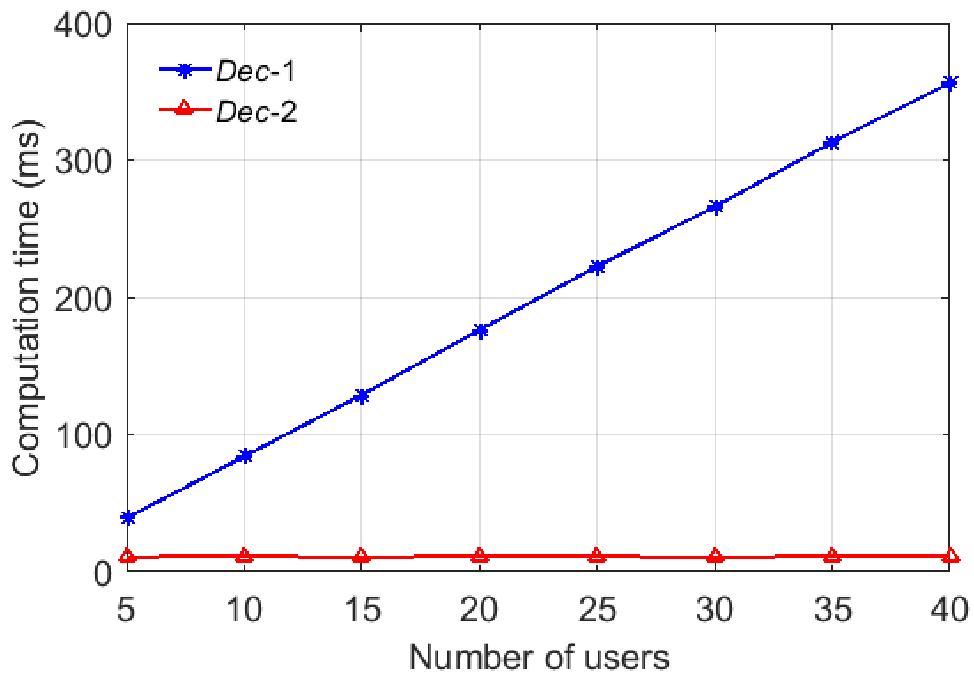
A standout result is the Specialist's decryption cost. By offloading the transformation to the cloud, the specialist's decryption time remains constant at approximately 11ms, regardless of how complex the original access policy was.
Critical Insight & Conclusion
While many papers focus on just "Access Control" or just "Searchable Encryption," this work recognizes that Social Discovery is a fundamental part of modern healthcare. By integrating equality tests into an identity-based framework, the authors solve the "isolated data" problem of typical encrypted clouds.
Limitations: While the specialist's decryption is fast, the setup requires a trusted Central Authority to manage keys. Future iterations could explore decentralized authorities or TEEs (Trusted Execution Environments) to further reduce reliance on a single point of trust.
The Takeaway: For MHSN developers, the message is clear—efficiency doesn't have to sacrifice granularity. By using proxy re-encryption as a bridge between identity-based and attribute-based logic, we can create systems that are both doctor-friendly and patient-centric.