
Pre-empting Toxicity: Predicting Cyberbullying on Instagram Before it Happens
Prediction of cyberbullying incidents in a media-based social network
This paper introduces a proactive approach to cyberbullying by shifting the focus from detection to pre-emptive prediction on Instagram. By leveraging multi-modal features—including image content, captions, and social graph metadata—the authors developed a logistic regression-based predictor that can anticipate cyberbullying incidents before comments are even posted.
TL;DR
Most AI safety tools act like digital "fire extinguishers"—they put out the fire (delete the comment) after the burning starts. This research shifts the paradigm to "fire prevention." By analyzing an Instagram post's metadata, image content, and the user's social graph at the moment of posting, the authors developed a system that predicts whether a media session will spiral into a cyberbullying incident with up to 99% recall.
Background Positioning
In the landscape of social media safety, this work sits at the intersection of Multi-modal Analysis and Predictive Modeling. While prior SOTA methods focused on Natural Language Processing (NLP) to detect hate speech in existing comment threads, this paper is among the first to explore the "predictive power" of pre-comment data on media-based platforms.
The Problem: Detection is Too Late and Too Expensive
The authors identify two critical flaws in current cyberbullying detection:
- Victim Impact: Detection occurs after the victim has already read the harmful comment.
- Scalability: Running complex NLP classifiers on billions of comments in real-time is computationally ruinous.
The "Research Insight" here is simple yet profound: Certain types of content (images and captions) act as "bull magnets." If we can identify these magnets the moment they are uploaded, we can concentrate our heavy-duty detection tools only on the "high-risk" sessions.
Methodology: The Anatomy of a Prediction
The researchers treated Instagram as a sequential timeline: Post Image Analysis Predicted Outcome.
1. Feature Extraction
Instead of waiting for comments, the model looks at:
- Image Content: Using manual labeling (later proposed for automation), images were categorized. Categories like "drugs" showed higher correlation with bullying than "food."
- Social Graph: The number of followers and following (indicative of social standing and reach).
- Metadata: Post time and caption profanity.
2. The Predictive Architecture
The authors utilized a Logistic Regression classifier with forward feature selection to identify which non-text features carried the most weight.
 Fig 1. The Instagram media session structure: The image and caption provide the "A Priori" data used for prediction.
Experiments & Critical Results
The study evaluated the model across three datasets with varying levels of profanity (Set40+, Set0+, and Set0).
- The "Early Warning" Power: Using only image content, the model captured 98% of bullying incidents in the Set0+ group.
- The Hybrid Boost: When the model was allowed to see just the first 15 early comments, the False Positive Rate on clean data (Set0) dropped to a remarkable 1%.
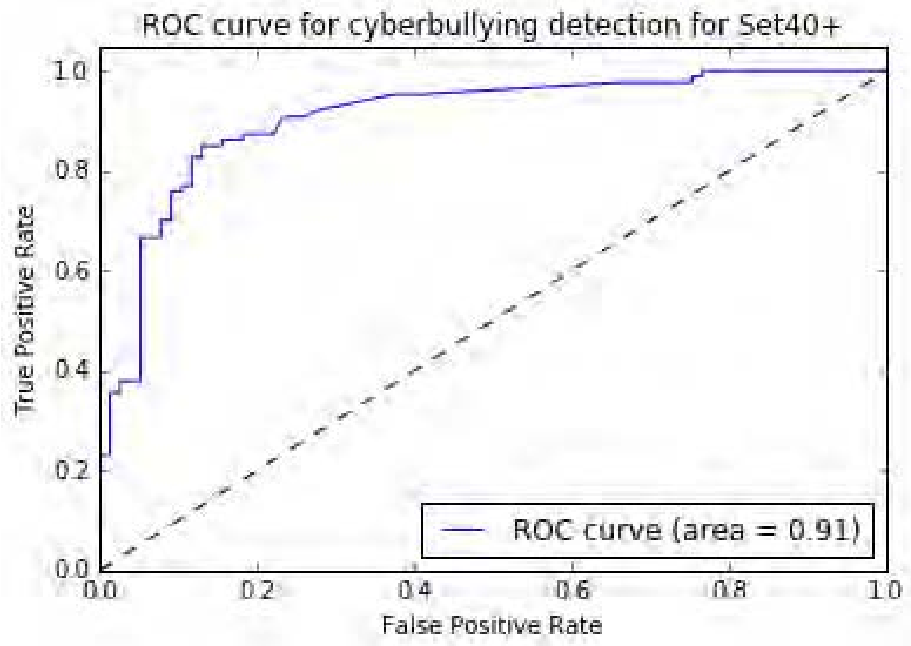 Fig 2. ROC Curve showing high AUC (0.91) for detecting incidents with high negativity, validating the strength of the feature set.
Feature Insights
Interestingly, while social graph features (Followers/Following) helped the predictor, they were less useful for the post-hoc detector. This suggests that a user's social position is a strong indicator of vulnerability to bullying, even if it doesn't describe the nature of the bullying itself.
Critical Analysis & Future Outlook
Limitations
- Manual Image Tagging: The study relied on manual categorization of images. For production use, a pre-trained Computer Vision model (like ResNet or a CLIP-based encoder) would be necessary.
- Temporal Dynamics: The study used a static "snapshot." Future work could benefit from Recurrent Neural Networks (RNNs) or Transformers to model the "velocity" of incoming comments.
Conclusion
This paper serves as a blueprint for "Smart Moderation." Instead of a brute-force approach to scanning every comment on the internet, platforms can use these predictive signals to create a "High-Risk Queue," allowing for faster intervention, lower server costs, and—most importantly—a safer experience for vulnerable users.