
The Digital Witness: Decoding Why Adolescents Help or Hurt in Cyberbullying
Cyberbullying on social network sites. An experimental study into bystanders’ behavioural intentions to help the victim or reinforce the bully
This experimental study examines how contextual factors—incident severity, bystander identity, and peer behavior—influence adolescent bystanders' intentions to help victims or reinforce bullies on Social Network Sites (SNS). Using a scenario-based design with 453 students, it identifies critical triggers for intervention and social conformity in cyberbullying.
TL;DR
Witnessing cyberbullying on Facebook doesn't always lead to a helping hand. This study reveals that an adolescent's decision to intervene is a complex calculation of incident severity and social identity. While severe incidents generally trigger more help, the presence of "good friends" can either be a powerful catalyst for support or a dangerous incentive to join the bully, depending on the situation's gravity.
Contextualizing the Bystander on SNS
In the traditional playground, a bystander's role is clear-cut. On Social Network Sites (SNS), however, the lines are blurred by "weak ties," public comments, and the "Like" button. This research moves beyond mere statistics to ask the "Why": What contextual triggers turn a passive observer into either a defender or a co-conspirator?
The "Arousal: Cost-Reward" Logic
The authors utilize the Arousal: Cost-Reward model to explain bystander behavior. Adolescents face a psychological trade-off:
- Cost: Fear of appearing "foolish" or social retaliation.
- Reward: Social status, admiration, and the internal relief of helping.
1. Incident Severity: The Call to Action
The study manipulated severity by comparing a simple "wall insult" to a "privacy-invading photo."
- Finding: Higher severity (the photo) significantly boosted intentions to comfort the victim and report the incident.
- Insight: In severe cases, the "social reward" for helping is clearer, and the risk of looking foolish is lower because the need for help is unambiguous.
2. The Interaction of Identity and Severity
One of the paper’s most provocative findings is the interaction between who is watching and how bad the incident is.
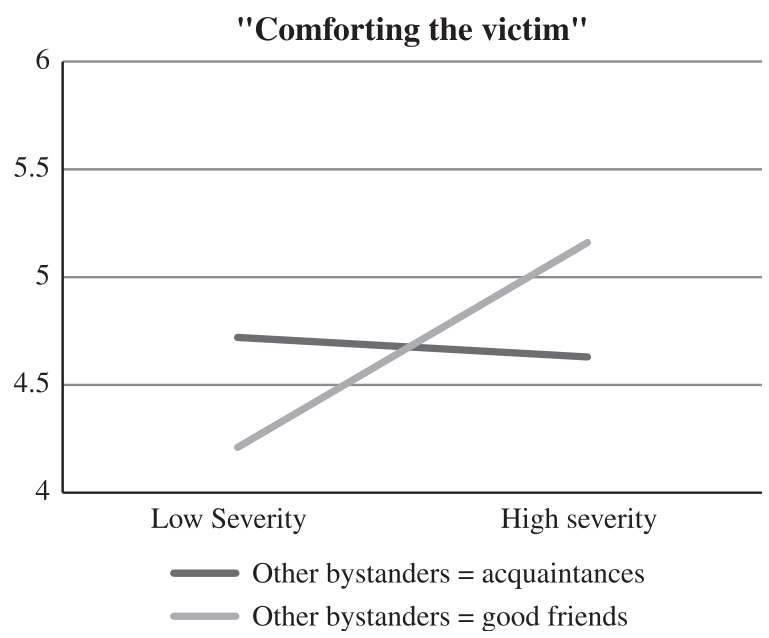
- Low Severity: Bystanders help less when good friends are present (fear of social judgment).
- High Severity: Bystanders help more when good friends are present (seeking admiration from the in-group).
3. Joining the Bully: The Power of Peer Influence
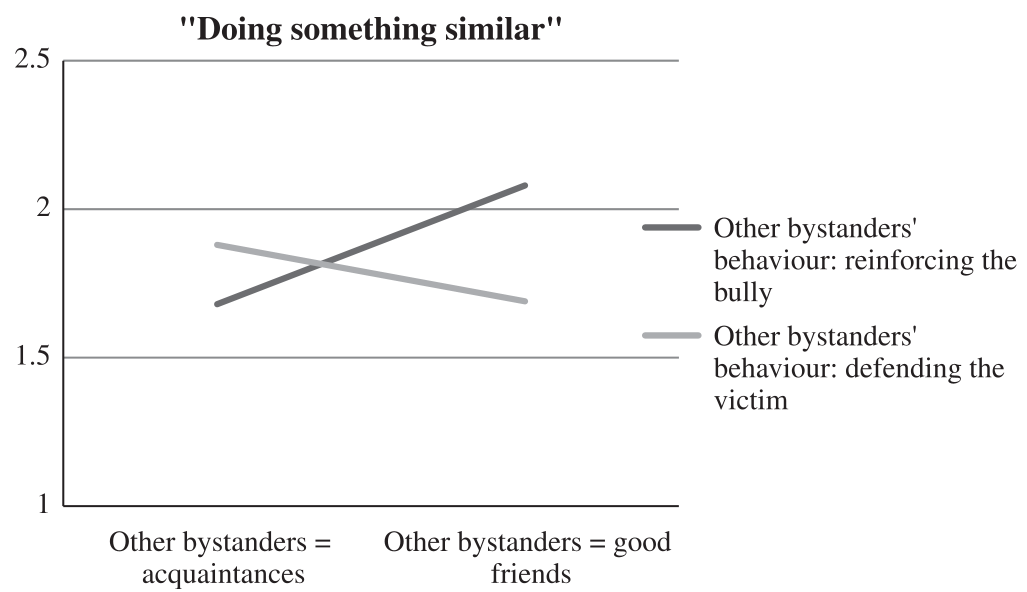
When it comes to "reinforcing" the bully (e.g., clicking "Like" or posting similar insults), the identity of other bystanders is paramount.
- The "Friend" Effect: If other bystanders were "good friends," the intention to join in the bullying was three times higher than if they were just acquaintances.
Methodology Snapshot
The researchers conducted a scenario-based experiment with 453 Flemish students (ages 13-14). By using a Facebook-simulated environment, they captured behavioral intentions across a spectrum of responses, from private messages to public reporting.
Critical Insight & Future Outlook
Takeaway for Schools: Anti-bullying programs shouldn't just teach "empathy"—they must teach resistance to peer pressure. The data shows that adolescents are hypersensitive to their "in-group" (good friends).
Limitations: The study relies on "behavioral intentions" rather than "actual behavior." Future research using Virtual Reality (VR) or "live" simulated social networks could bridge the gap between what students say they will do and what they actually do when the "Like" button is right in front of them.
Conclusion
Cyberbullying is not just a conflict between a bully and a victim; it is a social performance. By understanding that "good friends" act as a double-edged sword, educators can better design interventions that flip the social script from reinforcement to defense.