
From Victim to Bystander: Breaking the Vicious Cycle of Cyberbullying
How do victims react to cyberbullying on social networking sites? The influence of previous cyberbullying victimization experiences
This study investigates how 622 teenagers act as bystanders when witnessing cyberbullying on social networking sites (SNSs), specifically focusing on the influence of their own past victimization. Utilizing data from the Pew Internet Survey, the research identifies gender and previous trauma as critical determinants of prosocial versus antisocial behavioral trajectories.
TL;DR
Does being bullied online make you more likely to stop it when you see it happening to others, or does it turn you into part of the problem? A study of 622 teenagers reveals a sobering reality: previous victimization often leads to antisocial bystander behavior. However, the outcome is heavily dictated by gender, with girls leveraging empathy to protect others, while boys often fall into a trap of negative reciprocity.
The "Bystander" Dilemma in the Digital Age
In the physical world, the "Bystander Effect" is often characterized by passivity. In the digital realm of Social Networking Sites (SNSs), the stakes are different. Digital bystanders don't just "watch"; they can amplify harassment with a single click or stop it with a supportive comment.
The researchers behind this study sought to answer a fundamental psychological question: Does past trauma breed empathy or aggression?
Methodology: Decoding Teenage Social Mechanics
The study analyzed data from the Pew Internet Survey, focusing on:
- Previous Victimization: Whether the teen was bullied in the last 12 months.
- Gender Roles: How socialization affects emotional processing.
- Social Interaction: The frequency of private messages, tagging, and status updates.
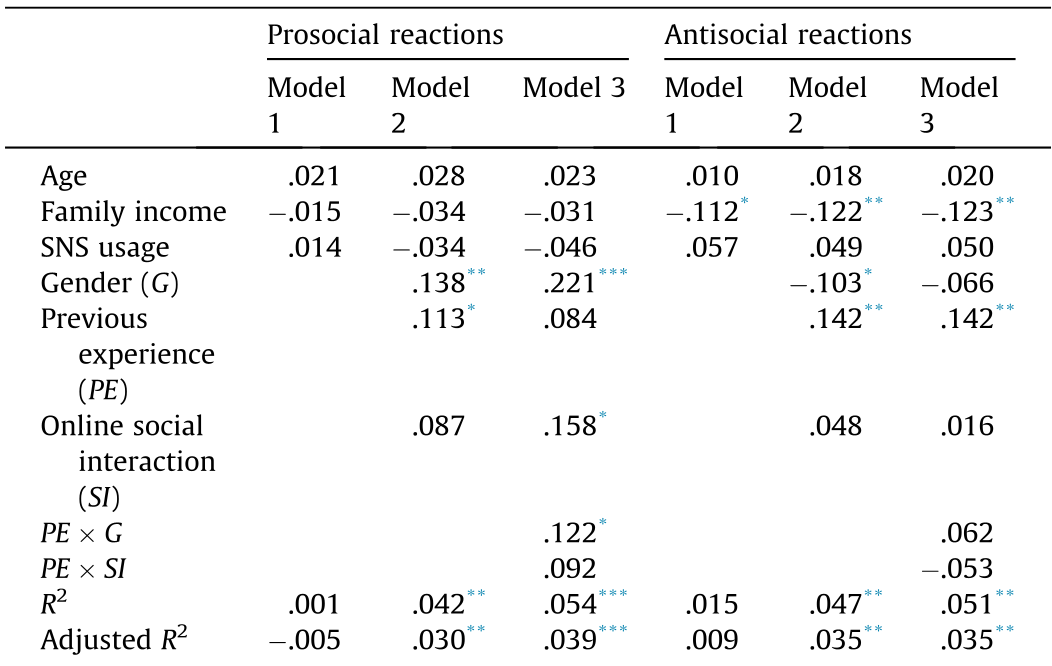 The table above illustrates the significant impact of previous experience and gender on reaction strategies.
Key Insights: Why the Cycle Continues
1. The Revenge Mechanism (Negative Reciprocity)
The data suggests that victims report significantly more antisocial reaction strategies (e.g., joining in the harassment) than non-victims. This follows the "Reciprocity Principle": doing to others what was done to you. For many, joining the bully is a way to regain a sense of "balance" or power after being victimized.
2. The Gender Gap in Empathy
The research found a stark contrast in how boys and girls react to witnessing bullying:
- Prosocial Girls: Girls were significantly more likely to defend the victim or tell the bully to stop. Interestingly, girls who had been bullied themselves were more likely to help others—their past pain fueled empathy.
- Antisocial Boys: Boys were more likely to engage in antisocial behaviors. Unlike girls, the trauma of being bullied did not translate into increased prosocial defense for male victims.
3. The Power (and Limit) of Social Interaction
Teenagers with high levels of online social interaction (posting, chatting, tagging) were generally more prosocial. Active social "bonds" act as a shield against apathy. However, social interaction was not enough to "cure" the antisocial tendencies of those already traumatized by victimization.
The "Cyberbully-Victim" Vicious Cycle
The most alarming takeaway is the emergence of the "cyberbully-victim." In the digital era, these roles are not fixed. A victim today may become a bystander-turned-bully tomorrow, creating a self-sustaining loop of toxicity on SNS platforms.
 The interaction between gender, victimization, and bystander behavior.
Conclusion and Outlook
This work signals a shift in how we must approach digital safety. We cannot simply treat cyberbullying as an isolated event between a bully and a victim.
- For Educators: Programs must focus on male teenagers, who are at a higher risk of turning their victimization into outward aggression.
- For Platforms: SNS design should promote "upstander" behavior—making it easier and socially rewarding to defend victims.
The study concludes that while the digital world often desensitizes us through a lack of nonverbal cues (moral disengagement), fostering a supportive online environment remains our best defense against the "indifference" that allows cyberbullying to flourish.