
CKG-Medical: Strengthening Healthcare Defense via Multi-Source Knowledge Augmentation
Cybersecurity Threat Intelligence Augmentation and Embedding Improvement - A Healthcare Usecase
This paper presents an automated system that constructs and augments a Cybersecurity Knowledge Graph (CKG) specifically for the healthcare IoT domain. By integrating manufacturer alerts and ICS-CERT data with external structured knowledge from Wikidata and the FDA's AccessGUDID database, the authors generate high-quality graph embeddings that significantly improve information retrieval for medical device vulnerabilities.
TL;DR
The medical industry is under siege by sophisticated cyberattacks targeting IoT devices. This paper introduces a method to build a Cybersecurity Knowledge Graph (CKG) specifically for healthcare by fusing raw security alerts with global knowledge bases like Wikidata and FDA's AccessGUDID. By enriching the graph's context, the researchers achieved a 31% boost in Mean Average Precision (MAP) for information retrieval tasks, proving that better data context leads to smarter AI security embeddings.
The Motivation: Why Medical IoT is a "Sitting Duck"
In modern hospitals, Internet of Things (IoT) devices—from ultrasound machines to life-support systems—are ubiquitous. While they enable continuous patient monitoring, they are often "black boxes" regarding security.
The authors point out two critical failures in current defenses:
- Intelligence Fragmentation: Vulnerability data is scattered across manufacturer PDFs, HTML alerts, and ICS-CERT bulletins.
- Context Blindness: General security tools don't understand that a "Philips Brilliance CT System" isn't just a generic computer; it’s a medical asset with specific operational constraints.
The goal was to bridge this gap by creating a machine-understandable repository that knows both the exploit and the asset context.
Methodology: The Core of Knowledge Augmentation
The researchers designed a pipeline that transforms unstructured web text into a mathematically dense vector space.
1. Extraction and Ontology Mapping
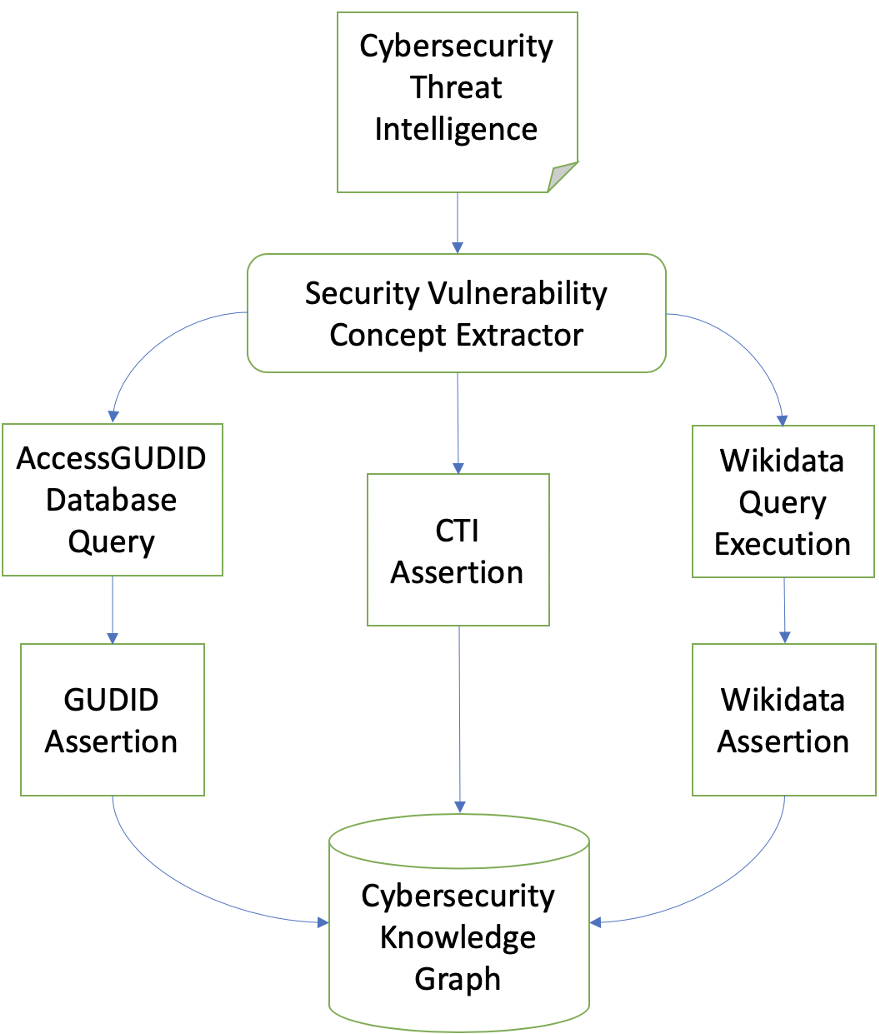
Using a specialized Security Vulnerability Concept Extractor (SVCE), the system identifies "Means of Attack," "Consequences," and "Affected Software/Hardware." These are mapped onto the Unified Cybersecurity Ontology (UCO 2.0), ensuring the data follows a standardized schema (STIX 2.0).
2. Multi-Source Fusion
This is where the "Augmentation" happens:
- Wikidata: Provides a global "who's who" for manufacturers and technologies.
- FDA AccessGUDID: Adds clinical depth, such as the unique device ID (UDI) and the intended purpose of the medical equipment.
3. Creating Graph Embeddings
To make this graph useful for AI, the authors used node2vec to generate embeddings. By treating the knowledge graph as a network and using Breadth-First Search (BFS) to define local neighborhoods, they mapped complex relationships into 200-dimensional vectors.
Experimental Results: The Power of Context
How do we know the augmentation actually helped? The authors treated it as an Information Retrieval (IR) problem. They tested how well the system could find "similar" vulnerabilities or products based on their vector similarity.
| Knowledge Augmentation Level | MAP score |
|---|---|
| Raw CTI Only | 0.54 |
| CTI + Wikidata | 0.66 |
| CTI + Wikidata + AccessGUDID | 0.71 |
The jump from 0.54 to 0.71 (a 31% improvement) is significant. It demonstrates that adding "non-security" data (like the FDA device descriptions) actually helps the AI better understand the structure of security threats.

Critical Analysis & Conclusion
The Takeaway
The "secret sauce" of this research is the Inductive Bias provided by external ontologies. By teaching the model that a specific brand of ultrasound machine belongs to a certain class of devices governed by specific FDA regulations, the model discovers hidden relationships between different types of attacks that a standard keyword search would miss.
Limitations & Future Work
While the results are impressive, the mapping process still relies on TF-IDF similarity when exact manufacturer names don't match. Future iterations could benefit from Deep Entity Resolution or Large Language Models (LLMs) to better link ambiguous product names.
Moving forward, this framework provides a blueprint for any specialized sector—be it smart grids, automotive, or aerospace—to build its own "Security Brain" by marrying general threat intelligence with domain-specific industrial knowledge.