
Cycle-Centrality: Decoding the "Prime Numbers" of Network Dynamics
Cycle-Centrality in Economic and Biological Networks
The paper introduces "Cycle-centrality," a novel metric to quantify the importance of individual cycles and subgraphs in complex networks by measuring the fraction of total information flow they intercept. Demonstrated on US economic and Arabidopsis thaliana biological networks, it achieves SOTA results in modeling systemic impacts and pathogen-targeting behaviors.
TL;DR
Researchers have developed a mathematically rigorous way to measure the importance of cycles (loops) in a network, rather than just individual nodes. By treating cycles as the "prime numbers" of network flow, this "Cycle-centrality" measure outperforms traditional methods like PageRank or Degree Centrality in predicting economic collapses and biological pathogen attacks.
Background: Beyond the Individual Node
In network science, we usually ask: "Which node is the most important?" We look for the biggest hub (Degree) or the most connected authority (Eigenvector). But systems like the global economy or a living cell don't just happen at nodes; they happen in feedback loops.
Previous metrics lacked a formal way to measure these loops. Most researchers simply averaged the scores of nodes within a loop, a method the authors argue is "conceptually hollow." The core insight of this paper is that a cycle’s importance should be defined by the Information Flow it intercepts.
Methodology: The Combinatorics of "Hikes"
The authors represent a network as a collection of "walks." Mathematically, they lean on a semi-commutative extension of number theory where cycles are the "primes" and walks are the "integers."
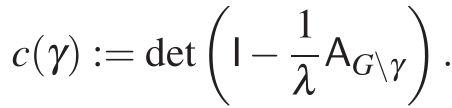
The central formula is elegant:
This formula calculates the proportion of all possible "hikes" (multi-sets of closed walks) that pass through a specific cycle . If a cycle is central, removing it from the graph significantly reduces the "flow" capacity of the network.
Experiment 1: The US Economy and the FIAR Clique
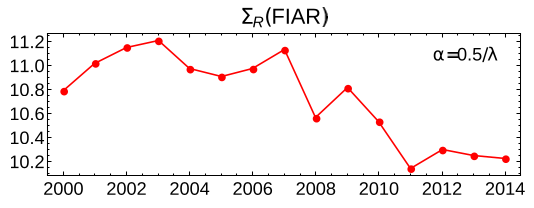
The authors analyzed the US economy (2000–2014) focusing on the FIAR clique (Finance, Insurance, and Real Estate).
- Traditional measures (Resolvent/Eigenvector) suggested the FIAR sector was thriving or stable during periods when we know it was actually crashing or being heavily regulated.
- Cycle-centrality correctly identified the exponential surge leading to 2006, the sharp "bail-out" spike in 2008, and the stabilization following the Dodd-Frank Act.
Experiment 2: Biological Warfare in Arabidopsis
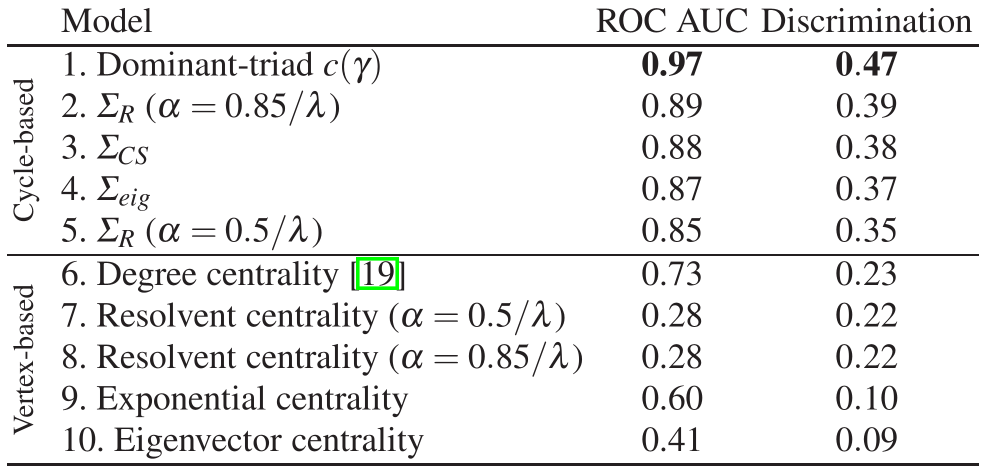
Pathogens are smart; they don't just attack the "biggest" proteins. They target specific triads that disrupt the most biological sequences. Using the Dominant-triad model, the authors showed that pathogen-targeted proteins are concentrated in triads with high cycle-centrality.
- Performance: The cycle-based model achieved a 0.97 ROC AUC, compared to only 0.73 for the standard degree-based model used in previous landmark studies.
Critical Insight: Why This Matters
The computation of cycle-centrality ( effectively) is slightly more intensive than simple degree counting but offers a massive leap in interpretability. Because the result is always between 0 and 1, it provides a "Universal Scale" for importance—a feature most spectral centralities lack.
The paper proves that a network's "vibe" or "health" isn't stored in its parts, but in its circuits.
Conclusion & Future Work
Cycle-centrality offers a bridge between rigid structural analysis and dynamic flow modeling. While currently tested on economic and biological data, its application to Neural Network pruning (identifying critical feedback loops in weights) or Supply Chain resilience is a high-potential frontier.
Takeaway: To understand a system's heart, stop looking at the dots and start looking at the circles.