
The Rise of the Cyclic Nucleotide Family: How "Moonlighting" Enzymes Tune Plant Life
Cyclic nucleotides – the rise of a family
This review elucidates the evolving landscape of plant cyclic nucleotides, highlighting the discovery of moonlighting 3',5'-cAMP/cGMP cyclases and 2',3'-cAMP/cGMP synthetases. It establishes these molecules as essential signaling components, with specific emphasis on the TIR1/AFB auxin receptors and TIR immune proteins acting as catalytic hubs.
TL;DR
Long considered the "ugly ducklings" of plant biology, cyclic nucleotides (cAMP and cGMP) have finally come of age. Recent landmark studies reveal that these molecules are not generated by standalone enzymes as in animals, but by moonlighting domains hidden within complex receptors like the auxin sensor TIR1. This "molecular tuning" mechanism allows plants to precisely control growth and immunity through both canonical 3',5' and the emerging 2',3' isomers.
Perspective: From Controversy to Core Signaling
For years, plant scientists debated whether cAMP and cGMP even existed in higher plants. The absence of homologs to animal cyclases led many to believe plants used different pathways. However, the discovery of hidden motifs—short, functional amino acid sequences embedded within larger proteins—changed everything.
The field has now established that these nucleotides are not just present; they are essential "tuners" that integrate environmental cues into physiological responses.
The "Moonlighting" Revelation: TIR1 and Immune Receptors
The most groundbreaking shift comes from the discovery of catalytic activities within well-known proteins:
- Auxin Signaling (TIR1/AFB): The classic auxin receptor TIR1 has been revealed to carry an Adenylate Cyclase (AC) activity. When auxin binds, it triggers the production of cAMP, which is essential for root growth responses.
- Plant Immunity (TIR Domains): Toll/interleukin-1 receptor (TIR) proteins, long known for their role in cell death, are now recognized as 2',3'-cAMP/cGMP synthetases. They Produce these isomers by hydrolyzing RNA or DNA, triggering systemic defense responses.
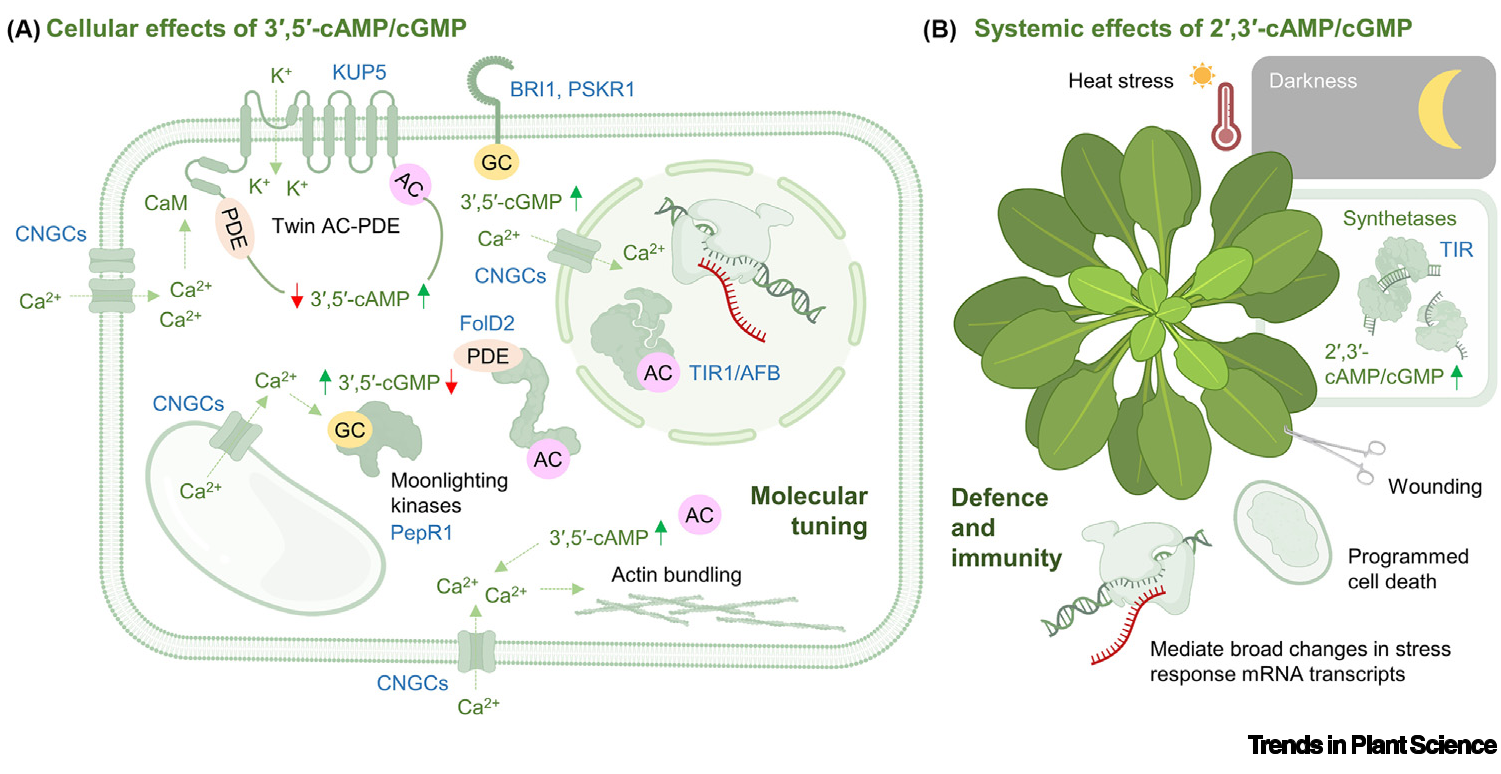 Figure 1: Comparison of localized 3',5' tuning vs. systemic 2',3' defense signaling.
Methodology: The Logic of Molecular Tuning
Why does it matter that these enzymes are "moonlighting"? In a plant cell, space is restricted by massive vacuoles. Physical integration of the "On" switch (cyclase) and the "Off" switch (phosphodiesterase, or PDE) within a single protein—a twin AC-PDE architecture—allows for:
- Compartmentalization: Signals don't leak; they stay where the receptor is.
- Transient Dynamics: The protein can generate and then immediately degrade the signal to prevent over-activation.
- Bimodal Switching: For example, in the PSKR1 receptor, Calcium acts as a switch that turns on the guanylate cyclase while simultaneously turning off the kinase domain.
2',3' vs. 3',5' Isomers: A Division of Labor
The review highlights a fascinating functional delineation:
- 3',5'-cAMP/cGMP: Act at low concentrations in specific cellular microenvironments (e.g., controlling ion channels or gene transcription).
- 2',3'-cAMP/cGMP: Act at the systems level. Their levels spike during wounding, heat, or darkness, functioning as high-concentration signals for stress and programmed cell death.
 Experiment Summary: Key highlights of plant cyclic nucleotide research evolution.
Critical Insight & Future Outlook
The plant proteome appears to have evolved a "cryptic" signaling language. By embedding cyclases within receptors, plants achieve a level of signaling precision that standalone enzymes cannot match.
The Challenge: We currently don't know the full extent of this "motifs" library. How many other proteins harbor hidden cyclases? The Opportunity: If we can map these motifs, we can use CRISPR to precisely edit the "tuning" of a crop's response to drought or pests without breaking the entire receptor's function.
Conclusion
Cyclic nucleotides in plants are no longer a myth—they are a sophisticated family of molecular regulators. By understanding the "twin" domains and the role of noncanonical isomers like cCMP and cUMP, we are opening a new frontier in biotechnological innovation.
Glossary of Key Terms:
- Moonlighting: A catalytic activity hidden within a structurally different, larger protein domain.
- TIR1/AFB: Auxin receptors that integrate AC activity for transcriptional control.
- Molecular Tuning: The rapid modulation of cellular pathways through localized signal intensities.