
D-Book: Reimagining Social Networks for Disconnected Environments
D-Book: A Mobile Social Networking Application for Delay Tolerant Networks
This paper introduces D-Book, a mobile social networking application built on DTN#, a custom .NET implementation of the Delay Tolerant Networking (DTN) bundle specification. D-Book enables profile sharing, searching, and messaging in "challenged networks" where persistent connectivity is unavailable, achieving decentralized social interaction via epidemic-style multicast and caching.
TL;DR
D-Book is a pioneering mobile social application designed for Delay Tolerant Networks (DTN). Built on a custom .NET stack called DTN#, it allows users to search for profiles, exchange messages, and follow "friends" in environments with zero internet connectivity and frequent network disruptions. It treats mobile devices as "data mules" that opportunistically sync information when they come into proximity.
Background: The Challenge of the "Disconnected" Social
Most social networks we use today are fundamentally "fragile"—they fall apart the moment we enter an elevator or a remote forest. From a networking perspective, these are "challenged networks" characterized by excessive delays and partial disconnections.
The authors argue that the popular social networking metaphor (profiles, updates, friends) is actually a perfect fit for asynchronous communication. Instead of a central server, why not use the users themselves to carry and propagate data?
Methodology: The DTN# Architecture
To build D-Book, the team first had to build DTN#, a specialized implementation of the DTN Bundle Protocol for the .NET platform.
1. The Core Forwarder
The architecture separates the Forwarder Core from the Routing logic. This allows the system to swap out different protocols—like Epidemic routing (flooding) or Link-State routing—depending on the density of the users.
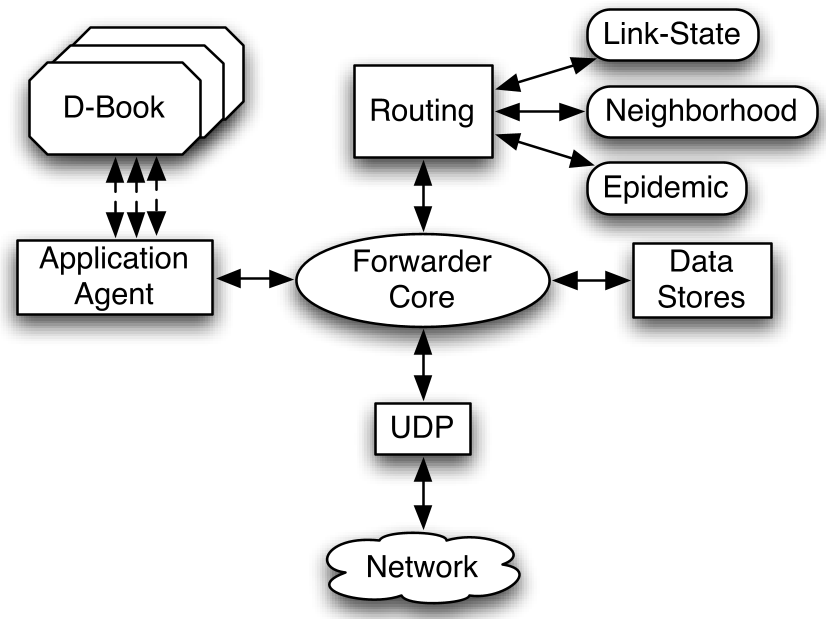
2. Distributed Search & Caching
Unlike Facebook, where search happens on a server, D-Book search queries are broadcast to all nodes in range. If a node has a matching profile in its local cache (even if that person isn't present), it can respond on their behalf.
3. Heartbeats and Consistency
How do you know if a cached profile is stale? D-Book uses "Heartbeats"—periodic signals that broadcast a version number.
- Good: Heartbeat heard, profile matches.
- Unsure: No heartbeat heard.
- Bad: Heartbeat heard, but version number is higher than the cached copy.
Key Features: Social Without the Internet
- Ownership: The "master copy" of a profile lives only on the user's device.
- Multicast Discovery: Uses DTN# multicast to find people with shared interests across a multi-hop ad-hoc network.
- Extensibility: A modular API allows developers to plug in new apps (like the "PictureApp" for photo sharing) that piggyback on the existing DTN social graph.
Experimental Validation
The system was demonstrated using vintage hardware (Dell Axim handhelds) and Windows XP laptops. Even with limited resources and the physical movement of devices, the "Epidemic" nature of the protocol ensured that messages and profile updates eventually reached their destination as people physically moved between groups.
Critical Insight & Future Outlook
D-Book was ahead of its time in envisioning decentralized sociality. While we now take "syncing" for granted, D-Book's contribution lies in its middleware-level approach: treating social interactions as a series of bundles that can wait for hours in a buffer until a physical connection appears.
As we look toward the future of edge computing and mesh networks, the principles of D-Book—caching, local-first master copies, and opportunistic multicast—remain highly relevant for building resilient digital communities that don't rely on "The Cloud."
Takeaway: D-Book proves that social networks are effectively "delay tolerant" by nature; humans are comfortable with asynchronous updates, and our software architecture should reflect that physical reality.