
D-Dupe: Bridging the Gap Between Data Mining and Visual Intuition for Entity Resolution
D-Dupe: An Interactive Tool for Entity Resolution in Social Networks
D-Dupe is an interactive visual analytics tool designed for entity resolution (deduplication) in social networks. It combines algorithmic similarity measures with a task-specific network visualization, allowing users to resolve ambiguous references by analyzing local relational contexts.
TL;DR
D-Dupe is a specialized visual analytics tool that tackles the "entity resolution" problem—identifying when different records refer to the same real-world entity—specifically within social networks. By isolating potential duplicates and their immediate relational neighborhoods into a stable, five-region visual layout, it enables humans to quickly verify algorithmic suggestions, outperforming both fully automated and purely manual cleaning methods.
The "Needle in a Haystack" Problem
Data quality is the silent killer of network analysis. When a single person appears as "George Robertson," "G. Robertson," and "George G. Robertson," centrality measures and pathfinding algorithms break.
Existing solutions fall into two flawed camps:
- Automated Systems: High efficiency but suffer from the precision-recall trade-off (they either miss too many or merge too aggressively).
- Manual Cleaning: High precision but impossible for large-scale "haystack" datasets.
The authors argue that the missing ingredient is the social context—who is this person connected to? If two "George Robertsons" share the same co-authors, they are likely the same person. If their networks are disjoint, they are likely distinct.
Methodology: The Power of Local Context
D-Dupe doesn't try to visualize the whole network. Instead, it adopts a task-specific approach centered on the Collaboration Context Network.
1. The Stable Substrate Layout
Standard graph layouts (like Spring Embedders) are unstable—nodes jump around every time you refresh. D-Dupe solves this with a Stable Layout divided into five vertical regions:
- Region 2 & 4: Target potential duplicates.
- Region 3: Shared neighbors (the "Smoking Gun" for a merge).
- Region 1 & 5: Unique neighbors of each candidate.
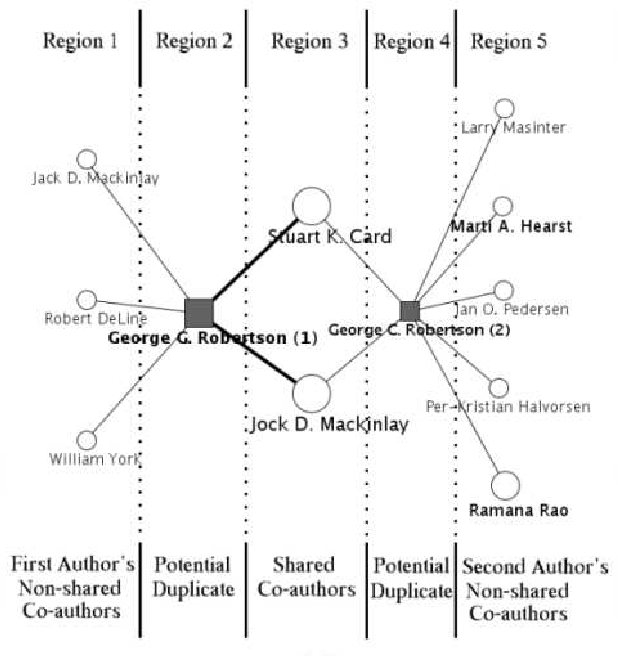 In the figure above, the layout clearly separates shared co-authors in the center, allowing for instant visual verification.
2. Algorithmic Interleaving
D-Dupe allows users to "chain" different metrics (Jaccard for word-level similarities, Levenstein for character misspellings). As one pair is merged, the network updates, often revealing new potential duplicates that were previously hidden.
Experimental Results: Finding the "Invisible" Duplicates
The researchers tested D-Dupe on bibliographic datasets that were already cleaned by experts.
- InfoVis Contest Data: Despite months of manual community cleaning, D-Dupe found 60+ new duplicates in just 30 minutes.
- CiteSeer: Found 10 duplicates in 20 minutes by switching between similarity measures to catch different types of parsing errors.
- User Efficiency: The stable layout provided a 15% speed increase in identification tasks compared to traditional force-directed layouts.
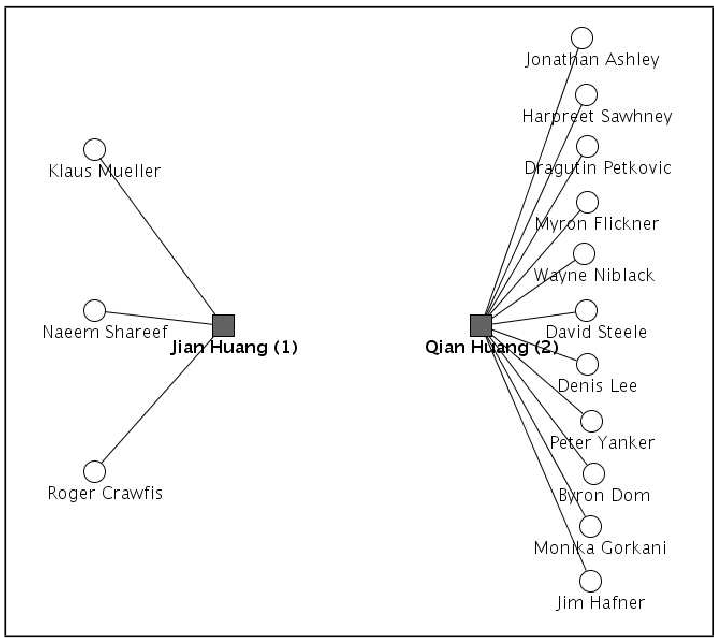 Successive merges (indicated in green) clarify the network structure, transforming a messy graph into an accurate representation.
Critical Insight: Why Does This Work?
The brilliance of D-Dupe lies in reducing Cognitive Load. By ignoring the global structure and focusing on a localized, consistent sub-view, the analyst can process hundreds of candidates without the "search cost" of re-orienting themselves to a new graph layout. It treats entity resolution not as a one-time calculation, but as an iterative discovery process.
Conclusion & Future Outlook
D-Dupe proves that for complex data cleaning, the human eye is still the best "classifier" when provided with the right evidence. While this paper focuses on bibliographic data, the principles apply to fraud detection, geospatial data, and academic genealogy.
Future Work: The authors suggest that supporting "Undo" operations in iterative merges is a primary challenge, as resolutions are often deeply interdependent.