
DACNN: Reimagining Emotion Recognition with Dynamic Attention and Multi-channel CNNs
DACNN: Dynamic Weighted Attention with Multi-channel Convolutional Neural Network for Emotion Recognition
The paper introduces DACNN (Dynamic Weighted Attention with Multi-channel Convolutional Neural Network), an ensemble architecture designed for sentence-level emotion recognition in social media text. By combining XLNet embeddings, a multi-layer BiGRU with a novel dynamic weighting attention mechanism, and a multi-channel CNN, the model achieves new SOTA results across three major Twitter datasets (CBET, TEC, and SE).
TL;DR
Recognizing human emotion in "noisy" social media text like Twitter is notoriously difficult. The DACNN (Dynamic Weighted Attention with Multi-channel Convolutional Neural Network) model breaks previous records by combining the local feature extraction of CNNs with a novel dynamic layer-weighting attention mechanism applied to XLNet embeddings. It achieves an accuracy boost of up to 3.1% over previous state-of-the-art methods without requiring any manual feature engineering.
Background: Beyond Sentiment Polarities
While "Sentiment Analysis" typically focuses on binary positive/negative polarities, Emotion Recognition targets a broader spectrum (e.g., Joy, Sadness, Anger, Fear). Previous SOTA models often relied on external lexicons or metadata like hashtags and emojis to reach high performance. DACNN changes the game by proving that deep architectural optimization—specifically focusing on how we aggregate information from different neural layers—can outperform feature-heavy models.
Methodology: The Best of Both Worlds
The architecture of DACNN is a sophisticated ensemble designed to capture both local and global semantic features.
1. The Multi-Channel CNN Branch
To capture local "emotional cues" (specific phrases or n-grams), the model uses three different kernel sizes. This acts like a sliding window that spots intense emotional keywords regardless of where they appear in the tweet.
2. The Dynamic Weighted BiGRU Branch
Instead of just using the final output of a Recurrent Neural Network (RNN), DACNN uses a 5-layer BiGRU.
- The Problem: Early layers capture shallow syntax, while deeper layers capture abstract semantics. Averaging them or only using the top layer is sub-optimal.
- The Solution: DACNN introduces Dynamic Weights (). The model learns which layers are most useful for a specific dataset and weights their contributions before entering the attention decoder.
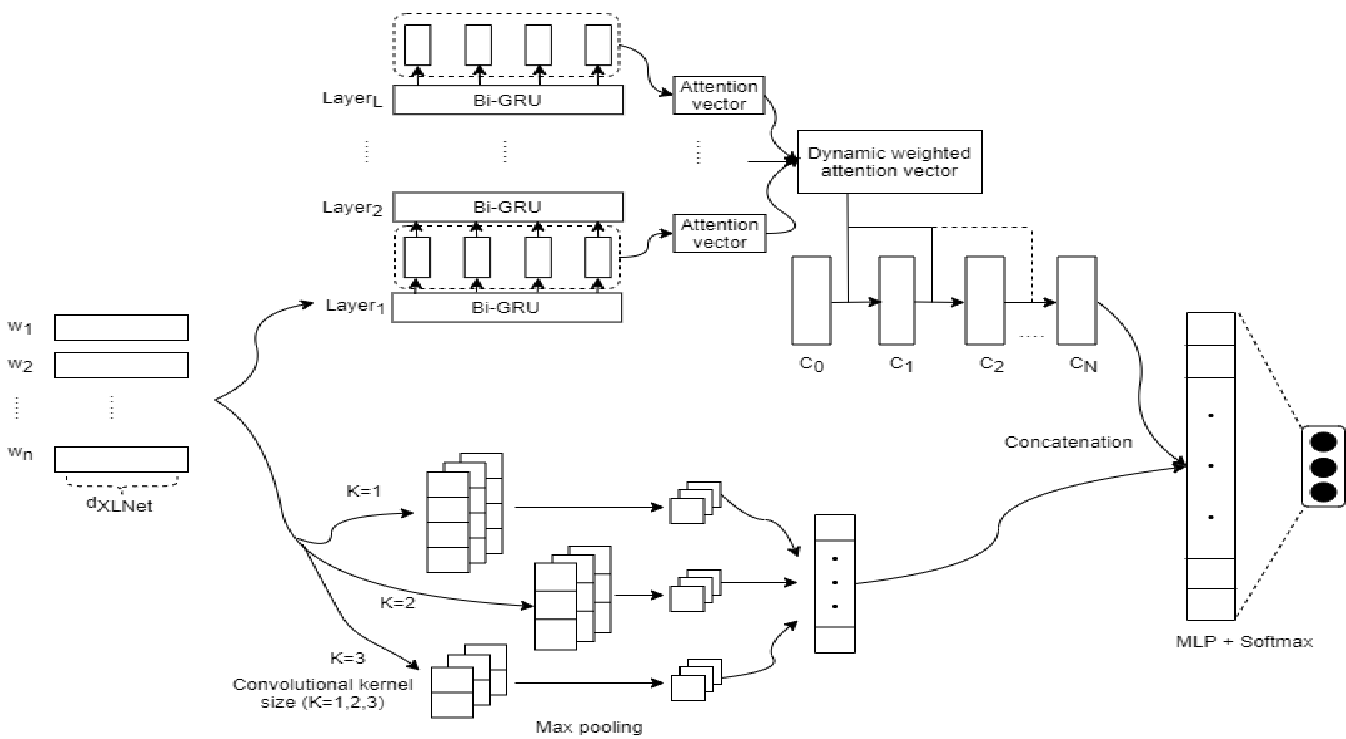 Fig 1: The dual-channel architecture showing the fusion of CNN and Dynamic Attention layers.
Experiments & SOTA Results
The authors tested DACNN against strong baselines (including MC-CNN and CNN-LSTM) on three major datasets: CBET, TEC, and SE.
- Accuracy Leap: DACNN consistently outperformed others, reaching 65.38% on the SE dataset (a ~3.4% improvement over the baseline).
- Embedding Impact: Even when using older GloVe embeddings, DACNN's architectural advantage held firm, though the switch to XLNet provided the final performance peak.
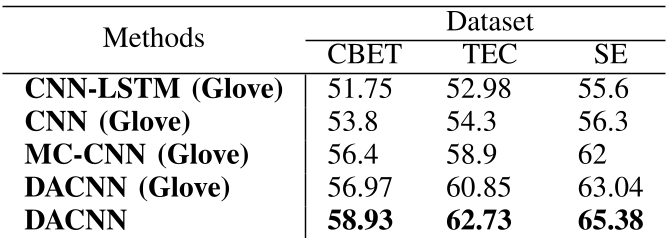 Table 1: Competitive analysis across three datasets, showing the consistent lead of DACNN.
Why It Works: Deep Insights
The success of DACNN lies in three critical hyper-parameter choices revealed in their ablation studies:
- Iterative Attention: The model performs better with 2 iterations of attention. One iteration isn't enough to capture complex nuances, but more than two leads to overfitting.
- Layer Depth: Using 5 BiGRU layers was the "sweet spot." Too few layers lacked representational power; too many introduced noise that even dynamic weighting couldn't fully filter out.
- Dynamic vs. Static: Replacing dynamic weights with a simple average dropped performance significantly, proving that "not all layers are created equal" in the eyes of an emotion classifier.
Critical Analysis & Conclusion
DACNN represents a significant step forward in making NLP models more "emotionally intelligent" using pure text.
- Pros: Highly robust; removes the need for manual lexicon building; effectively leverages the strengths of both CNNs and RNNs.
- Limitations: While it handles "noisy" text well through pre-processing, the model is computationally heavier than a standard BERT or CNN-only model due to the multi-layer recurrent structure and iterative attention.
- Future Outlook: The concept of dynamic layer weighting is highly transferable. We could see this logic applied to modern Transformer backbones to better aggregate "intermediate" layer insights which are often discarded.
Takeaway: In the quest for understanding human emotion, how you combine your neural features is just as important as the features themselves.