
Daily Deals Architecture: Prediction, Social Diffusion, and the Price of Reputation
Daily Deals: Prediction, Social Diffusion, and Reputational Ramifications
This paper presents a multi-dimensional study of daily deal sites like Groupon and LivingSocial, utilizing longitudinal datasets across 20 US cities. It explores deal performance prediction, the impact of "soft incentives" (scheduling, placement), and the influence of social diffusion via Facebook and reputational shifts on Yelp.
TL;DR
Is the "Groupon effect" a blessing or a curse for local businesses? This seminal study by Byers et al. (WSDM '12) moves beyond the hype of the early 2010s daily deal craze to scientifically quantify how these platforms work. By scraping and analyzing over 16,000 deals and cross-referencing them with Facebook and Yelp data, the authors find that while deals drive massive short-term volume, they often leave a trail of lower reputational scores in their wake.
Problem & Motivation: Beyond the 50% Off Tag
In 2011-2012, Groupon was one of the fastest-growing companies in history. However, the mechanics of its success were a "black box." Merchants struggled to know if deep discounts (often 50% off + 50% revenue share to the platform) were sustainable. Researchers wanted to know:
- What factors (besides price) drive a deal's "size" (number of units sold)?
- Does social media actually "viralize" these deals?
- What happens to a merchant's reputation after the "deal seekers" arrive?
Methodology: The Multi-Source Approach
The researchers didn't just look at sales; they triangulated data from three distinct ecosystems:
- Sales Data: Internal metrics from Groupon and LivingSocial (revenue, price, duration).
- Social Data: Facebook "Like" counts as a proxy for word-of-mouth diffusion.
- Reputational Data: 58,900 Yelp reviews to track merchant sentiment before and after deals.
The Prediction Model
The authors proposed a log-linear regression model to estimate deal size (): Through this, they discovered that price elasticity is -0.48, meaning demand is relatively inelastic. The biggest driver of success isn't dropping the price by another $5; it's the Featured Status (being on the front page/email), which boosts sales by over 140%.
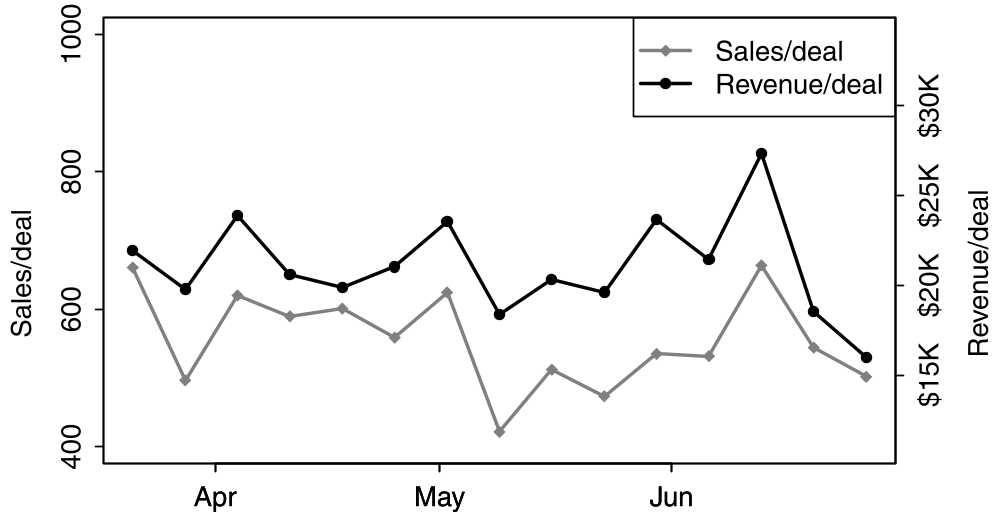 Figure 1: Comparison of weekly revenue and sales showing the relative stability in established markets despite reported explosive growth.
Social Diffusion: Do "Likes" Matter?
The study investigated whether deals propagate like a biological virus. Using the Independent Cascade (IC) and Weighted Cascade (WC) models on a high-energy physics collaboration network (as a proxy for social structures), they found that the relationship between Facebook likes and sales is sub-linear.
While more "Likes" correlate with more sales, the "marginal utility of a Like" decreases as the deal scales. Most "social spreading" is driven by a small seed set of highly active users (the "top-k" influential nodes).
The "Yelp Sting": Reputation Rams
The most striking finding involves merchant reputation. Does a surge of new customers improve a business?
- Volume Increase: Review frequency jumps significantly after a deal.
- Rating Decrease: Average ratings drop by roughly 0.14 stars (a 10% relative decrease in score) for those mentioning the deal.
- The "Misfit" Hypothesis: Reviewers mentioning both "Groupon" and "Coupon" gave scores that were 21% lower than the baseline.

Critical Insight & Conclusion
Byers et al. successfully demonstrated that daily deals are more than just discounted sales; they are a complex reputational gamble.
Takeaway for Today's Platforms: The "negative reputation" effect identified here is a precursor to modern concerns about "platform-induced churn." If a marketing channel brings in customers who are price-sensitive but service-intolerant, it may harm the business more than the cash flow helps.
Limitations: The study relies on public-facing data and cannot account for private refunds or the "back-end" profitability for the merchants. However, as an early look at the social-commerce intersection, it remains a masterclass in cross-platform data analysis.