
Dalica: Infusing Historical Heritage with Ambient Intelligence via Logical Agents
DALICA: Agent-Based Ambient Intelligence for Cultural-Heritage Scenarios
The paper introduces Dalica, a multi-agent system (MAS) built on the DALI logic programming language, designed for Ambient Intelligence in cultural heritage. It addresses two primary scenarios—Cultural Assets Fruition (CAF) and Cultural Assets Monitoring (CAM)—using Galileo satellite signals and intelligent agents to provide personalized visitor guidance and secure artifact transportation.
TL;DR
Dalica is an innovative Multi-Agent System (MAS) that bridges the gap between ancient stone monuments and modern satellite technology. By leveraging the DALI logic programming language, the system provides personalized archaeological tours and secures the transportation of priceless artifacts. It moves beyond static digital guides by using "agent proactivity" to deduce user interests and coordinate security protocols in real-time.
The Problem: When "Information Push" Isn't Enough
Existing technology in cultural heritage projects (like MAGA or Minerva) often falls into two traps:
- Rigid Personalization: They present data based on pre-defined static profiles rather than evolving with the visitor's real-time behavior.
- Fragile Security: Monitoring systems during artifact transport (CAM) are prone to false alarms. Simple sensor threshold violations (like a sudden drop in temperature) trigger alerts even if they are caused by harmless environmental changes rather than theft.
The research team behind Dalica recognized that simple "if-then" triggers were insufficient for the messy, unpredictable environment of an open-air site like Villa Adriana.
Methodology: The Architecture of Intelligence
The core of Dalica lies in its multi-layered environment abstraction. The system interprets the physical world as a network of "specialized cells"—including ontological descriptions of sites (Points of Interest, or POIs), user GPS positions, and sensor data.
1. The DALI Agent Engine
Unlike standard imperative programming, Dalica uses the DALI logic language. This allows agents to process External Events (like receiving a Galileo satellite signal) and trigger Internal Events (proactive reasoning).
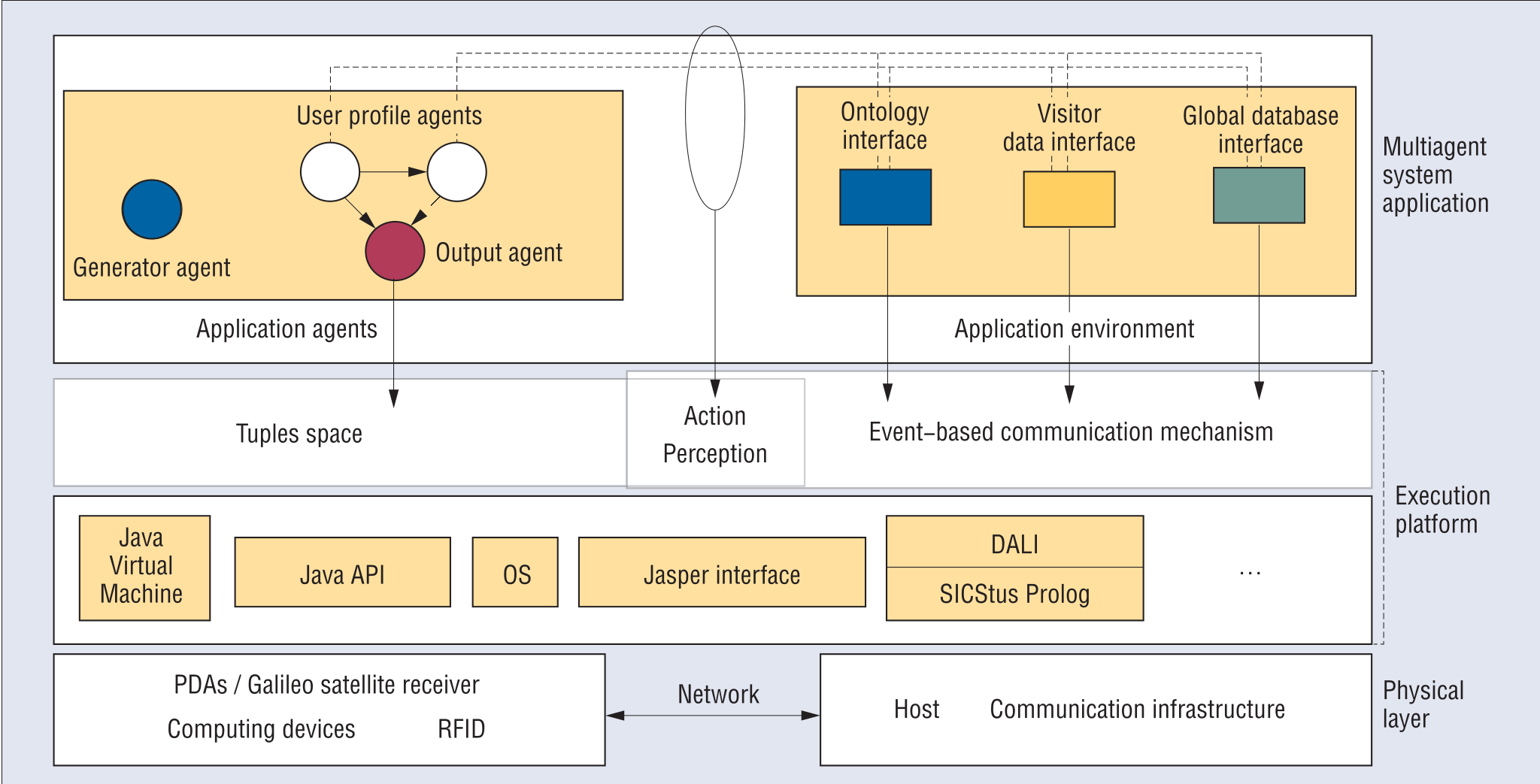 Figure 1: The environment abstraction layers of the CAF scenario, showcasing the integration between physical hardware (PDAs/Galileo) and the MAS Middleware.
2. Interest Deduction (The CAF Scenario)
How does an agent know you like mosaics? Dalica doesn't just ask; it observes.
- Dwell Time: If you stay at the "Pretorio" longer than the average 8 minutes, the agent notes a potential interest.
- Intersection Analysis: If you stand where multiple POI circles overlap, the agent uses keyword weighting (e.g., [water: 60%, garden: 30%]) to refine your profile.
- Social Cooperation: Agents can communicate with neighbor agents to suggest group activities for visitors with overlapping interests.
Experiments: Real-World Deployment at Villa Adriana
The system was stress-tested in complex scenarios involving both tourism and high-stakes logistics.
The CAM Scenario: Reducing False Alarms
When transporting cultural assets from Rome to Florence, Dalica agents provided a critical layer of fault tolerance. In one instance, if all packages reported a sudden temperature spike simultaneously, the agents communicated to conclude that it was a weather change rather than multiple simultaneous package breaches, thereby suppressing a false alarm.
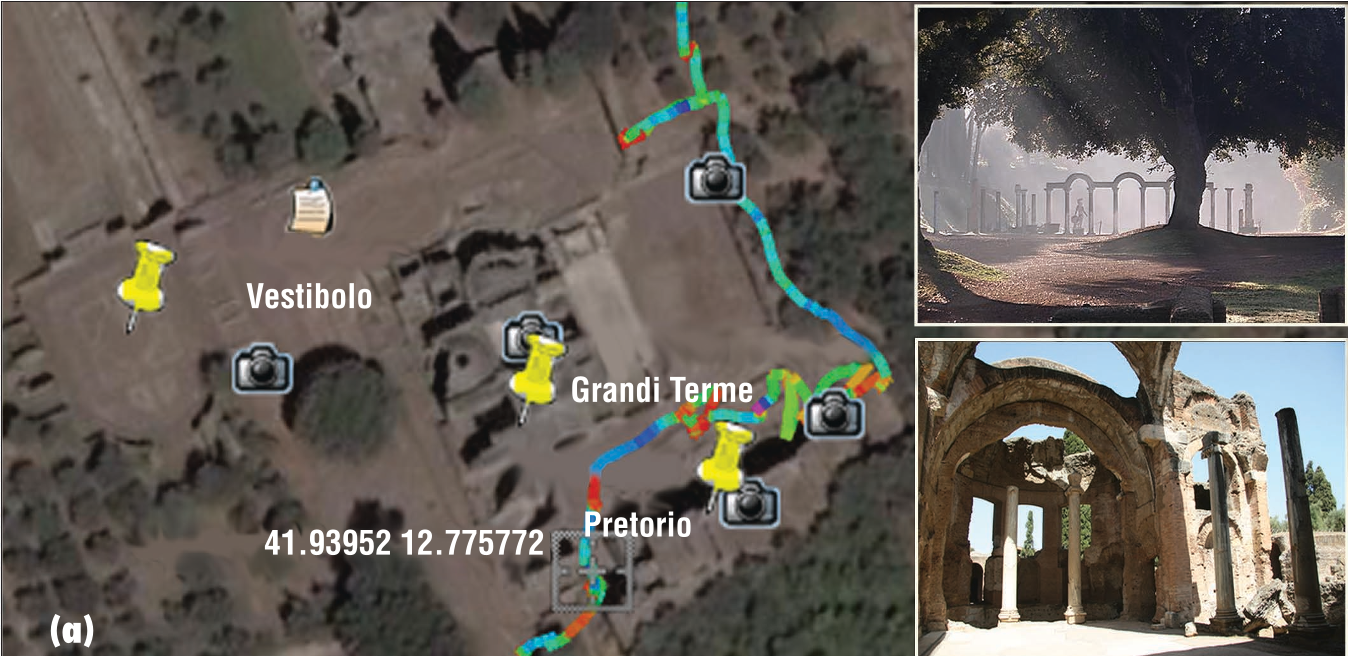 Figure 2: A satellite overview and code snippet showing the agent deducing a user's interest in "thermae" based on their movement patterns around the Grandi Terme.
Quantifiable Observations:
- Profile Refinement: The three-phase deduction process showed high accuracy in predicting user preferences during the Villa Adriana tests.
- Fault Tolerance: The "redundant check" between the GTA monitoring component and the Logic Agents provided a dual-validation mechanism that enhanced security.
Critical Analysis & Conclusion
Dalica represents a shift from "Passive Technology" to "Active Presence." By using logic-based agents, the researchers created a system that doesn't just store data but reasons about it.
Takeaway: The success of Dalica suggests that the future of AmI (Ambient Intelligence) lies in Decentralized Reasoning. Instead of a central server making every decision, local agents with specific "Beliefs" and "Goals" can respond more fluidly to the nuances of human behavior and environmental noise.
Limitations: While the logic-based approach is robust, the current system relies heavily on manually weighted labels (keywords) provided by experts. Future iterations could benefit from automated "Interest Learning" via more advanced neuro-symbolic techniques.
Future Outlook: The integration of Social Computing—where agents negotiate dining or group tours for their users—could turn archaeological sites into dynamic social networks, fundamentally changing the museum experience.