
Damage Assessment from Social Media Imagery: Deep Learning for Rapid Disaster Response
Damage Assessment from Social Media Imagery Data During Disasters
This paper introduces an automated system for multi-level damage assessment using social media imagery during natural disasters. By fine-tuning deep Convolutional Neural Networks (CNN), specifically VGG16, the authors track physical destruction across three severity levels: severe, mild, and little-to-no damage, achieving state-of-the-art performance in disaster response scenarios.
TL;DR
This study presents an automated pipeline to assess the severity of infrastructure damage using social media images. By leveraging fine-tuned VGG16 architectures and cross-event data transfers, the researchers achieved up to 90% accuracy in identifying damage levels, providing a critical tool for humanitarian organizations to prioritize relief efforts within hours rather than weeks.
Background & Motivation: The Information Blackout
When a disaster strikes, the first few hours are the most critical, yet they are often characterized by an "information blackout." While platforms like Twitter are flooded with images of the destruction, humanitarian agencies traditionally rely on slow-moving manual surveys or satellite feeds.
The challenge isn't just getting the data; it's the inherent complexity of the imagery. Disaster photos are "noisy," subjective, and lack the clean object definitions found in datasets like ImageNet. A "mildly" damaged building to one observer might be "severely" damaged to another, and the visual appearance of rubble varies significantly across different global regions.
Methodology: Beyond Hand-Crafted Features
The paper compares three distinct approaches to determine the level of damage—Severe, Mild, and Little-to-no damage:
- Bag-of-Visual-Words (BoVW): A traditional computer vision baseline using SIFT/HOG descriptors.
- Pre-trained CNN (VGG16-fc7): Using a deep network as a fixed feature extractor.
- Fine-tuned CNN: Taking a pre-trained VGG16 and retraining its final layers using a cross-entropy loss function to adapt to the specific "visual language" of disaster rubble.
Architecture Overview
The core of the system is a 16-layer VGG network. While the lower layers capture general edges and textures, the fine-tuning process allows the upper layers to learn the specific nuances of "structural failure," such as roof collapses or bridge cracks.
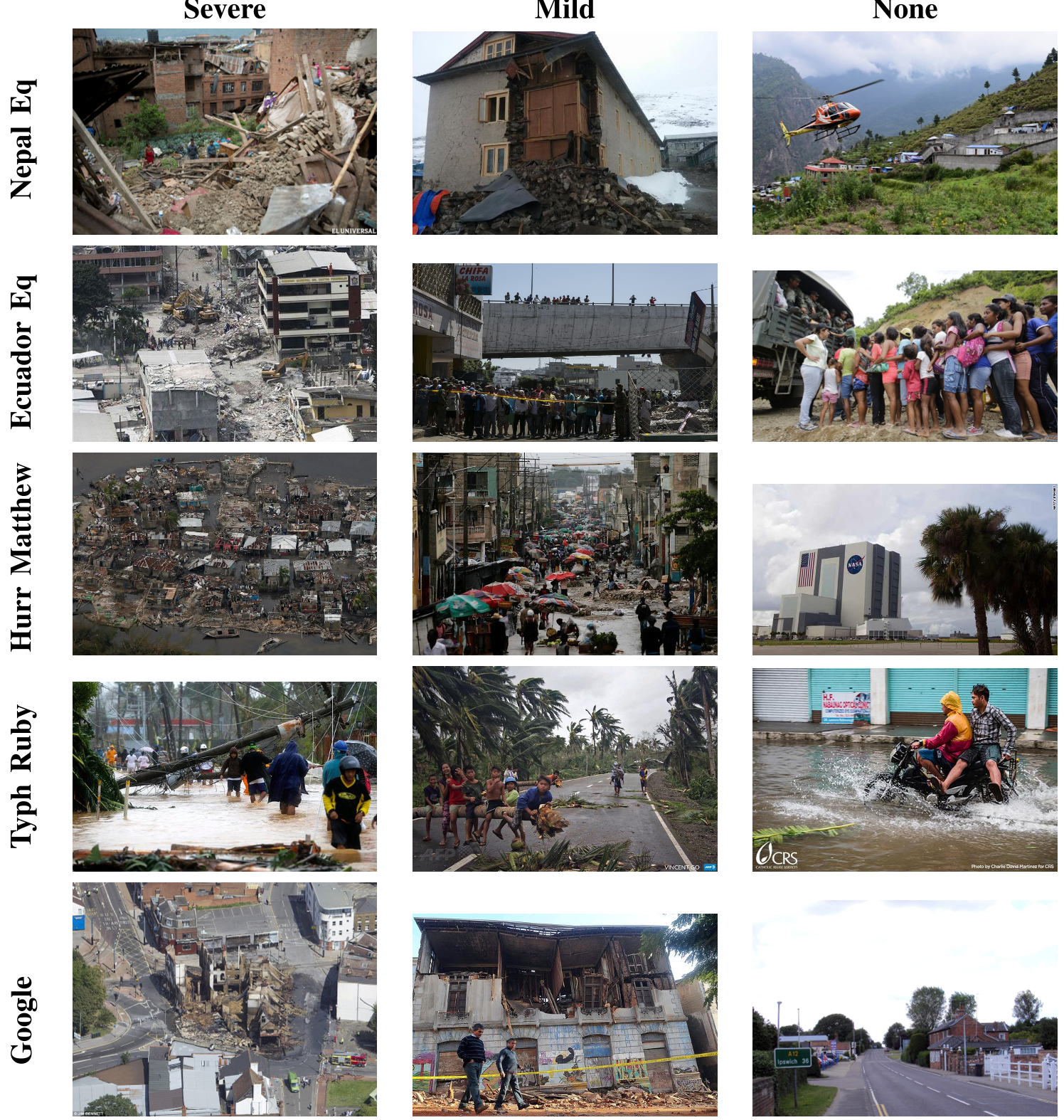 Fig 1. Sample images showing the visual diversity of damage levels across Nepal, Ecuador, and Typhoon datasets.
Overcoming the "Cold-Start" with Cross-Event Learning
One of the paper's most significant contributions is its strategy for the Cold-Start Problem. How do you train a model for a disaster that just happened? The authors propose a Cross-Event setting:
- Source Data: Crawled Google images (e.g., "damaged bridge") and data from past disasters (e.g., Nepal Earthquake).
- Target Data: The new, ongoing disaster (e.g., Ecuador Earthquake).
Their results prove that even if geographical conditions differ, the underlying visual patterns of "damage" are transferable.
Experimental Results & Performance
The experiments covered four major events: Typhoon Ruby, Nepal Earthquake, Ecuador Earthquake, and Hurricane Matthew.
| Method | Nepal (Acc) | Ecuador (Acc) | Ruby (Acc) |
|---|---|---|---|
| BoVW (Baseline) | 0.78 | 0.82 | 0.73 |
| VGG16-Fine-tuned | 0.84 | 0.87 | 0.81 |
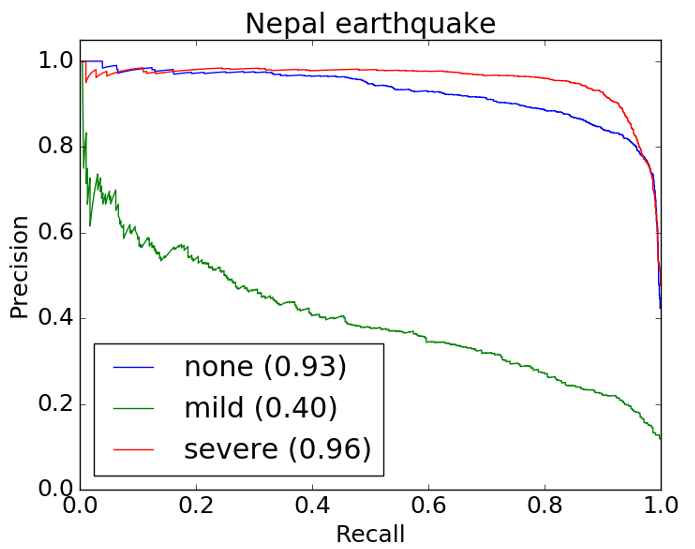 Fig 2. Precision-Recall curves indicating that "Severe" and "None" classes are relatively easy to distinguish, while "Mild" damage remains the most ambiguous due to task subjectivity.
Critical Insight: The "Mild" Ambiguity
The study highlights a fascinating limitation: Task Subjectivity. In the Nepal and Hurricane Matthew datasets, the "Mild" damage class was the hardest to classify. This mirrors human performance; annotators often disagree on whether a partially damaged roof constitutes "mild" or "severe" destruction.
The authors suggest that future work should move toward a hierarchical classification or multi-dimensional labels (e.g., intensity vs. spread) to better handle this gray area.
Conclusion & Future Impact
This research transitions disaster response from reactive to proactive. By integrating deep learning into the AIDR (Artificial Intelligence for Disaster Response) platform, organizations like the UN can now process tens of thousands of images per hour.
The success of Cross-Event Learning suggests that as we build more extensive global disaster datasets, our ability to respond to the next unforeseen crisis will only become faster and more accurate. This marks a shift toward "Global Intelligence" in crisis management, where data from a quake in Asia helps save lives during a quake in South America.