
Danmaku-Powered EBSN: Bridging the O2O Gap Through Real-Time Bullet Chats
Is Danmaku an Effective Way for Promoting Event based Social Network?
This paper explores the integration of Danmaku (bullet chatting) into Event-Based Social Networks (EBSN) to enhance real-time Online-to-Offline (O2O) interactions. Using a custom application called "USee," the authors demonstrate how live commentary displayed on large screens during public events can bridge the gap between digital and physical social spaces.
TL;DR
This paper introduces a novel application of Danmaku (real-time synchronized commentary) within Event-Based Social Networks (EBSN). By deploying the "USee" app at live campus events, the authors utilized a specialized TF-IDF sentiment model to prove that Danmaku significantly boosts user engagement, achieving a staggering 50% conversion rate among event attendees and providing a real-time "pulse" of the audience's emotional state.
Background: The Social Potential of the "Bullet Screen"
While Danmaku is a staple of Asian video platforms like Bilibili and Niconico, its application in physical, real-world events remains a frontier. The authors identified a synergy: EBSNs aim to link online and offline worlds, while Danmaku creates a "one-to-many" social experience that thrives on synchronicity.
The Problem: Measuring "Interaction" in the Physical World
Most EBSNs suffer from a "second screen" problem—users are either engaged with the event or their phones, but rarely both in a way that enhances the collective experience. The challenge is twofold:
- Stimulating Participation: How do you get a theater full of people to contribute to a digital layer?
- Quantifying Engagement: How can we mathematically measure the "vibe" or social density of an event using text data?
Methodology: Quantifying the Social Pulse
The researchers developed USee, an app where users post location-aware topics. In the context of a live event, these posts appear as "bullets" flying across a large LED screen in the theater.
To measure success beyond simple message counts, they proposed the User Participation Degree (UPD). This is not just a frequency count; it is a weighted model that considers:
- TF-IDF: The uniqueness and frequency of words.
- Keyword Length: A logarithmic weight for longer, potentially more descriptive words.
- Top-K Summation: Aggregating weights of the most significant keywords within a specific time window.
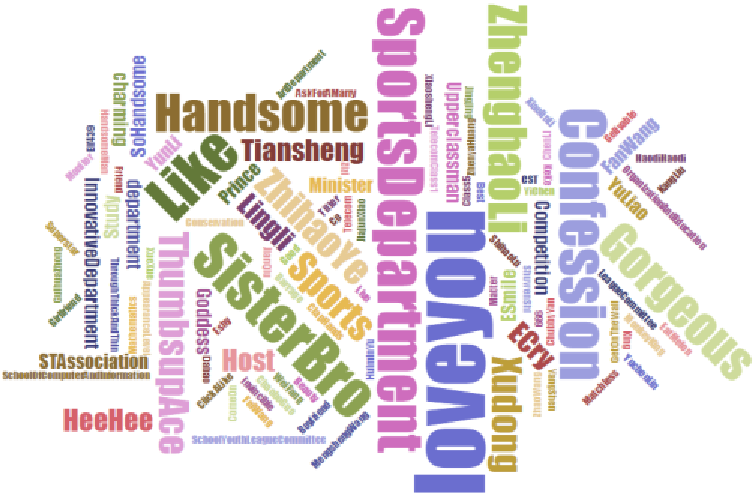 Figure: The USee interface and the "Topic Room" where the Danmaku magic happens.
Experimental Results: The Data Doesn't Lie
The team tested USee at three major campus soirees (S1, S2, S3). The results were striking:
- Direct Correlation: In S1, the UPD peaks perfectly mirrored the timeline of the most popular stage performances. When the "best program" started at 20:20, the UPD hit its absolute zenith.
- Conversion & Density: During a single event, 136 new users signed up (50% of the audience), generating 2,633 Danmaku messages. This averages out to 20 messages per person in just two hours—a level of engagement rarely seen in traditional social apps.
- Sentiment Mapping: Word clouds revealed that keywords like "love," "handsome," and "gorgeous" dominated the weighted rankings, providing organizers with instant qualitative feedback.
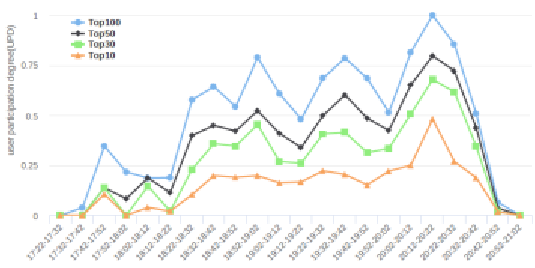 Figure: The UPD trend for soiree S1, showing the distinct peaks corresponding to live performance highlights.
Industry Insight & Future Outlook
The "Danmaku effect" in physical spaces proves that the anonymity and real-time visualization of feedback lower the barrier to entry for social participation. For event organizers and product managers, this suggests that the "large screen" shouldn't just be for broadcasting the stage—it should be a collaborative canvas for the audience.
Limitations: Currently, the model is heavily text-based. Future iterations could integrate computer vision to correlate Danmaku spikes with physical audience reactions (cheering, clapping) to build a truly holistic EBSN model.
Takeaway: Danmaku is more than just a video overlay; it is a powerful tool for community building that can turn a passive audience into an active, content-generating powerhouse.