
DARE2HACK: Bridging Crowdsourcing and Design Thinking for Service Innovation
DARE2HACK: Crowdsourcing ideas through hackathons to codesign new human-centric services
The paper introduces the DARE2HACK methodology, a structured three-stage framework (pre-hackathon, execution, post-hackathon) designed to facilitate open innovation. It focuses on using hackathons as a crowdsourcing tool to codesign human-centric services by integrating Design Thinking and service-dominant logic.
Executive Summary
TL;DR
This paper presents DARE2HACK, a robust methodology that transforms the traditional "coding marathon" into a strategic tool for Open Innovation. By integrating Design Thinking into a crowdsourcing contest, the authors demonstrate how organizations can rapidly generate and prototype human-centric services. The study culminates in a real-world application in Mexico, proving that a structured hackathon can generate hundreds of viable service ideas in just 48 hours.
Academic Positioning
This work resides at the intersection of Service Science and Innovation Management. It shifts the hackathon narrative from purely technical "hacking" to a strategic "ideathon" focused on Service-Dominant (S-D) Logic, where value is co-created with the user rather than embedded in a physical product.
The Shift: From Closed Walls to Open Ecosystems
The central motivation of the DARE2HACK framework is the obsolescence of the Closed Innovation model. In an era of rapid technological change, companies can no longer rely solely on internal R&D. The authors argue that the "walls" of an organization must become permeable.
However, "going open" is difficult. The most common failure point is the lack of understanding of the customer’s pain points—often referred to as the "fuzzy front-end" of innovation. Companies frequently design solutions for problems that don't exist. DARE2HACK addresses this by mandating a human-centric approach right from the start of the crowdsourcing event.
Methodology: The DARE2HACK Framework
The core of the paper is a three-stage methodology designed to ensure that the "collective brainpower" of a crowd results in more than just "post-it notes on a wall."
1. Pre-Hackathon (The Foundation)
Preparation is the most critical and often overlooked phase. It involves:
- Trend Analysis: Understanding global megatrends.
- Stakeholder Mapping: Identifying the right mix of talent (Startups, Academia, Government, Private Sector).
- Empathy Pre-work: Conducting surveys to discover real-world innovation barriers before the event begins.
2. Execution (The Design Thinking Loop)
During the hackathon, teams follow the five stages of Design Thinking:
- Empathize & Define: Using "Personas" and "Empathy Maps" to ground ideas in reality.
- Ideate: Rapid brainstorming aimed at volume.
- Prototype & Test: Building low-fidelity models to gather immediate feedback.
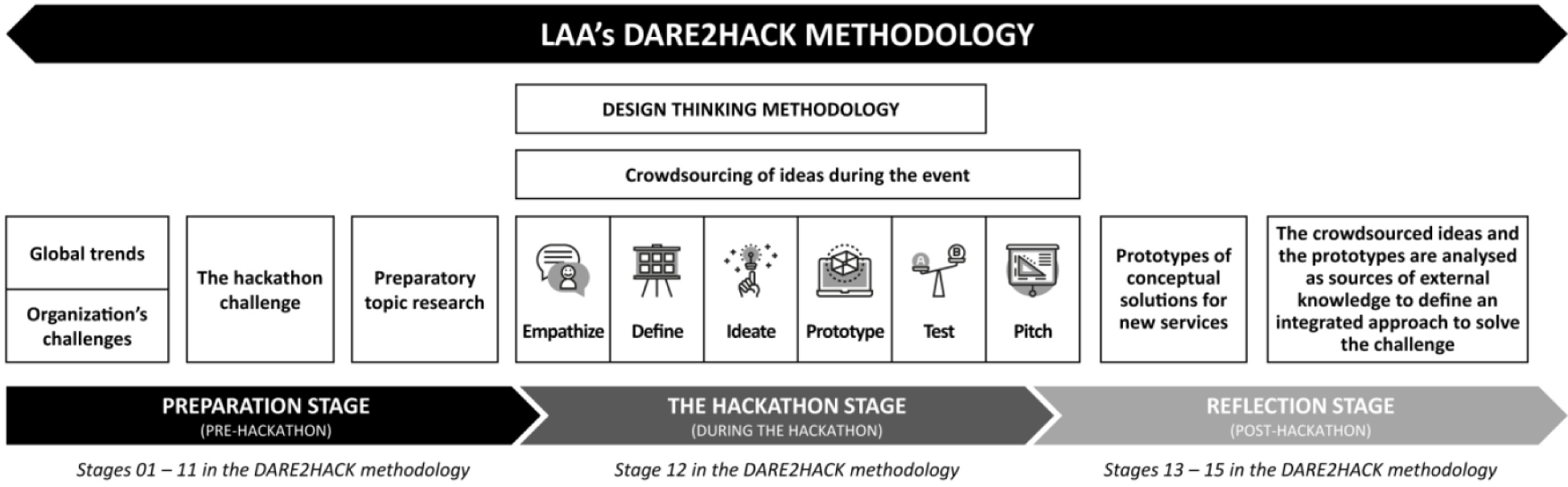 Fig 1. The DARE2HACK workflow showing the integration of Design Thinking stages within the execution phase.
3. Post-Hackathon (The Value Capture)
The "Reflection" stage ensures that high-energy ideas don't die once the event ends. This involves systematic documentation, feedback analysis, and the formal establishment of projects based on winning solutions.
Evidence from the Field: The Mexico City Case Study
The authors validated their model through a hackathon targeted at designing a new Innovation Hub. The diversity of the crowd was key: 74 participants from 26 companies, 4 government entities, and 4 universities.
Key Quantitative Results:
- Volume: 207 unique ideas generated across 6 teams.
- Diversity of Ideation: Team 3 led the ideation phase with 44 distinct service concepts.
- Service Themes: The most frequent needs identified were Intermediation (connecting stakeholders), IP Advice, and Physical Infrastructure.
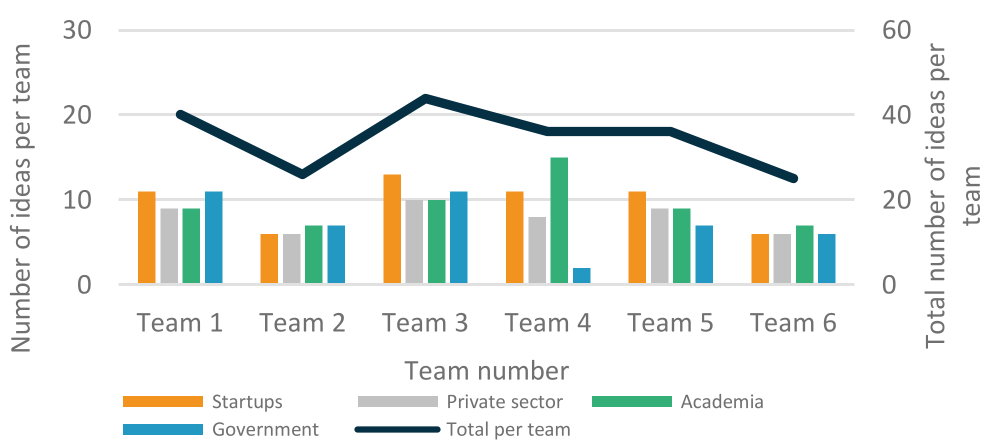 Fig 2. Breakdown of ideas generated per team, categorized by the "Persona" (User Segment) they targeted.
Critical Insights & Future Outlook
The "Aha!" Moment
The paper reveals a crucial shift in perception: Participants viewed the ideal Innovation Hub not just as a "co-working space," but as a co-creation engine. The most valuable services identified were intangible—mentorship, legal support for IP, and networking—proving that human-centric design accurately captures the nuances of service value that traditional business planning often misses.
Limitations & Takeaways
While the DARE2HACK framework is powerful, its success depends heavily on the Post-Hackathon follow-through. Without leadership support to fund the prototypes, a hackathon remains a "theatre of innovation" rather than a true driver of change.
For practitioners, this research provides a clear blueprint: If you want radical innovation, stop looking inward. Open your challenges to a diverse crowd, frame them using Design Thinking, and treat the hackathon as the start of a project, not the end of a contest.