
DARIM: A Hybrid Strategic Shield Against Rumors in Multiplex Social Networks
DARIM: Dynamic Approach for Rumor Influence Minimization in Online Social Networks
The paper introduces DARIM (Dynamic Approach for Rumor Influence Minimization), a hybrid strategy that combines node blocking and anti-rumor campaigns to curb misinformation in single and multiplex Online Social Networks (OSNs). By leveraging survival theory and a greedy optimization framework, DARIM achieves a documented (1 - 1/e) approximation ratio, significantly outperforming traditional single-strategy methods across various detection stages.
TL;DR
The spread of rumors on platforms like Twitter and Facebook poses a systemic risk to public trust and health. DARIM represents a new generation of rumor mitigation that doesn't just block users or just spread "the truth"—it does both. By treating rumor propagation as a survival problem, researchers have developed an algorithm that optimally chooses which users to block and which to recruit for truth campaigns, achieving a near-optimal reduction in rumor influence.
Problem & Motivation: The False Dichotomy of Defense
In the fight against digital misinformation, we have historically relied on two distinct "weapons":
- Blocking Nodes: Effective but heavy-handed. It stops rumors fast but hurts user engagement and raises censorship concerns.
- Anti-Rumor Campaigns: Democratic and "soft," but often too slow to catch a rumor that has already gone viral (late-stage detection).
The authors of DARIM argue that neither is a silver bullet. The real challenge is determining the optimal mix: how do we spend a limited budget to maximize "survival" against a rumor?
Methodology: Survival of the Truthful
The genius of DARIM lies in its use of Survival Theory. Usually applied in medicine to track patient outcomes, here it models the probability that a node (user) remains "uninfected" by a rumor over time.
The Propagation Model
Instead of simple diffusion, DARIM uses the HISBmodel, which accounts for:
- Individual Factors: Forgetting/remembering (), background knowledge (), and hesitation ().
- Social Factors: Acceptance probability based on network influence.
The DARIM Algorithm
The problem of picking the best nodes is NP-hard. However, the authors prove that their influence function is submodular and monotone. This allows the use of a Greedy Algorithm that provides a mathematical guarantee: the results will be within 63% (specifically ) of the theoretical optimum.
 Figure 1: The multi-step rumor transmission rule involving sending, selecting, and acceptance probabilities.
Experiments & Results: Dominance Across the Board
The researchers tested DARIM on diverse datasets, including a complex multiplex structure combining Facebook, Twitter, and Youtube.
Key Findings:
- Early vs. Late Discovery: If a rumor is caught early, truth campaigns (TCS) are powerful. If caught late, blocking becomes necessary. DARIM automatically shifts its strategy to handle both.
- Budget Efficiency: Even with a small budget (), DARIM's hybrid approach prevents more infections than using the same budget on just one strategy.
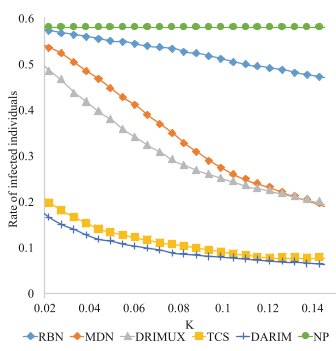 Figure 2: Performance comparison showing DARIM (bottom line) consistently maintaining the lowest rate of infected individuals.
Critical Analysis & Conclusion
DARIM is a significant step forward because it respects the User Experience (UX). By not relying solely on blocking, it maintains the social fabric of OSNs while effectively neutralizing threats.
Limitations: The model assumes we can accurately estimate a user's "subjective judgment factor" (), which in the real world requires deep sentiment analysis or historical data that might not be readily available.
The Takeaway: The future of network safety isn't just about better filters; it's about dynamic response orchestration. DARIM provides the mathematical blueprint for how social platforms can fight fake news without turning into digital lockdowns.