
Mapping the Digital Underground: A Sophisticated Infrastructure for Dark Web Analysis
Developing a Dark Web collection and infrastructure for computational and social sciences
The paper presents the "Dark Web Forum Portal," a comprehensive research infrastructure designed to collect and analyze extremist content across 29 international jihadist forums. It integrates advanced incremental spidering, multilingual machine translation, and Social Network Analysis (SNA) to provide a centralized hub for counter-terrorism research.
TL;DR
Researchers from the University of Arizona and the Naval Postgraduate School have developed the Dark Web Forum Portal, a specialized research infrastructure that solves the "ephemeral" nature of extremist content. By utilizing incremental spidering and Social Network Analysis (SNA), the portal provides a persistent, searchable, and translatable archive of 13 million jihadist forum posts, allowing analysts to identify key influencers and radicalization patterns across multiple languages.
The Challenge: Catching a Digital Ghost
Analyzing extremist groups online is like trying to map a shifting desert. Jihadist forums are "ephemeral"—they disappear, move URLs, or are taken down by authorities overnight. For social scientists and security analysts, this creates two massive hurdles:
- Access & Persistence: How do you maintain a consistent database of sites that are constantly moving?
- Scale & Language: Manual analysis of 13 million posts in Arabic, Russian, and French is humanly impossible.
Prior work often relied on "complete spidering" (downloading the whole site every time), which is too slow and alerts forum administrators, leading to IP bans.
Methodology: Scalable Intelligence
The authors overhauled their previous framework by introducing three technical pillars:
1. Incremental Spidering: Surgical Precision
Instead of a brute-force crawl, the system uses a three-step incremental process. It first identifies sub-forum URLs, then checks "Thread List Pages" for the last update date. If a thread is newer than the last database entry, the spider retrieves it. This allows the system to update a massive forum like Hanin Net in under 40 minutes.
2. Multi-Level Multilingual Search
To bridge the language gap, the portal integrates the Google Translation API. Crucially, it supports Cross-Forum Searching. A user can type "bomb" in English, and the system automatically queries Arabic, French, and Russian equivalents, aggregating results into a single dashboard.
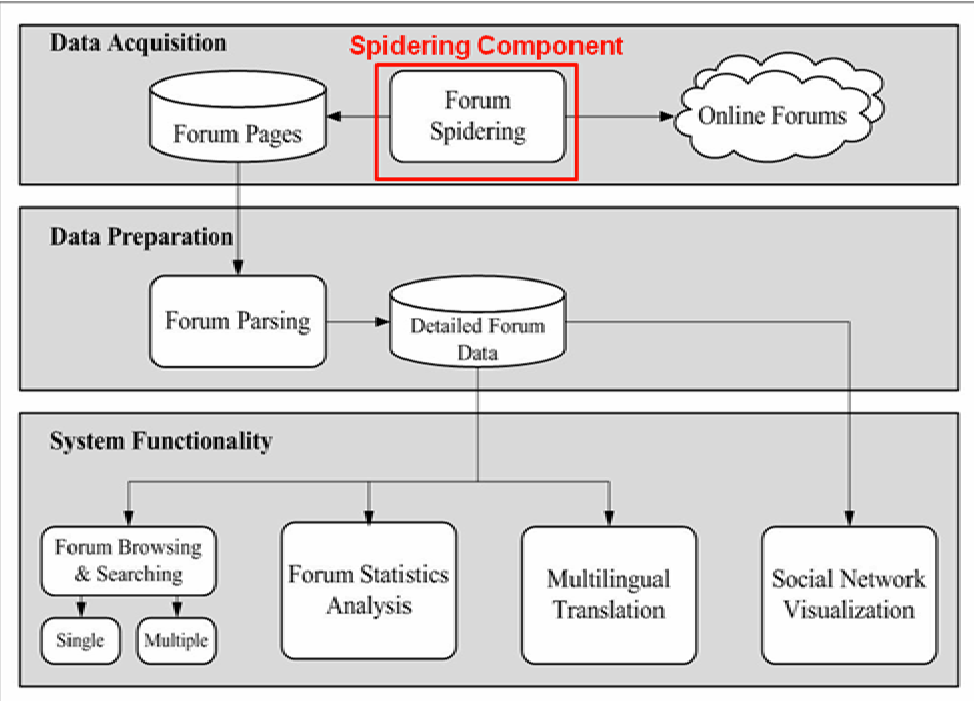 Figure 1: The three-tier architecture of the Dark Web Forum Portal: Data Acquisition, Preparation, and Functionality.
3. Social Network Analysis (SNA)
The system treats forum interactions as a Bipartite Directed Graph. Nodes represent users, and edges represent "reply-to" relationships. By calculating metrics like Betweenness Centrality (who acts as a bridge?) and In-Degree (who is receiving the most attention?), analysts can pinpoint the ideological "hubs" of a network.
Experiments: Real-World Impact
The power of the system is best seen in its scale. The portal currently hosts:
- 29 Targeted Forums (17 Arabic, 7 English, 3 French, 1 German, 1 Russian).
- 13.1 Million Messages and over 339,000 Members.
In a case study on the "Islamic Awakening" forum, the SNA component identified specific users like "Bint ul Islam" and "iloveislam" as high-frequency posters on Sharia and Sunni-Shia topics. By clicking these nodes in the visualization, an analyst can instantly see the actual content of their radicalizing posts.
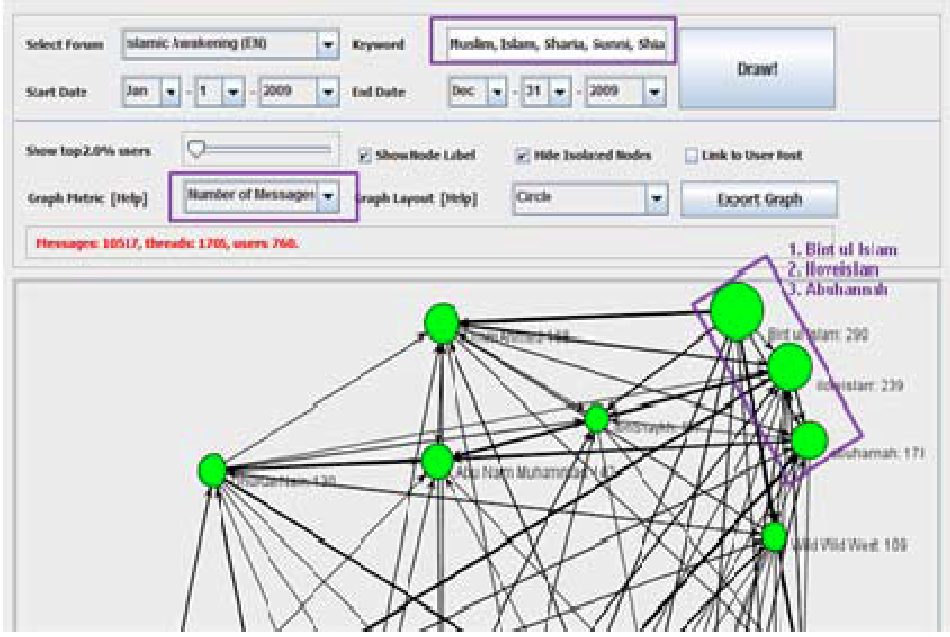 Figure 2: Social Network Visualization identifying active participants and their interaction clusters.
Critical Insight & Future Directions
The "Dark Web Forum Portal" moves the field from reactive observation to proactive monitoring. The use of incremental spidering is the "Inductive Bias" that makes this specific domain manageable—treating forums as ordered sequences of threads rather than chaotic web clouds.
However, the authors acknowledge a limitation: Sentiment Analysis. While we can see who is talking to whom, the system doesn't yet automatically distinguish between a user "debating" extremist views and one "promoting" them. The next frontier for this infrastructure will be the integration of NLP engines to automatically classify the intent behind the 13 million posts they have successfully archived.
Conclusion
This infrastructure provides the "telescope" needed to observe the dark corners of the web. By combining robust data engineering with sociological graph theory, the Dark Web Forum Portal empowers researchers to understand the radicalization process in a way that manual browsing never could.