
IEAM-RP: Leveraging Environmental Adaptation for Precision Data Clustering
Data Clustering Using Environmental Adaptation Method
This paper introduces a data clustering method based on the Improved Environmental Adaptation Method with Real Parameter (IEAM-RP), an optimization algorithm inspired by biological environmental adaptation. The approach aims to minimize intra-cluster distances across various datasets, outperforming several recent metaheuristics including GWO, SSA, and BOA.
TL;DR
Researchers have successfully applied the Improved Environmental Adaptation Method with Real Parameter (IEAM-RP) to the problem of data clustering. By treating cluster centroids as individuals in an adapting environment, this optimization-based approach consistently outperforms established metaheuristics like the Grey Wolf Optimizer (GWO) and Butterfly Optimization Algorithm (BOA) across multiple benchmark datasets, offering more stable convergence and better avoidance of local optima.
Problem & Motivation: The Local Trap of K-Means
Data clustering is the cornerstone of unsupervised learning, yet it remains challenging. Traditional deterministic methods, most notably K-means, are "greedy" at heart—they are fast but notoriously sensitive to where you start. If you choose poor initial centroids, the algorithm gets stuck in a local optimum, failing to find the true structure of the data.
Heuristic approaches (metaheuristics) were introduced to "jump" out of these local traps. However, many current metaheuristics are either overly complex to tune or lack the necessary Exploration vs. Exploitation balance. The authors posit that the Environmental Adaptation Method (EAM), which mimics how organisms adapt to their surroundings, provides a more robust framework for navigating the complex search space of cluster centroids.
Methodology: The Logic of Adaptation
The proposed IEAM-RP approach transforms clustering into a global optimization task where the goal is to minimize the Fitness Function (): the sum of squared Euclidean distances between data objects and their nearest centroids.
The Adaptation Mechanism
The population starts with random candidates. The "survival of the fittest" logic is implemented through two distinct strategies:
- For the Best Solution: It refines its position relative to the average population fitness. This represents a nuanced exploitation of the most promising region found so far.
- For the Rest (): They adjust their positions based on the gap between the currently Best () and Worst () solutions:
This term is the secret sauce. In early iterations, this difference is large, forcing the "organisms" (candidate solutions) to explore wide regions of the search space (Exploration). As the population converges, this difference shrinks, allowing for fine-tuned precision (Exploitation).
 Note: The algorithm iteratively combines adaptation and selection operators to evolve the best centroids.
Experiments & Results
The authors compared IEAM-RP against four contemporary algorithms: Multi-Verse Optimizer (MVO), Salp Swarm Algorithm (SSA), Grey Wolf Optimizer (GWO), and Butterfly Optimization Algorithm (BOA).
SOTA Comparison
Using six benchmark datasets (Aggregation, Compound, Iris, Pathbased, Spiral, and Yeast), IEAM-RP dominated the rankings.
| Dataset | IEAM-RP (Best) | GWO (Best) | BOA (Best) |
|---|---|---|---|
| Aggregation | 2712.00 | 2861.16 | 3016.26 |
| Iris | 96.65 | 99.85 | 132.68 |
| Yeast | 269.09 | 360.46 | 380.74 |
The reduction in the intra-cluster distance is significant, particularly in the Yeast dataset, where IEAM-RP achieved a vastly tighter clustering configuration than the next-best competitor, GWO.
Convergence Reliability
Statistical tests (Friedman and Iman-Davenport) confirmed that these results weren't just luck; the improvement is statistically significant. The convergence curves illustrate that IEAM-RP reaches lower error rates faster than competing algorithms.
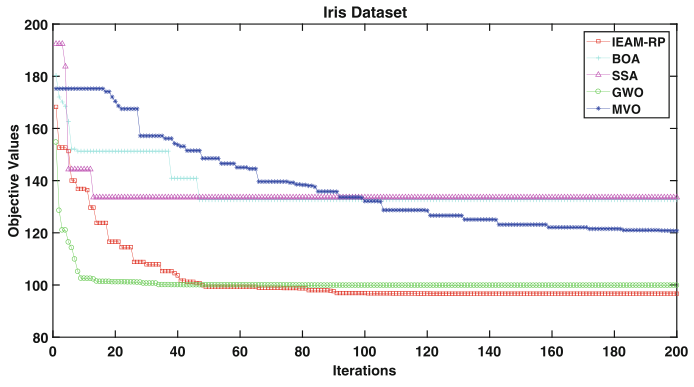 Experimental evidence shows the rapid descent of the IEAM-RP error curve (Pathbased and Spiral datasets).
Critical Insight & Future Outlook
The success of IEAM-RP lies in its simplicity. By utilizing fewer tuning parameters, it avoids the "over-engineering" trap that many modern bio-inspired algorithms fall into.
Takeaway: If you are dealing with large-scale data and find that K-means is providing inconsistent results, switching to an adaptation-based optimizer like IEAM-RP provides a more "globally aware" searching mechanism that is less likely to settle for mediocre clustering.
Future Work: The authors suggest that this adaptation logic could be applied to Feature Selection (identifying the most relevant data attributes) and Multi-objective Optimization, where one might want to minimize intra-cluster distance while simultaneously maximizing inter-cluster separation.