
RDP: Breaking the Latency Barrier in Opportunistic Cellular Offloading
Data Dissemination Protocols Based on Opportunistic Sharing for Data Offloading in Mobile Social Networks
This paper introduces three data dissemination protocols—RRDP, RDP, and LDP—designed for cellular data offloading within Mobile Social Networks (MSNs). By leveraging opportunistic peer-to-peer sharing via Bluetooth or WiFi Direct, the Random Dissemination Protocol (RDP) achieves the best performance, significantly reducing data access latency compared to traditional methodologies.
TL;DR
To combat the crushing traffic on cellular networks, researchers have turned to Opportunistic Mobile Social Networks (MSNs). This paper presents three protocols aimed at reducing the high latency usually associated with peer-to-peer offloading. The standout winner, Random Dissemination Protocol (RDP), slashes access delays by over 50% on campuses and 30% in vehicular environments by simply embracing the "chaos" of random data fragment selection.
Background: The Cost of Connectivity
As mobile data consumption skyrockets, cellular towers are reaching their limits. Opportunistic offloading—where users share downloaded content (like videos) with nearby peers via Bluetooth or WiFi—is a "free" way to expand capacity. However, the Achilles' heel has always been latency. If you have to wait an hour for a 2-minute clip to propagate through a crowd, you'll just use your 5G data instead.
The Core Insight: Diversity over Order
The authors realize that in a highly mobile environment, contact times are fleeting. If everyone requests data pieces in order (1, 2, 3...), the later pieces become rare "bottlenecks." By using Random Dissemination, nodes request fragments in a non-sequential, stochastic order. This increases the global diversity of fragments, ensuring that whenever two nodes meet, they are highly likely to have something the other needs.
Methodology: Three Contenders
The study compares three distinct logic flows for how a "user node" requests pieces from a "seed node" or "semi-seed node":
- RRDP (Request-Reply): A basic sequential request (1, 2, 3...). High risk of redundant pieces and slow spread of trailing fragments.
- LDP (LRU Dissemination): Uses a priority queue based on Least Recently Used logic. Better than RRDP, but still structured.
- RDP (Random Dissemination): Requests pieces in a random sequence. This turns the mobile network into a high-entropy "gossip" system.
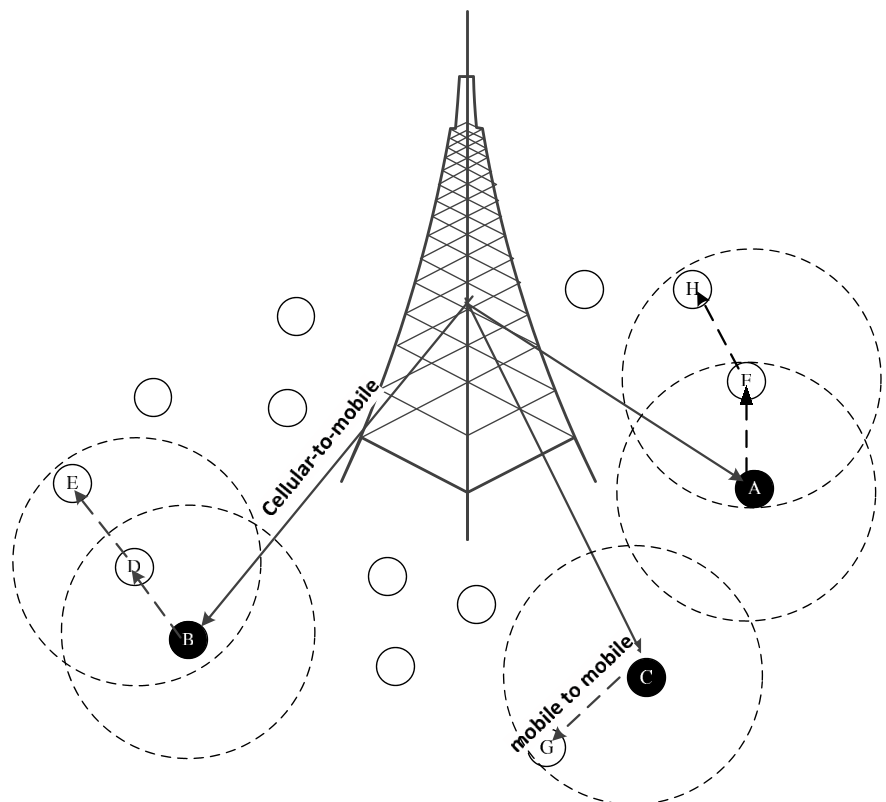 Fig 1. Model of data offloading where seed nodes (A, B, C) serve as the bridge between cellular networks and the opportunistic mesh.
Simulation & Performance
The protocols were tested in two disparate environments: a dense, low-speed Campus (Bluetooth range) and a sparse, high-speed Vehicular environment (UTRA-TDD range).
Key Findings:
- Seed Sensitivity: As the number of initial seed nodes increases, latency drops exponentially across all protocols.
- The Randomness Edge: RDP consistently outperformed the others. In the campus simulation, RDP's latency was significantly lower than RRDP (56.4% reduction).
- Speed vs. Reliability: In vehicular tests, higher speeds increased the frequency of contacts but decreased their duration. RDP proved most resilient to these "short-burst" contacts because it didn't rely on a specific sequence to be useful.
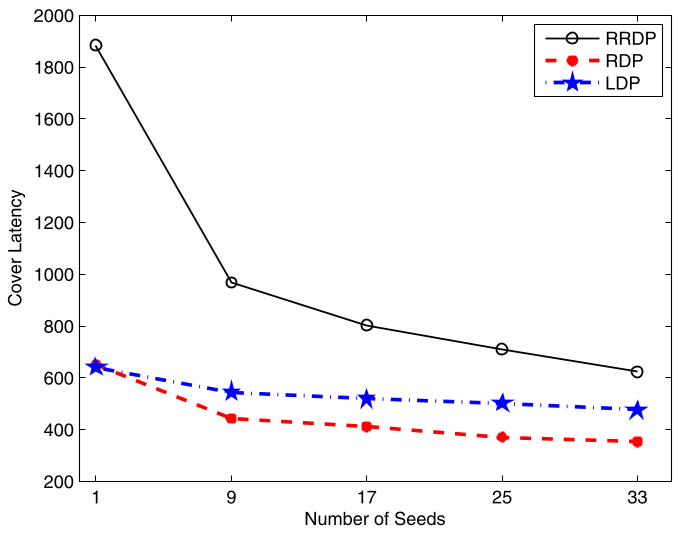 Fig 2. Cover Latency vs. Number of Seeds on Campus. Note how RDP (bottom line) achieves much lower latency as resources become available.
Critical Analysis & Conclusion
The beauty of RDP lies in its simplicity. It requires no complex coordination or heavy metadata—just a commitment to fragment diversity.
Takeaway: When designing protocols for intermittent, high-mobility networks, structured synchronization is the enemy of efficiency. Stochastic methods naturally adapt to the unpredictable nature of human and vehicle movement.
Limitations: While latency is improved, the paper notes that RDP might consume more energy than more "conservative" protocols because it triggers more frequent transmissions. Future work should look at the "Energy-Latency" Pareto front to find the absolute sweet spot for battery-powered mobile devices.
Final Verdict
This work transitions opportunistic offloading from a theoretical "maybe" to a practical "how-to," proving that with the right fragmentation strategy, we can offload significant cellular traffic without making users wait an eternity.