
Minecraft for Infrastructure: Can Gaming Save Our Public Assets through Data Governance?
Coordinating Data-Driven Decision-Making in Public Asset Management Organizations: A Quasi-Experiment for Assessing the Impact of Data Governance on Asset Management Decision Making
This paper proposes a quasi-experimental framework to evaluate the impact of data governance on data-driven decision-making in public asset management (AM). It introduces a simulation approach using "Serious Gaming" (Minecraft) to quantify how specific governance mechanisms improve data quality and maintenance outcomes.
Executive Summary
TL;DR: Researchers from Delft University of Technology have designed a quasi-experiment that uses Minecraft to solve a very "adult" problem: how to stop public infrastructure (roads, bridges, utilities) from failing due to poor data. By simulating asset management in a controlled gaming environment, the study aims to prove that formal Data Governance—coordination, monitoring, and shared standards—directly improves the quality of data and, consequently, the life expectancy of physical assets.
Background Positioning: This work bridges the gap between theoretical data management and practical engineering by treating data infrastructures as Complex Adaptive Systems (CAS). It moves beyond "check-the-box" compliance into measurable performance gains.
The "Data Noise" Problem in Asset Management
Modern public organizations are drowning in data. From IoT sensors on bridges to social media reports of potholes, the volume is staggering. However, as the authors note, "too much data can create 'noise' which detracts from the quality."
The core pain point is uncertainty. If an engineer doesn't trust the accuracy or timeliness of a sensor report, they cannot accurately estimate an asset's remaining service life. Prior work often failed to isolate why data-driven decisions failed—was it a bad sensor (technical) or a lack of accountability (governance)?
Methodology: Gaming the System
The authors propose a Quasi-Experiment using a serious gaming approach. Unlike a standard experiment, a quasi-experiment deals with existing groups rather than random assignments, making it more reflective of real-world organizational dynamics.
The Minecraft Simulation
Participants are tasked with maintaining assets in a Minecraft virtual world. These assets degrade over time. The "Game Master" introduces data artifacts—missing values, delays, or inaccuracies—simulating the messy reality of data infrastructure.
The Four Design Propositions
The study tests four functional elements of data governance:
- Coordination Mechanisms: Who has the right to change data? Who is accountable?
- Data Quality Requirements: Defining exactly what "good" looks like for a specific task.
- Monitoring: Real-time checking of data "health."
- Shared Data Commons: Ensuring everyone sees the same "truth."
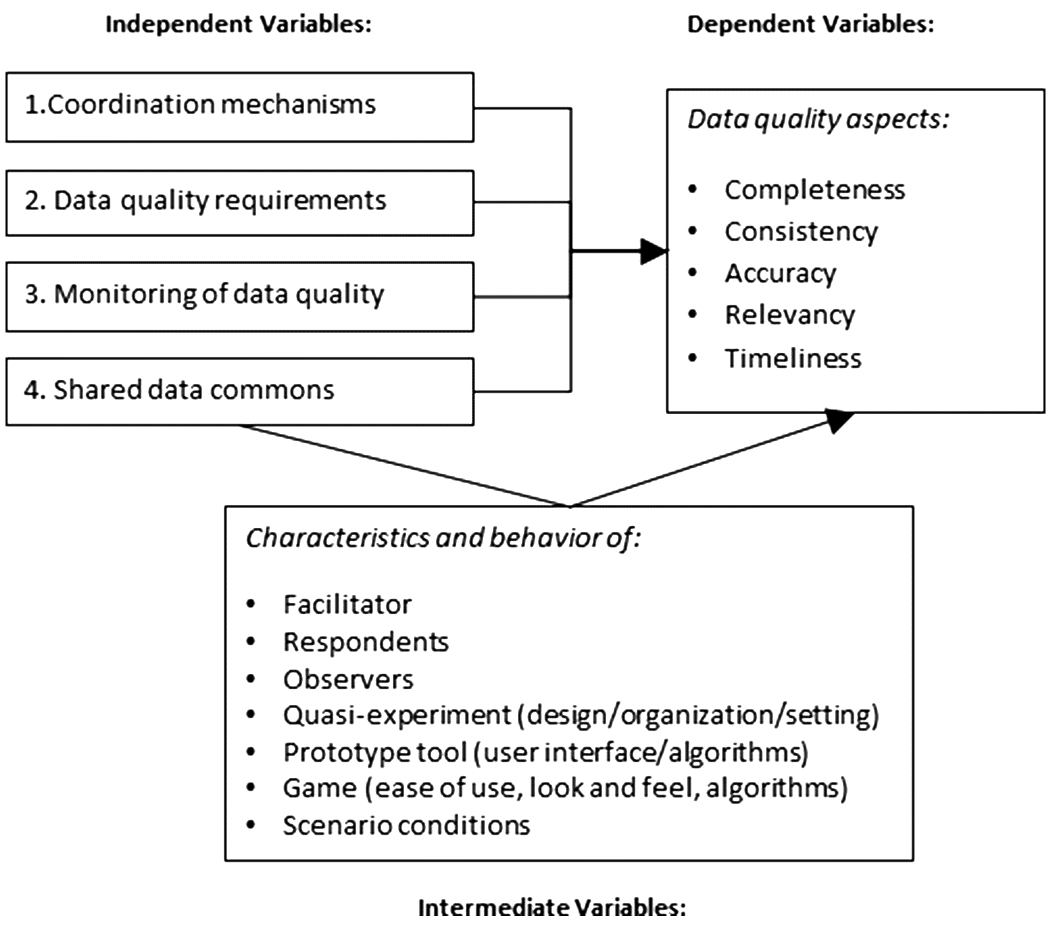 Figure 1: Conceptual framework showing the relationship between Data Governance (Treatment) and Data-Driven Decision Making (Outcome).
Measuring "Fitness-for-Use"
To quantify success, the study focuses on five dimensions of data quality summarized in the table below:
| Data Quality Aspect | Definition |
|---|---|
| Completeness | Sufficient breadth and depth for the task. |
| Consistency | Data presented in the same format. |
| Accuracy | Correctness and reliability. |
| Relevancy | Applicability to the specific maintenance task. |
| Timeliness | How up-to-date the data is. |
 Figure 2: The research workflow, from pre-test surveys to the gaming execution and post-test analysis.
Critical Insight: Data Infrastructure as a CAS
The authors' most profound insight is viewing data infrastructure as a Complex Adaptive System (CAS). In this view, data isn't just "rows and columns"; it's a living environment where "Agents" (people) interact with "Building Blocks" (technology) under a "Schema" (governance rules). By changing the "rules" (governance), you change the "emergent behavior" of the entire system.
Conclusion & Future Outlook
While the study acknowledges limitations (such as internal validity and the 50-minute time cap), its value lies in the quantification of governance. For public organizations, this research provides a roadmap to move from "owning data" to "governing data."
Future Outlook: If this model succeeds, we can expect public agencies to use digital twins and sandbox games not just for training, but as "stress tests" for new policies before they are enacted in millions of dollars' worth of infrastructure.