
DDARACE: Enhancing Emotion Recognition via Data-Driven Rough Set Theory
A Data Driven Emotion Recognition Method Based on Rough Set Theory
This paper introduces DDARACE, a novel emotion recognition framework that combines Rough Set Theory with Support Vector Machines (SVM). By utilizing a tolerance relation based on data-driven threshold selection, the method achieves significant feature reduction while maintaining competitive recognition accuracy across facial expression datasets.
TL;DR
Recognizing human emotions through technology—Affective Computing—is a cornerstone of next-gen AI. While Support Vector Machines (SVMs) and Neural Networks are common, they often struggle with noisy, continuous facial feature data. This paper presents DDARACE, a method that uses Rough Set Theory and Tolerance Relations to automatically select the best facial features. By "letting the data speak" to find the optimal threshold for similarity, the authors reduce feature count by over 60% while improving or maintaining high recognition rates.
The Discretization Dilemma
In the world of Rough Sets (a mathematical tool for dealing with vagueness), we usually group data into "equivalence classes." For example, if two people have the exact same eyebrow height, they are indiscernible.
However, facial features are continuous. Traditional methods force this data into discrete "bins" (e.g., Categorizing an eye-opening width of 10.2mm and 10.5mm into different boxes). This discretization causes:
- Information Loss: Subtile nuances in expression are flattened.
- Rigidity: If the measurement error is 0.1mm, a fixed boundary might treat 10.49 and 10.51 as completely different states.
The Innovation: Data-Driven Tolerance
Instead of rigid "equality," the authors use a Tolerance Relation. Two features are considered "related" if the distance between them is less than a threshold .
1. Finding Without the Experts
The genius of this paper lies in . Usually, you need a human expert to say "0.5mm is a reasonable error margin." The authors argue that since knowledge preservation is key, should be the largest possible value that still results in zero conditional entropy (). This ensures the model generalizes well without losing the ability to distinguish between different emotions.
2. The DDARACE Algorithm
Once the optimal tolerance is found, the DDARACE (Data Driven Attribute Reduction based on Conditional Entropy) algorithm kicks in. It ranks features by their contribution to "knowledge" and prunes those that don't help in identifying the emotion.
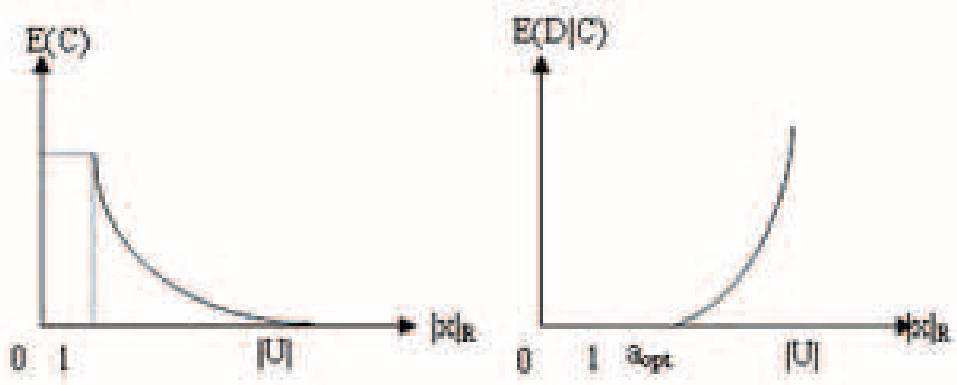 Figure 1: The relationship between entropy and knowledge granularity—finding the sweet spot for .
Experimental Validation
The authors tested their approach on the CMU dataset and a custom volunteer dataset, comparing:
- DDARACE + SVM (Proposed)
- CEBARKNC + SVM (Traditional Rough Set Baseline)
- Pure SVM (Standard approach using all 33 features)
Key Results
On the volunteer dataset, the proposed method didn't just match the competition—it crushed it in efficiency:
| Method | Accuracy | Feature Count |
|---|---|---|
| DDARACE+SVM | 83.59% | 14 |
| CEBARKNC+SVM | 78.83% | 13.5 |
| Standard SVM | 90.80% | 33 |
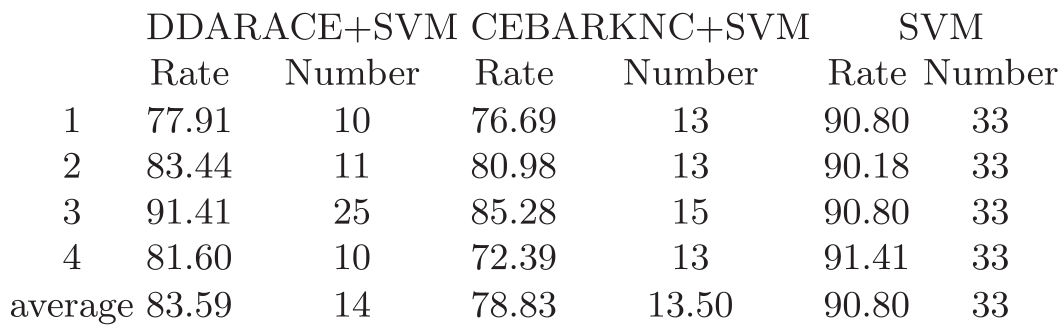 Table 2: Comparison of recognition rates and feature numbers on Volunter Data.
Insight: While the standard SVM (using all 33 features) has the highest raw accuracy (90.80%), it requires nearly 3x the features. For a real-time system running on a mobile device or a robot, the DDARACE approach provides the best balance of speed and intelligence.
Critical Analysis & Conclusion
The beauty of this research is its robustness. By removing the need for expert-tuned thresholds, the system suggests a path toward truly autonomous affective computing systems that can calibrate themselves to the specific noise levels of their sensors.
Takeaway: Complexity isn't always better. By mathematically pruning unnecessary "noise" features through Rough Set Theory, we can build emotion recognition systems that are faster and more reliable in real-world, imprecise environments.
Future Outlook: While this paper focuses on facial features, the logic of "Data-Driven Tolerance" could easily be extended to multi-modal data—combining voice, heart rate, and facial metrics into a single, highly efficient unified reduction framework.