
Stalking Wall Street: Quantifying the Link Between Anonymity and Mobility on WeChat
Data-Driven Privacy Analytics: A WeChat Case Study in Location-Based Social Networks
This paper presents a data-driven privacy analysis of WeChat's "People Nearby" feature, introducing an automated framework to stalk users globally. By combining GPS spoofing, mobile emulation, and OCR, the authors quantify the correlation between user anonymity and mobility patterns based on a 7-day study in New York's Wall Street.
TL;DR
Researchers have demonstrated a scalable, automated method to track WeChat users anywhere in the world—specifically targeting Wall Street—by exploiting the "People Nearby" feature. The study reveals a fascinating behavioral insight: users who hide behind pseudonyms are significantly more active and mobile in the physical world than those using their real names.
The Illusion of Proximity Privacy
WeChat’s "People Nearby" service is designed with a layer of obfuscation. It doesn't give you a GPS coordinate; it gives you a distance band (e.g., "within 100 yards"). Prevailing wisdom suggests this blurring protects the user. However, this paper argues that for an adversary with a bit of automation, this defense is paper-thin.
The authors identify a core Privacy Paradox: LBSNs like WeChat do not enforce real-name policies for nearby discovery. While this encourages users to explore and interact, it creates a goldmine for "broad-net" surveillance. If a user queries the service repeatedly while moving, they leave a digital breadcrumb trail that can be harvested by virtual probes.
Methodology: The Automated Stalker's Toolkit
Instead of complex protocol reverse-engineering, the researchers used "off-the-shelf" technology to bypass WeChat's security measures.
The Stack:
- BlueStacks: An Android emulator to run WeChat on a desktop.
- Fake GPS: To place "virtual probes" at specific coordinates (Wall Street).
- Sikuli: A GUI automation tool that "clicks" and "scrolls" the app like a human.
- ABBYY FineReader (OCR): To convert screenshots of the user list into structured data (Username, Distance, Timestamp).
 Figure 1: The automated data collection architecture.
Measuring Anonymity
Using a majority-vote system among human labelers, the researchers categorized 3,215 users into four buckets based on their display names:
- Identifiable: Full real names (e.g., "John Doe").
- Partially Anonymous: Only first or last names.
- Anonymous: Pseudonyms or random characters.
- Unclassifiable: Ambiguous strings.
Key Findings: The "Anonymous" are More Active
The experiment monitored Wall Street for 7 days, capturing over 41,000 entries. The data yielded two major insights:
1. The Prevalence of Pseudonyms
Nearly 40% of users were fully anonymous, and over 77% were at least partially anonymous. This indicates that the ability to remain "nameless" is a primary driver for using the People Nearby feature.
2. Anonymity Fuels Mobility
The most striking result was the correlation between identity and behavior. Anonymous users were found to be more dynamic. They queried the service more often and moved through public spaces more frequently. In contrast, "Identifiable" users (using real names) tended to be more static and cautious in their usage.
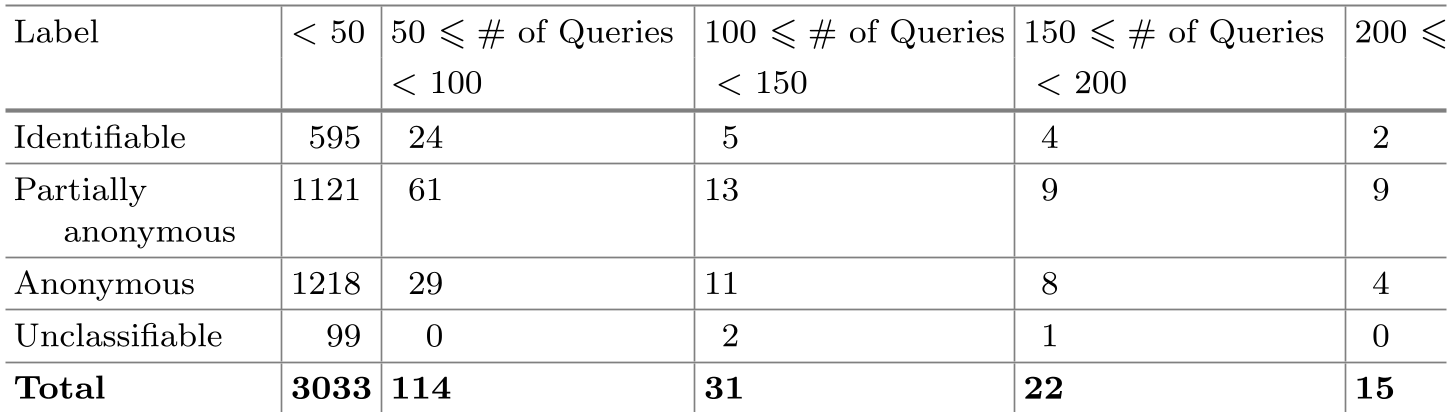 Table 1: Correlation between user labels and query frequency.
Critical Insight & Limitations
This work carries a heavy implication for LBSN design: Anonymity provides a false sense of security. While users feel safer moving and interacting when their real name is hidden, the system stability of their pseudonym allows them to be tracked just as easily as a real name would.
Limitations:
- Target Specificity: The study assumes that a unique username equals a unique person.
- Opt-in Requirement: Users who never open the "People Nearby" tab are completely safe from this specific attack.
- OCR Errors: Despite pre-processing, character recognition isn't 100% accurate, though the authors used manual verification to mitigate this.
Conclusion
As social networks increasingly blend digital interaction with physical location, the risks of automated "stalking" grow exponentially. This paper proves that even without elite hacking skills, a motivated actor can map the mobility of thousands of users. For developers, the message is clear: simple distance blurring is not enough; we need to rethink how metadata and pseudonyms are exposed in real-time discovery services.