
OSNRS: Revolutionizing Social Media Mining with Multi-Agent Systems and APIs
Data Extraction from Online Social Networks Using Application Programming Interface in a Multi Agent System Approach
The paper introduces an enhanced Online Social Network Retrieval System (OSNRS) that utilizes a Multi-Agent System (MAS) and Application Programming Interfaces (APIs) to automate data extraction from social media. It transitions from traditional web-parsing to API-based retrieval, specifically targeting Facebook, to achieve real-time monitoring of user profile changes.
TL;DR
Researchers have developed an enhanced Online Social Network Retrieval System (OSNRS) that moves away from brittle web scraping toward a decentralized, Multi-Agent System (MAS) powered by official APIs. By deploying autonomous agents that "live" in dedicated containers, the system can monitor real-time updates on social profiles (like Facebook) with greater speed, reliability, and structural integrity than traditional parsers.
The Fragility of the "Web Parser" Era
In the early days of social media mining, researchers relied on web scrapers (parsers) to extract data. These tools acted like rigid templates: if a social network moved a "Like" button or changed a <div> tag in their HTML, the parser would break.
The authors identified three critical pain points in prior work:
- Structural Sensitivity: HTML is designed for display, not data exchange. Small UI updates ruin automated crawlers.
- Centralization Bottlenecks: Single-threaded crawlers cannot handle the massive, real-time updates of modern OSNs.
- Static Snapshots: Most tools capture a profile once, failing to track the evolution of a user's digital footprint over time.
Methodology: The MAS Architecture
To solve this, the authors designed a decentralized system using the JADE (Java Agent DEvelopment) framework. The heart of the system lies in the interaction between different agent roles.
1. The MasterAgent (mAg)
The "brain" of the operation. It manages a queue of profile URLs, allocates tasks to subordinates, and handles the historical data repository. It ensures that no profile is visited twice across the platform.
2. The GrabberAgent (gAg)
The "worker bees." These agents are assigned to specific profiles. Their novelty lies in their autonomy: they can decide when to "wake up" and check for updates. If a profile is highly active, the gAg reactivates more frequently; if dormant, it sleeps longer.
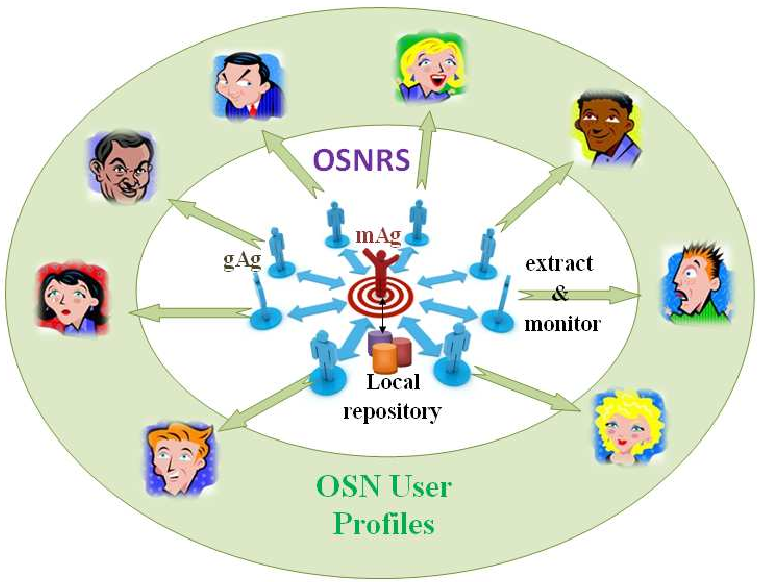 Figure: The structural model of OSNRS showing the hierarchy between the MasterAgent and GrabberAgents.
3. API Integration over Scraping
Instead of reading HTML, agents communicate via Facebook's Graph API. By using JSON (JavaScript Object Notation), which the paper proves is faster and more resource-efficient than XML (see Table 1 in the paper), the system maintains a secure and stable connection even if the website's visual design changes.
Experimental Insights: Case Study Analysis
The researchers tested three scenarios to find the most efficient way to crawl a network.
- Case Study 1: One agent monitors an entire list of friends.
- Case Study 2: A unique agent is assigned to each friend in the list (Parallelism).
Results: Parallelism Wins
The experiments on a "Mock Network" (from the Artemis project) showed that Case Study 2 (one agent per profile) was vastly superior for large accounts. For a profile with 16 friends, the parallel agent approach was 33% faster than the single-agent approach.
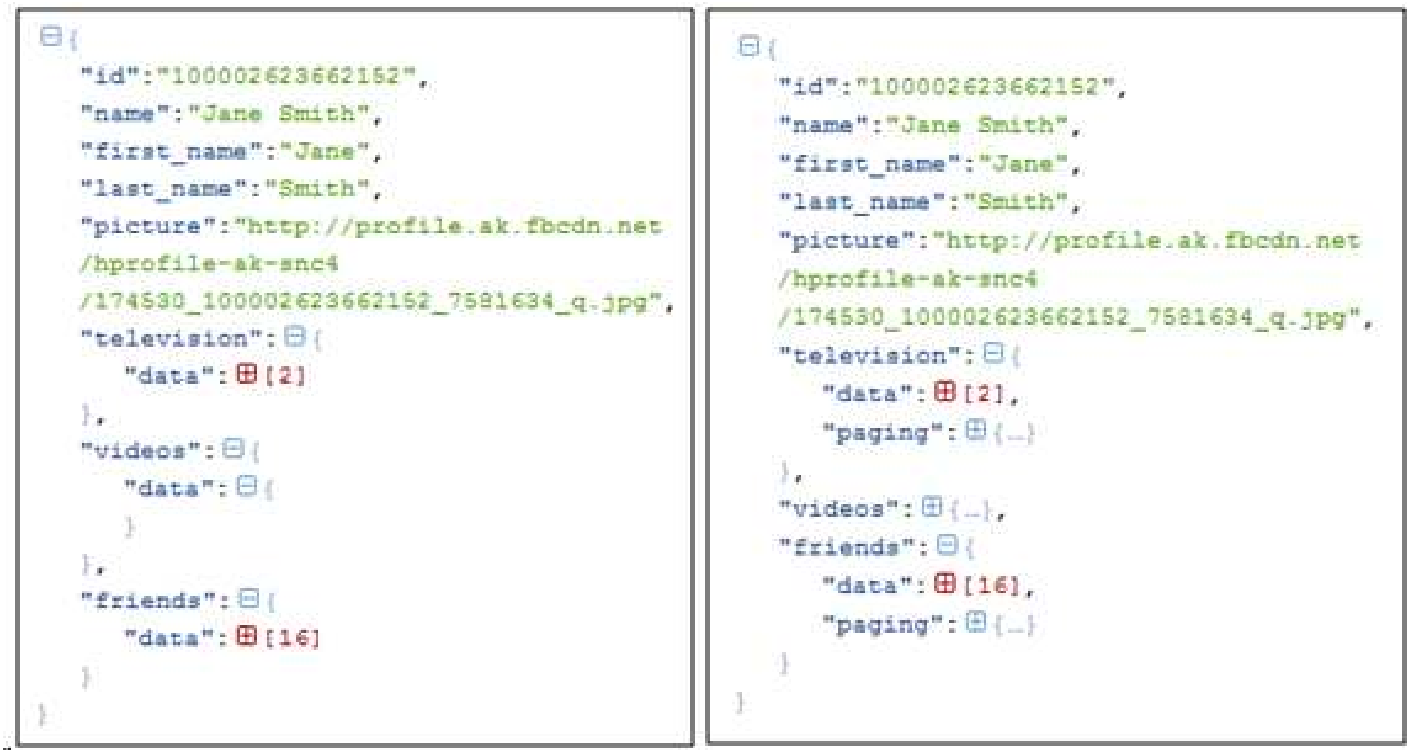 Figure: Comparison of processing time between Case Study 1 (centralized) and Case Study 2 (distributed).
Critical Analysis & Conclusion
While OSNRS represents a significant leap in Inductive Bias for web crawling (favoring decentralization), it faces modern challenges:
- The "walled garden" problem: APIs are more stable than HTML, but they are controlled by corporations. The paper notes that Facebook limits "Friends of Friends" access, a hurdle even for MAS.
- Token Expiry: Monitoring is limited by the life of the API access token, requiring "offline permission" strategies for truly continuous historical tracking.
Takeaway: The transition from centralized "scrapers" to decentralized "agents" is essential for modern data science. By treating each social profile as a dynamic entity monitored by its own autonomous agent, we move closer to understanding the true "pulse" of digital social behavior.
Future Outlook
The authors suggest that future versions will integrate Text Mining more deeply, allowing agents to not just collect data, but to understand sentiment and detect vulnerability (e.g., social engineering risks) in real-time.