
Deciphering Rumors: A Graph-Theoretic Cure for Data Incest in Social Networks
Data fusion and mis-information removal in social networks
This paper introduces a graph-theoretic framework for state estimation in social networks, specifically targeting the "data incest" or misinformation propagation problem. By modeling information flow as a Directed Acyclic Graph (DAG), the authors propose an optimal Bayesian fusion algorithm that reconstructs sufficient statistics to eliminate the redundant re-use of data.
TL;DR
In a world of echoes, how do we find the truth? This paper tackles the "Mis-information Propagation" problem—where agents in a network accidentally double-count information, leading to biased and overconfident estimates. By viewing a social network as a Directed Acyclic Graph (DAG), the authors provide a mathematical "undo" button that strips away redundant data to achieve optimal estimation.
Academic Positioning: This work bridges Bayesian Decentralized Estimation and Graph Theory, providing an exact solution for arbitrary topologies that satisfy specific structural constraints, moving beyond the sub-optimal "Covariance Intersection" methods of the past.
The "Data Incest" Motivation
Imagine Group A tells Group B a restaurant is good. Later, Group B tells Group C, and finally, Group C tells Group A. If Group A treats this as new evidence, they have essentially interviewed themselves through a proxy. In technical terms, this is Data Incest.
The core difficulty lies in delays. Because individuals take different amounts of time to form and communicate beliefs, the "information ancestry" becomes tangled. Naive Bayesian updates assume independence, which is violated the moment a message loops back to its progenitor.
Methodology: The Geometry of Information Flow
The authors map the social network into a Type-Based Representative Graph. Each node represents a specific group type at a specific time .
1. The Power of Transitive Closure
The breakthrough is using the Transitive Closure Matrix (). While an Adjacency Matrix () only shows who talks to whom directly, the Transitive Closure Matrix shows the entire lineage of a belief. If , then node has influenced node .
2. The Weighting Mechanism
The authors propose that the optimal estimate can be reconstructed as:
The weight vector is the "secret sauce." It is calculated using the inverse of the Transitive Closure Matrix of the previous state: Essentially, this weight vector targets only the "new" information and mathematically subtracts the overlapping historical data.
 The figure above illustrates the abstract information exchange protocol compared to the raw-measurement benchmark.
Experimental Validation
The paper tests this on a 5-group network with random delays.
- Naive Approach: The estimates quickly become overconfident and deviate from the true state because they treat every incoming message as fresh data.
- Proposed Algorithm: Tracks the "Full Information" benchmark perfectly, proving that even with constrained communication (only sharing beliefs, not raw data), we can reach the same accuracy as if everyone shared everything.
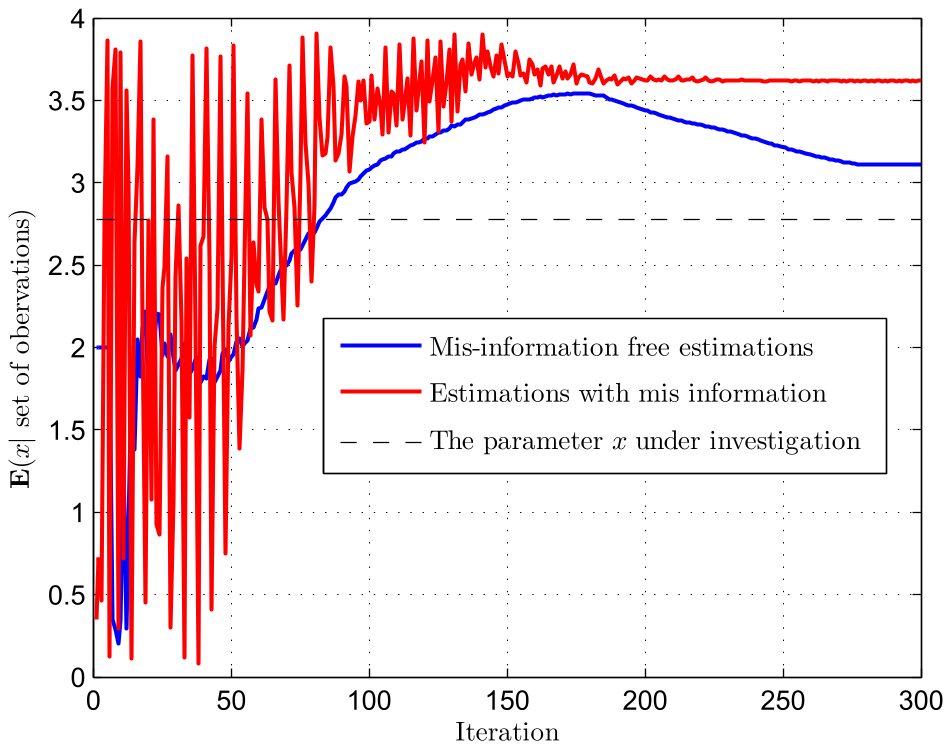 Fig 1: The divergence of naive estimation (Red) vs the ground truth and the optimal benchmark (Blue).
Critical Analysis & Conclusion
Takeaways
The elegance of this work is its derivation of Property 1: a necessary and sufficient condition on the adjacency matrix. If a network satisfies this, misinformation can be completely removed. It shifts the problem from "how to fuse data" to "how to track graph paths."
Limitations
The "Optimal" algorithm requires agents to know the graph topology (). In real-world social networks, we rarely know the exact routing of a rumor. While the authors propose a sub-optimal version based on "Expected Adjacency," the performance in highly volatile or adversarial networks remains an open question.
Future Outlook
This framework is ripe for application in Multi-Agent Reinforcement Learning (MARL) and Distributed Robotics, where avoiding "echo chambers" is critical for collective decision-making.