
The New Blue-Collar Frontier: How Data Labeling Reshapes Developing Economies
Data Labeling for the Artificial Intelligence Industry: Economic Impacts in Developing Countries
This paper examines the rise of the multi-billion dollar data labeling industry in developing countries, characterizing it as a "new type of blue-collar industry" essential for supervised machine learning. It explores how countries like China and India are leveraging low-cost labor to fulfill the massive data annotation demands of the global AI market.
TL;DR
Behind every prestigious AI model lies a massive, invisible workforce. This paper highlights the shift of low-skill AI labor—specifically data labeling—to developing nations. As manufacturing jobs decline due to automation and rising costs, "data tagging" has emerged as the new assembly line, providing millions of jobs in rural China and India while raising urgent questions about ethical labor practices and "impact-washing."
The Hidden Engine of AI: Why Human Labor Still Rules
We often think of Artificial Intelligence as a triumph of mathematics and silicon. However, the author, Nir Kshetri, points out a sobering reality: supervised learning is extremely thirsty for human time.
The productivity gap is staggering:
- The 80% Rule: Data labeling activities account for up to 80% of the time needed to build a functional AI system.
- The Video Tax: One hour of video for autonomous driving can require up to 800 man-hours of labeling.
This labor intensity has created a global mismatch. While AI research happens in "wealthy hubs" like Silicon Valley or Shenzhen, the actual "training" of these algorithms is outsourced to regions where labor is abundant and inexpensive.
From Foxconn to Data Farms: The Shift in China
One of the most compelling insights in the paper is the transformation of China’s "backward" provinces. As Foxconn replaces 400,000 workers with robots and manufacturing costs in Chinese hubs approach U.S. levels, the workforce is pivoting.
In North China's Shanxi and Henan provinces, the "factory worker" of yesterday is the "data labeler" of today. This isn't just a change of scenery; it's a change in job requirements. Unlike call-center outsourcing, which required English fluency, data labeling requires only digital literacy. If you can identify a car in a photo or a pedestrian in a video, you can fuel the global AI industry.
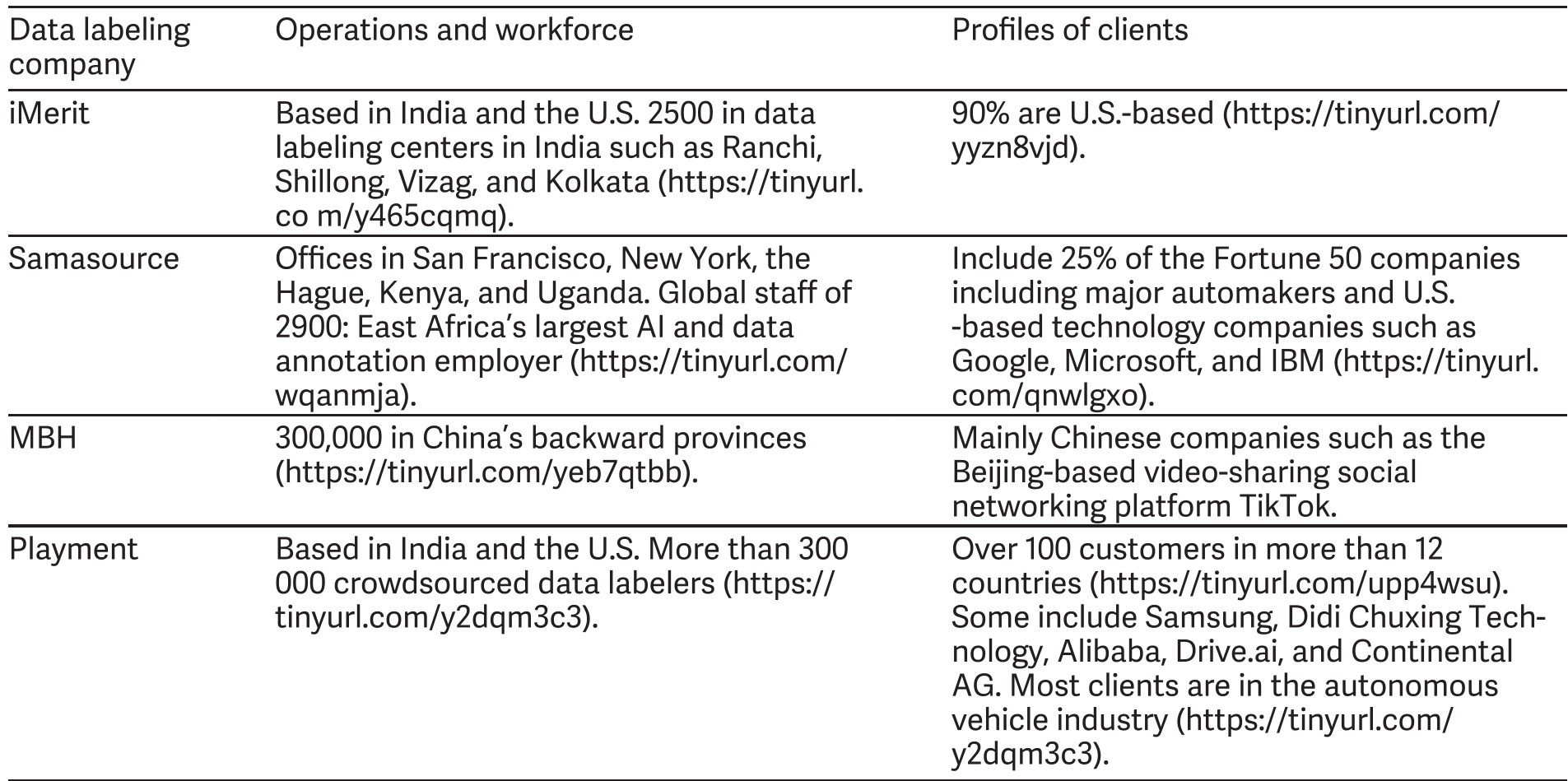 Figure 1: Comparison of major global data labeling firms and their workforce distribution.
Methodology: The Low Entry Barrier
The author identifies why this industry is booming specifically in developing countries:
- Low Skill Ceiling: Most training takes only a week (often via video call).
- Cultural Agnosticism: Labeling a "stop sign" or a "cancer cell" doesn't require specific Western cultural contexts, making it a "perfect" commodity.
- Generational Shifts: Chinese millennials are increasingly shunning "tedious" factory work for digital tasks that feel more aligned with the modern age, even if the work remains repetitive.
The Ethical Grey Zone: Impact Sourcing or Digital Slavery?
The paper doesn't shy away from the darker side of this economic boom. While firms like Samasource and iMerit claim "impact sourcing" (hiring from marginalized communities to reduce poverty), the author warns of impact-washing.
- Lack of Regulation: There are virtually no global standards or enforceable laws governing the working conditions of labelers.
- The GISC Loophole: While organizations like the Global Impact Sourcing Coalition (GISC) exist, members face no real penalties for failing social impact audits.
- The B2B Shield: Unlike "Fair Trade" coffee, which consumers can choose on a shelf, data labeling is a B2B (business-to-business) service. This means there is very little public pressure on tech giants to ensure their "data supply chain" is ethical.
Critical Insight: The "Bottomless" Resource
The paper concludes that developing countries provide a "seemingly bottomless" resource for the AI industry. However, this raises a critical question for the future: As AI becomes better at labeling its own data (Self-Supervised Learning), will these new blue-collar jobs vanish as quickly as the manufacturing jobs did?
For now, the economic lifeline provided by data labeling is undeniable for regions like Henan or rural India, but the stability and ethics of this "digital assembly line" remain on shaky ground.
Final Takeaway
Data labeling is the "blue-collar" engine of the 21st century. It has lowered the entry barrier for developing nations to participate in the AI revolution, but without transparency and standardized ethical metrics, we risk building the future of intelligence on a foundation of digital exploitation.