
Smart Forensic Finance: Hybrid Data Mining for Anti-Money Laundering
Application of Data Mining for Anti-money Laundering Detection: A Case Study
This paper presents a hybrid knowledge-based solution for Anti-Money Laundering (AML) in investment banking, combining K-means clustering, Multi-Layer Perceptron (MLP) neural networks, and Genetic Algorithms (GA). The method effectively identifies suspicious transaction patterns across massive datasets, achieving a significant reduction in investigation time compared to manual processes.
TL;DR
Money laundering has evolved from simple cash deposits to sophisticated investment schemes. This paper introduces a specialized AML framework for investment banking that replaces rigid statistical thresholds with a "Knowledge-Based" pipeline. By combining K-means, Genetic Algorithms (GA), and Neural Networks, the authors successfully automated the detection of complex laundering patterns in real-world corporate data, turning a 30-day manual investigation into a near-instantaneous process.
The "Investment World" vs. The "Cash World"
Most commercial AML solutions are built for retail banking—checking if a withdrawal exceeds a standard deviation. However, in investment banking, massive shifts in capital are normal due to market volatility.
The authors argue that a "naïve extension" of retail methods fails because:
- Complexity: Investment behaviors are influenced by fund types (pension vs. short-term), currency exchange, and market climate.
- High Dimensionality: Data spans customers, accounts, geography, and time.
- Class Imbalance: Legitimate transactions outnumber criminal ones by a factor of thousands, making it hard for traditional models to "learn" what a crime looks like.
Methodology: The Three-Pillar Defense
The core of the paper lies in its structured analytical pipeline, designed to handle the specific "physics" of investment transactions.
1. Feature Engineering (The Δ Parameters)
Instead of raw dollar amounts, the authors define six ratios. The most critical, Δ1, measures the proportion between redemption (taking money out) and subscription (putting money in) over a sliding time window (k-weeks). Δ2 compares redemption to the total share value. These parameters capture the "velocity" and "exhaustion" of funds, which are classic laundering red flags.
2. Hybrid Model Architecture
The workflow follows a logical progression from unsupervised to supervised learning:
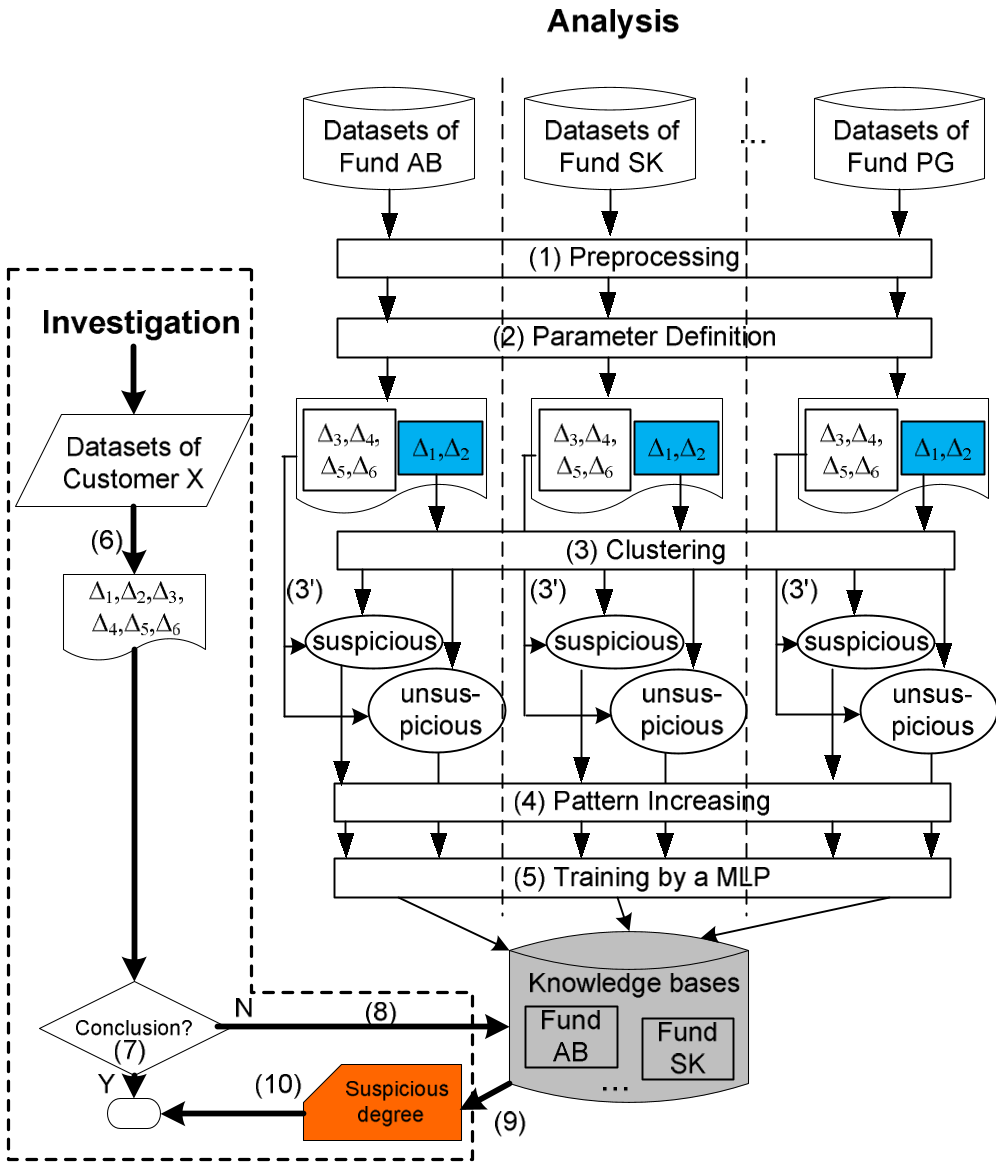
- Clustering (Unsupervised): A modified K-means uses expert heuristics to identify outliers in the main parameters (Δ1, Δ2).
- Genetic Algorithms (Synthetic Augmentation): Because true "suspicious" cases are rare, GA is used to evolve existing suspicious patterns into new, synthetic training data, ensuring the neural network has enough examples to learn.
- Neural Network (Supervised): A 3-layer MLP takes all 6 parameters and outputs a "Suspicious Degree" (0 to 1).
Experimental Results: Real-World Impact
The system was tested on 10 million records from six different funds at "CE Bank."
Visualizing Suspicion
The clustering results (shown below) demonstrate how the system separates "quiet" funds (like Fund AB, a pension fund) from "active" funds with outliers (like Fund SK).
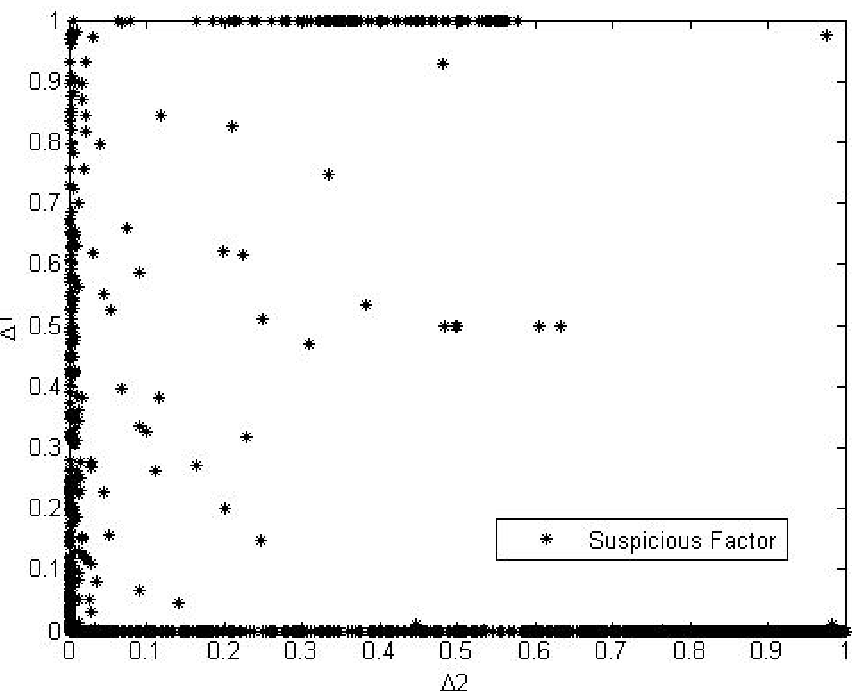 (a) Fund AB shows no outliers; (b) Fund PG shows distinct clusters of high-ratio transactions.
Key Performance Metrics:
- Efficiency: The clustering of 67,000 corporate records (the largest fund) took only 3.15 seconds.
- Precision: In one case study, a customer redeeming 97% of their subscription value (amounting to 80% of total shares) triggered a suspicious degree of 0.99.
- Human-AI Synergy: After the AI flagged potential threats, a refinement process by human experts identified 5 high-risk cases that matched the bank's manual 30-day report.
Critical Analysis & Takeaways
The brilliance of this work is not in the "newness" of the algorithms (MLPs and K-means are standard), but in the domain-specific orchestration.
- Why it works: By using GA to inflate the minority class (suspicious cases), the authors bypassed the biggest hurdle in financial AI: the lack of labeled "criminal" data.
- The Limitation: The "Refinement Process" still requires humans to filter out "exchange transactions" (moving money between sub-funds). Future iterations could automate this by incorporating relational/graph data.
- Future Outlook: As investment platforms move toward real-time trading, these light-weight ML models are better suited for "streaming" AML than the heavy, rule-based legacy systems used today.