
Empowering Linguistics with Data Mining: The Heuristic Path to Educational Optimization
Application of Data Mining in English Linguistics Teaching and Appraisal System
This paper introduces a Heuristic Attribute Reduction Algorithm based on Rough Set theory to optimize English Linguistics teaching design and discourse appraisal systems. By identifying core attributes like "language application" and "appreciation resources," the method simplifies complex educational datasets and enhances the accuracy of linguistic pattern discovery.
TL;DR
This research bridges the gap between mathematical data mining and English linguistics. By applying a Heuristic Reduction Algorithm based on Rough Set Theory, the authors successfully identified the "core" drivers of effective teaching and discourse appraisal, drastically reducing data complexity while maintaining high analytical validity.
The "Noise" Problem in Linguistics
In the realm of English Linguistics, educators are often overwhelmed by a sea of uncertain variables. When evaluating teaching effectiveness or analyzing discourse "appraisal resources" (emotions, judgments, and appreciations), traditional statistics often fail because the data is "incompatible"—meaning similar inputs can lead to different pedagogical outcomes.
The authors argue that we need a way to strip away the redundant "noise" to find the Attribute Core.
Methodology: Rough Sets and Heuristic Reduction
The core innovation lies in the use of Rough Set Theory, a mathematical tool designed for imprecise and uncertain knowledge. Unlike traditional sets, Rough Sets allow for the processing of redundant information through Attribute Reduction.
The Algorithm Workflow:
- Extract the Core: Identify attributes that, if removed, would change the fundamental classification of the data.
- Calculate Dependency: Measure how much a decision attribute (like "Teaching Success") depends on condition attributes (like "Rich Reading").
- Heuristic Selection: Iteratively add attributes with the highest "importance" until the system's dependency threshold is met.
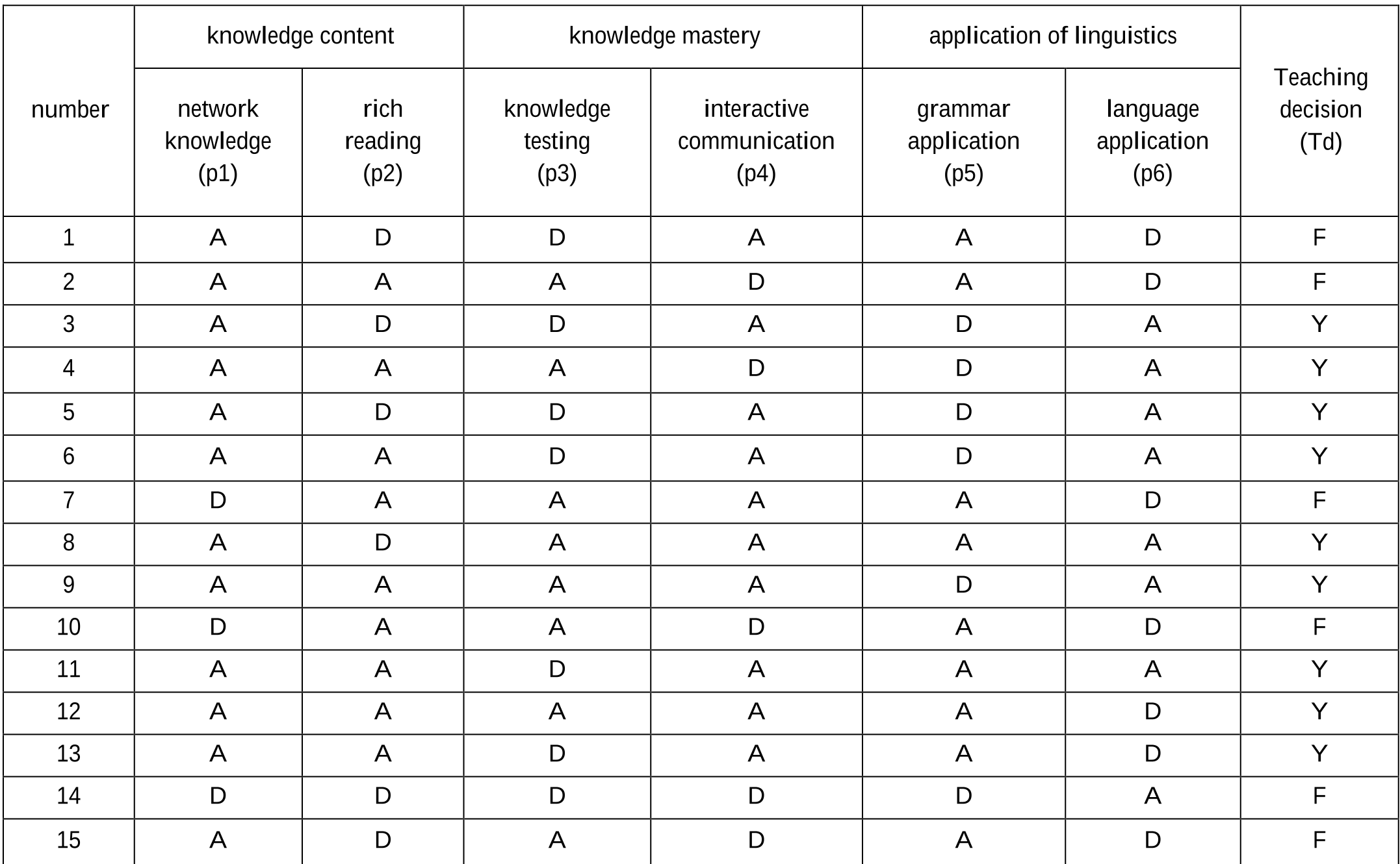 Table 1: The Decision Table used to analyze teaching methods, showcasing attributes like Network Knowledge (p1) through Language Application (p6).
Key Insights from Experimental Results
1. Optimizing Teaching Design
By analyzing six main teaching attributes, the algorithm pinpointed Language Application (p6) as the most critical factor for success. The reduction set concluded that the "expansion of network knowledge," "interactive communication," and "language application" form the essential triad for modern linguistics curriculum optimization.
2. Decoding Appraisal Resources
When analyzing English texts through the lens of Systemic Functional Linguistics, the study focused on the Appraisal System (Attitude, Engagement, and Graduation).
- The Findings: Appreciation resources (focusing on the object/text) dominate at 69.26%, followed by Judgment (22.26%).
- Efficiency Gain: Using the heuristic algorithm, the authors proved that "Emotion" attributes could be discarded (importance = 0) without losing the ability to track the discourse's intent, simplifying the analysis from three variables to two.
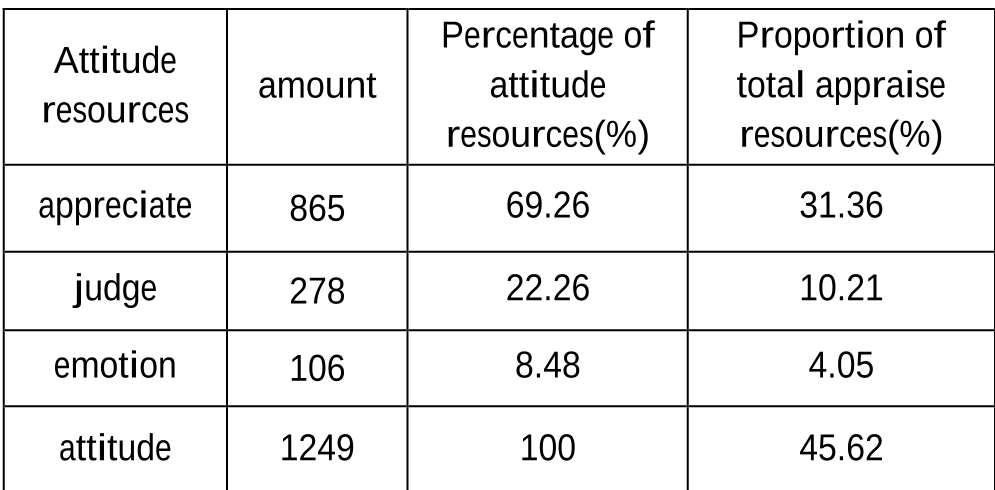 Table 2: Breakdown of Attitude resources showing the dominance of Appreciation and Judgment.
Critical Analysis & Conclusion
This paper demonstrates that even the "soft" science of linguistics can benefit from "hard" mathematical reduction. By identifying the CORE, educators can stop spread-betting their efforts across dozens of teaching metrics and focus on the 2 or 3 that actually move the needle.
Takeaway: The value of this work is not just in the algorithm, but in its application. It provides a blueprint for automated appraisal systems that can read a text and accurately "judge" its stance and attitude with minimal computational overhead.
Limitations: The study relies on relatively small-scale datasets (decision tables with 8-15 entries). Future work should test this heuristic approach on large-scale Big Data repositories to see if the attribute core remains stable across different cultural contexts.