
Beyond Apriori: Leveraging Artificial Immunity for Intelligent Marketing Strategies
Application of Data Mining Based on Artificial Immunity in Marketing
This paper introduces an association rule mining algorithm based on Artificial Immunity (AI) designed for marketing strategy optimization. By mapping sales attributes to "antigens" and association rules to "antibodies," the method leverages immune memory and affinity mechanisms to identify purchase patterns like "printer → computer" from transaction databases.
TL;DR
To survive fierce market competition, enterprises must rapidly extract actionable insights from mountains of sales data. This paper proposes a novel Artificial Immune System (AIS) approach to association rule mining. By treating data patterns as "antigens" and marketing rules as "antibodies," the system achieves high robustness and efficiency, scanning the database only once and avoiding the heavy computational cost of traditional algorithms like Apriori.
The Bottleneck of Traditional Mining
For years, the Apriori algorithm has been the gold standard for finding "who bought A also bought B." However, it has a fatal flaw: it must scan the entire database repeatedly and generate a massive number of candidate itemsets. In a modern retail environment with millions of transactions, this leads to:
- Resource Exhaustion: Extremely high CPU and I/O consumption.
- Noise: A surplus of statistically significant but practically useless rules.
- Rigidity: Lack of self-learning capabilities to adapt to shifting consumer trends.
The "Immune" Insight: Why AIS?
The biological immune system is a master of pattern recognition. It distinguishes between "self" and "non-self" (pathogens) using diversity and memory. The authors translate these biological traits into a computational framework for marketing:
- Antigen: The sales attribute or product a marketer is interested in.
- Antibody: A potential association rule ().
- Affinity: A mathematical measure of how well a rule fits the data, combining Support, Confidence, and Lift.
The Core Mechanism: Affinity Function
The paper introduces a unique affinity formula to ensure only the most "potent" rules survive: (Affinity = Support + Confidence + Lift)
This formula ensures that rules are not just frequent (Support) and accurate (Confidence), but also possess Lift—meaning the presence of product A truly increases the likelihood of product B, rather than them being popular items by pure coincidence.
Methodology: "Random Parallel Search"
The algorithm follows a biologically inspired workflow:
- Antigen Recognition: Define the target attribute.
- Initial Antibody Production: Randomly sample transaction records to form initial rules.
- Immune Memory: Maintain an "Interest-Rule Table." High-affinity antibodies (strong rules) are promoted and stored; low-affinity ones are inhibited (discarded).
- One-Pass Refinement: Unlike Apriori, this algorithm scans the actual database only once at the end to verify the support and confidence of the antibodies stored in the interest-rule table.
 Note: The system optimizes the "Interest-Rule Table" based on the affinity function calculated above.
Experiments: Real-World Retail Application
The authors applied the algorithm to an electronic products shop. By analyzing customer purchase paths, the system identified critical clusters:
- The Synergy Rule:
Printer → Computer(Confidence: 1.0; Affinity: 3.33). - The Consumable Rule:
Duplicator → Ink box(Confidence: 1.0; Affinity: 3.0).
Impact on Marketing Strategy:
- Layout Optimization: Placing ink boxes directly next to duplicators.
- Bundled Bargains: Offering a printer discount specifically when a computer is purchased.
- Cross-Selling: Real-time recommendations by shop assistants based on identified high-affinity rules.
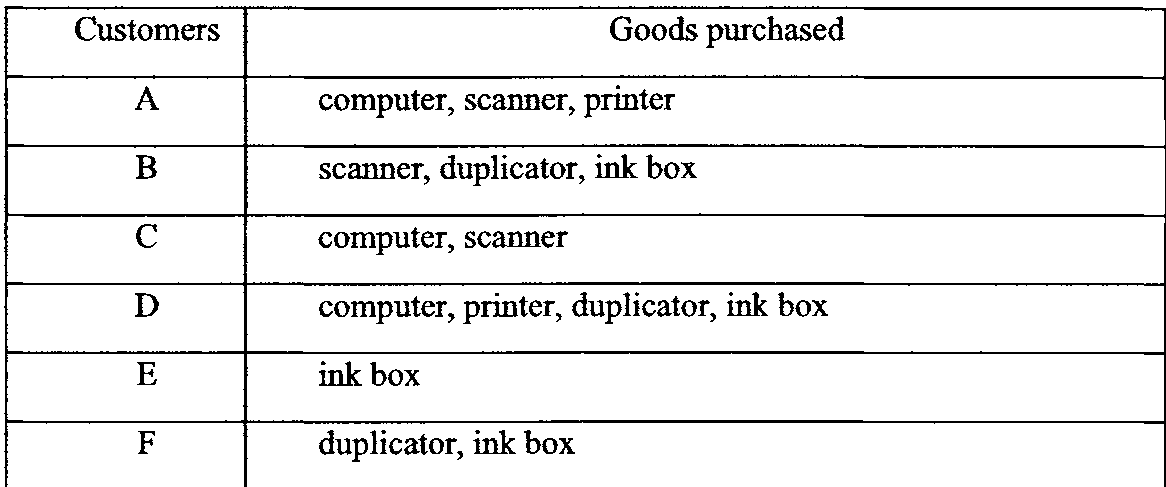 The small-scale test demonstrated how the algorithm filters noise to find targeted rules.
Critical Insight & Conclusion
This paper’s primary contribution is shifting association rule mining from a "brute-force search" to an "evolutionary selection" process. By using an Artificial Immune System, the authors introduced hidden parallelism—the ability to explore multiple rule directions simultaneously without the overhead of exhaustive candidate generation.
Limitations: While the one-pass scan is efficient, the initial antibody generation relies on random sampling ( records). If the sample size is too small, rare but highly profitable rules might be missed.
Future Outlook: Integrating this immune-based mining with deep learning embedding spaces could allow enterprises to discover associations not just between specific products, but between abstract consumer "styles" or "intents."