
Hybrid Data Mining: A Multi-Model Ensemble for Corporate Failure Prediction
A data mining approach to the prediction of corporate failure
This paper introduces a hybrid data mining approach for predicting corporate failure using financial statement data. By integrating statistical methods (Discriminant Analysis, Logistic Regression) with machine learning (Neural Networks, C5.0 Decision Trees), the authors developed a weighted voting ensemble that achieved a SOTA accuracy of up to 89.6% in predicting bankruptcy one year in advance.
TL;DR
Predicting corporate bankruptcy is critical for global financial stability. This paper moves beyond single-algorithm models, proposing a Hybrid Ensemble Classifier that combines Discriminant Analysis, Logistic Regression, Neural Networks, and Decision Trees. By weighting these models based on training performance, the authors achieved an impressive 89.6% prediction accuracy on UK financial data, proving that hybrid strategies significantly outperform traditional isolated methods.
Context & Positioning
In the landscape of credit risk, this work sits at the intersection of Traditional Econometrics and Modern Machine Learning. While earlier SOTA works focused on refining specific ratios (like Altman’s Z-score), this paper treats bankruptcy prediction as a pure data mining challenge, focusing on the SEMMA (Sample, Explore, Modify, Model, Assess) pipeline to optimize prediction robustness.
The Problem: The Limitations of Single Models
Prior work in corporate failure prediction faced two major hurdles:
- Non-linearity: Financial distress often involves complex, non-linear interactions between variables (e.g., liquidity vs. leverage) that linear models like Discriminant Analysis (DA) cannot capture.
- Feature Selection Bias: Researchers typically select ratios based on "human judgment," which might ignore hidden but statistically significant predictors.
Methodology: The Hybrid Architecture
The authors implemented a multi-stage workflow to handle the noise of real-world financial data.
1. Data Cleaning & ANOVA Selection
The study addressed missing values by transforming "N/A" into specific reserved numbers for software compatibility. They then compared two feature selection methods:
- Selection 1 (Expert-led): Choosing ratios like Return on Capital (ROCE), Turnover/Total Assets, Gearing, and Working Capital.
- Selection 2 (ANOVA-driven): Using Analysis of Variance to identify variables with statistically significant differences between failed and non-failed groups.
2. The Multi-Model Hybrid
Instead of picking one "winner," the paper proposes a weighted hybrid formula: The output is determined by a weighted sum of individual classifiers (DA, LG, NN, C5.0), where weights () are proportional to each model's training accuracy.
 Figure 1: The SEMMA methodology framework applied to financial data mining.
Experimental Results
The study utilized financial data from 1,133 UK firms between 1980 and 1999. The findings were decisive:
- ML vs. Stats: Neural Networks (88.1%) and Decision Trees (88.7%) significantly outperformed Logistic Regression (84.6%) and Discriminant Analysis (77.4%).
- Hybrids Win: The Hybrid 1 model (integrating all four base learners) reached 89.6% accuracy, effectively "smoothing out" the errors of individual models.
- Selective Advantage: Interestingly, the study found that ANOVA-based feature selection consistently yielded better results than human judgment, particularly for the machine learning components.
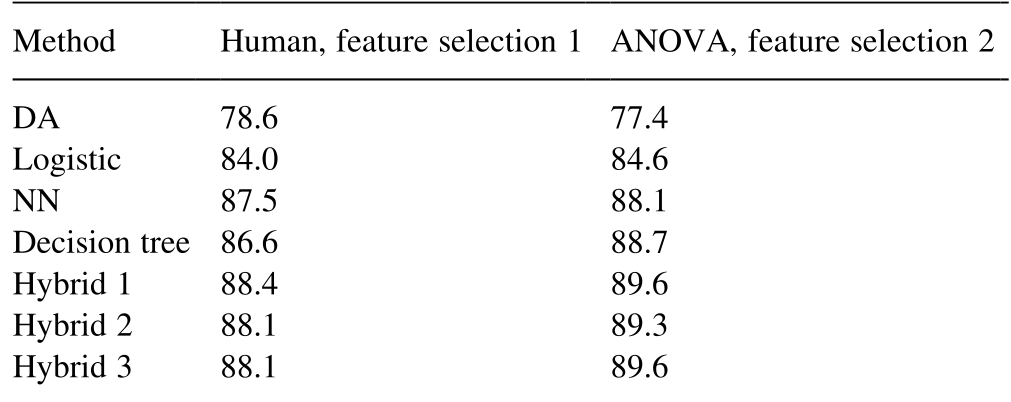 Figure 2: Bankruptcy prediction accuracy across different classifiers and selection methods.
Critical Insight: Why Does It Work?
The success of the hybrid approach lies in its error-correction capability. Machine learning models (NN/C5.0) are prone to overfitting on specific noise patterns, while statistical models (DA/LG) are too rigid. By combining them, the hybrid model leverages the stability of statistics and the flexibility of AI. Furthermore, the shift from human-selected ratios to ANOVA-driven features indicates that "intuition" in finance is often less reliable than automated statistical significance tests.
Conclusion & Future Outlook
This paper provides a robust blueprint for financial institutions to move beyond simple threshold-based risk models. While the 89.6% accuracy is high, the authors acknowledge the "black-box" nature of Neural Networks.
The next logical step for this research lineage would be the integration of Explainable AI (XAI)—explaining why a hybrid model flags a specific firm as a failure—which remains the "holy grail" for financial regulators and auditors.
Takeaway: In complex financial domains, ensembling diverse models with statistical feature selection is the most reliable path to SOTA performance.