
Mining Health Data for Early Intervention: Predicting Developmental Delays via Machine Learning
A study of applying data mining to early intervention for developmentally-delayed children
This study presents a data mining framework using Decision Trees (C5.0) and Association Rules (Apriori) to analyze medical histories for early intervention in developmentally-delayed children. It successfully identifies patterns between clinical illnesses and specific delay types (cognitive, language, motor, social-emotional), achieving predictive accuracies up to 92%.
TL;DR
Early intervention is the "golden timing" for children with developmental delays, yet identifying specific risks from complex medical histories is challenging. This study utilizes C5.0 Decision Trees and Association Rules to analyze 516 clinical cases, uncovering precise links between physical illnesses and developmental outcomes with up to 92% accuracy.
Background & Positioning
In the landscape of pediatric healthcare, "rehabilitation" and "protection" are paramount. While the importance of early intervention is well-legislated (e.g., the Children Welfare Law), the causal logic—why certain illnesses lead to specific delays—has historically been based on clinical intuition rather than data-driven evidence. This paper positions itself as a bridge between Data Mining (DM) and Pediatric Diagnostics, moving beyond case-based reasoning to discover "nuggets" of hidden knowledge in medical databases.
The Problem: The Complexity of "Delay"
Developmental delay is not a single condition but a manifestation of various factors like genetics, premature birth, and social environments. Prior methods often treated cognitive, language, and motor delays as isolated symptoms. However, these factors are deeply intertwined, making it difficult for physicians to provide a holistic prognosis based solely on a child's medical history.
Methodology: The Core Engine
The author adopts a two-pronged technical strategy:
1. Classification via Decision Trees (C5.0)
The study uses the C5.0 algorithm (an evolution of C4.5) to build classification rules. Each "leaf" in the tree represents a developmental outcome, while "branches" represent clinical criteria such as vision problems or psycho-intellectual disorders.
 Table: Defined attributes including confirmed causes and psycho-intellectual markers.
2. Association Rule Mining (Apriori)
To understand the co-occurrence of symptoms, the Apriori algorithm was applied. By setting Minimum Support (20%) and Confidence (30%), the model extracts rules like:
- IF {Cognitive Delay, Motor Delay} THEN {Language Delay}
- This quantifies the "Inductive Bias" that language skills are foundational to expressing cognitive and motor behaviors.
Empirical Results & SOTA Comparison
The model extracted 14 high-value rules. Notably, Rule #1 achieved 92% accuracy, linking congenital heart diseases and hypoxia to combined language, motor, and social-emotional delays.
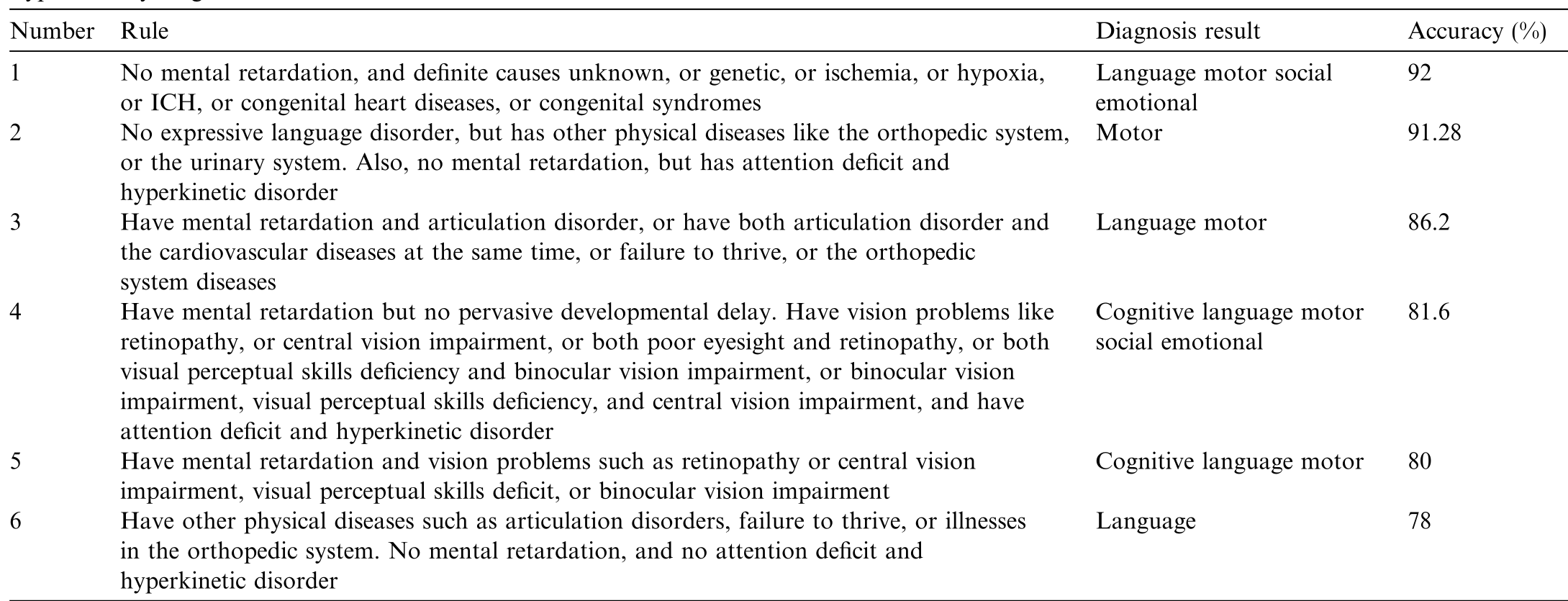 Table: Key classification rules and their predictive accuracy.
The association analysis provided a striking insight: there is a 97.8% confidence that motor and cognitive delays do not occur in isolation—they almost always carry a language impairment component. This suggests that pediatricians should prioritize language therapy even when motor issues appear to be the primary concern.
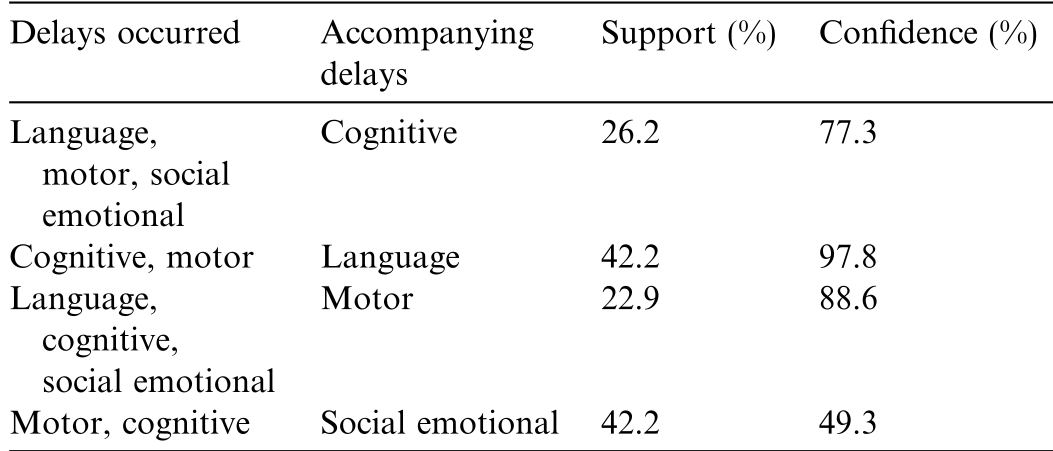 Table: Correlation between different developmental delays.
Critical Analysis & Conclusion
Takeaway
The primary value of this work is the transparent nature of the rules. Unlike "black-box" deep learning models, decision trees provide clinical interpretability, allowing doctors to understand the "Why" behind a prediction.
Limitations
- Data Sparsity: The study relies on 516 records. In the era of Big Data, larger multi-center datasets are needed to validate these rules across different demographics.
- Binary Features: Most fields were treated as binary (Presence/Absence), potentially ignoring the severity gradient of the illnesses.
Future Outlook
The next logical step for this technology is integration into Real-time Diagnostic Support Systems. By feeding these mined rules into an EHR (Electronic Health Record) system, clinicians could receive automated alerts for "High Risk of Delay" the moment a diagnosis like hypoxia or retinopathy is entered into a newborn's file.