
Ontology-Driven Data Mining: Bridging the Gap Between Raw Data and Industrial Intelligence
Application of Data Mining in Fault Diagnosis Based on Ontology * * Supported by Hebei R&D project of science and technology (04213506D)
The paper proposes an ontology-based data mining algorithm for automated fault diagnosis. By integrating domain-specific background knowledge through an ontology model, it transforms low-level raw data into high-level, interpretable classification rules that outperform traditional association rule mining in industrial applications.
TL;DR
This research tackles the "information overload" in industrial fault diagnosis by proposing an ontology-based data mining algorithm. Unlike standard methods that return cryptic low-level data points, this approach uses a conceptual hierarchy to "ascend" raw data into high-level rules (like "Machine Failure" or "Material Issue"), making the results fewer, clearer, and far more useful for enterprise decision-making.
Problem & Motivation: The "Low-Level" Trap
In modern manufacturing, databases are flooded with quality control records. Standard data mining algorithms excel at finding patterns, but they suffer from two major flaws:
- Lack of Meaning: They only speak the language of the raw data.
- Rule Explosion: They generate thousands of rules, most of which are redundant or obvious to experts.
The authors argue that without Background Knowledge, automated systems cannot distinguish between a trivial statistical coincidence and a significant operational failure.
Methodology: The Power of Conceptual Ascension
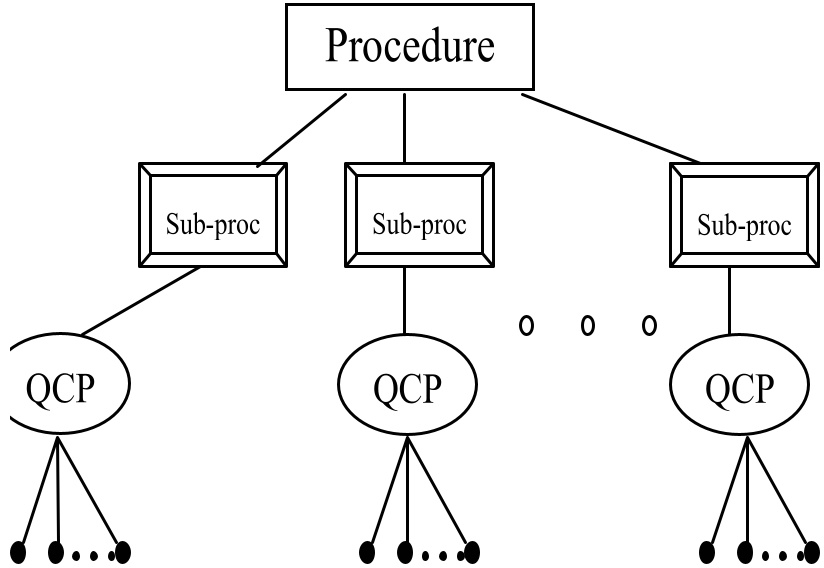
The core innovation lies in the Procedure Ontology Model. The authors structure domain knowledge into a four-layer framework:
1. The Ontology Framework
The model identifies five critical factors (MAN, MACHINE, MATERIAL, METHOD, ENVIRONMENT) across different operational levels:
- Procedure: The broad industrial process.
- QCP (Quality Control Point): Specific checkpoints.
- QRR (Quality Reference Record): The raw, leaf-node data.
2. The Multi-Level Discovery Algorithm
The algorithm follows a sophisticated pipeline:
- Step 1: Low-Level Mining: Use standard association rules to find initial patterns.
- Step 2: Generalization: Translate these patterns into higher-level concepts using the ontology's
Ideal_Depth(Id). - Step 3: Concept Merging: Consolidate overlapping high-level rules to simplify the output.
- Step 4: High-Level Mining: Re-run the analysis to extract the refined, strategic insights.
Experiments: Actionable Insights vs. Statistical Noise
The researchers tested their approach on an electric database containing 100,000 quality records.
Comparison Analysis
- General Data Mining: Produced a table of specific fault codes (e.g., "Fault 1 occurs with Procedure 3"). While accurate, it didn't tell management why it happened or how to fix it.
- Ontology-Based Mining: Grouped these specific faults into strategic buckets like "Outsourcing," "Human," and "Machine."

As shown in the table, the ontology approach identified Outsourcing as the top influence on product quality. This allowed the enterprise to immediately pivot toward strengthening supplier management rather than wasting time on minor procedural tweaks.
Critical Insight & Conclusion
The true value of this paper is its early recognition of Semantic Data Mining. By moving from "data-driven" to "knowledge-driven" discovery, the system acts less like a calculator and more like a junior analyst.
Limitations
- Ontology Construction: The method relies heavily on a pre-built, accurate ontology. Building this requires significant manual effort from domain experts.
- Static Nature: The ontology is static; it may not automatically adapt to new types of manufacturing technologies without manual updates.
Final Takeaway
For AI and Data Science in the industrial sector, the goal isn't just to find any rule, but to find the right rule. Incorporating Ontologies provides the "Inductive Bias" necessary to make automated diagnosis tools practically useful for human managers.