
Issues in Applying Data Mining to Grid Job Failure Detection and Diagnosis: A Practical Post-Mortem
Issues in applying data mining to grid job failure detection and diagnosis
This paper explores the practical implementation of machine learning for detecting and diagnosing job failures in Grid computation systems. Using a prototype built on the Condor platform, the authors evaluate the feasibility of real-time classification using algorithms like C4.5, J48, and VFDT to provide early warnings and failure diagnostics.
Executive Summary
TL;DR: This paper investigates the practicalities of turning machine learning from a research concept into a functional "Early Warning System" for Grid computation. By testing C4.5 and VFDT algorithms on the Condor platform, the authors demonstrate that real-time failure diagnosis is computationally cheap, provided you don't cheat by using data from the future (post-hoc attributes) and you maintain a balance between user-specific and system-wide perspectives.
Academic Positioning: This work serves as a foundational "implementation study." Rather than inventing a new algorithm, it bridges the gap between theoretical data mining and the messy reality of distributed systems, identifying the critical pitfalls of data collection and feature engineering in production environments.
Problem & Motivation: The Grid's Haystack Problem
In 2008, as Grid systems (like the ancestors of modern Cloud) expanded, they became "black boxes" for users. If a job failed, was it because of a code bug? A machine with a faulty RAM stick? Or a network congestion during file transfer? Traditional debuggers cannot scale to thousands of nodes.
The authors identified that while data mining could find patterns in these failures, the "How" was poorly understood. They addressed three core questions:
- Is it too expensive to train these models in real-time?
- Which features actually matter for prediction versus mere description?
- Should we train one giant model for the whole cluster or small ones for each user?
Methodology: The Condor Blueprint
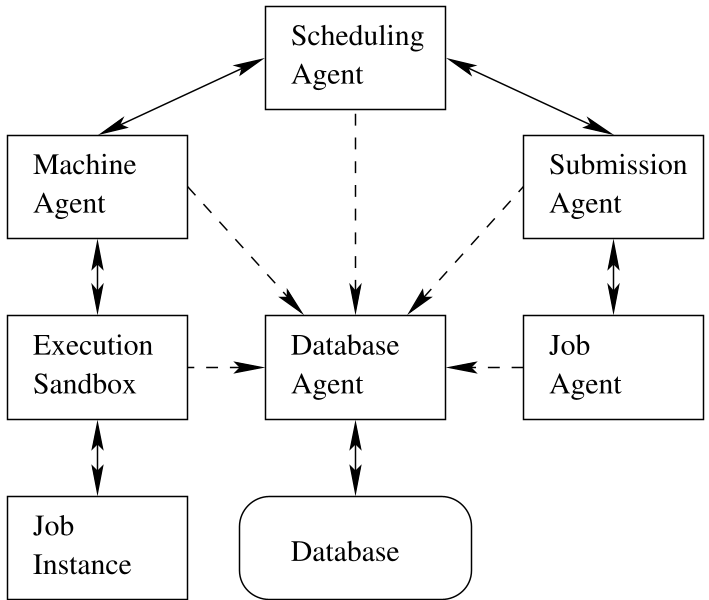
The study was conducted using the Condor grid-computing platform. The architecture relies on a centralized database agent that harvests metadata from various daemons (Job Agents, Machine Agents, and Schedulers).
The "Prediction vs. Description" Trap
One of the most profound insights in the paper is about feature leakage. If you include the exit_code or execution_time in your training set, your classifier will achieve 100% accuracy but 0% utility. Why? Because you only know those values after the job has already failed. To be a true "Early Warning System," the model must only use attributes known at the time of submission or early execution.
Experiments & Results: Efficiency and Scale
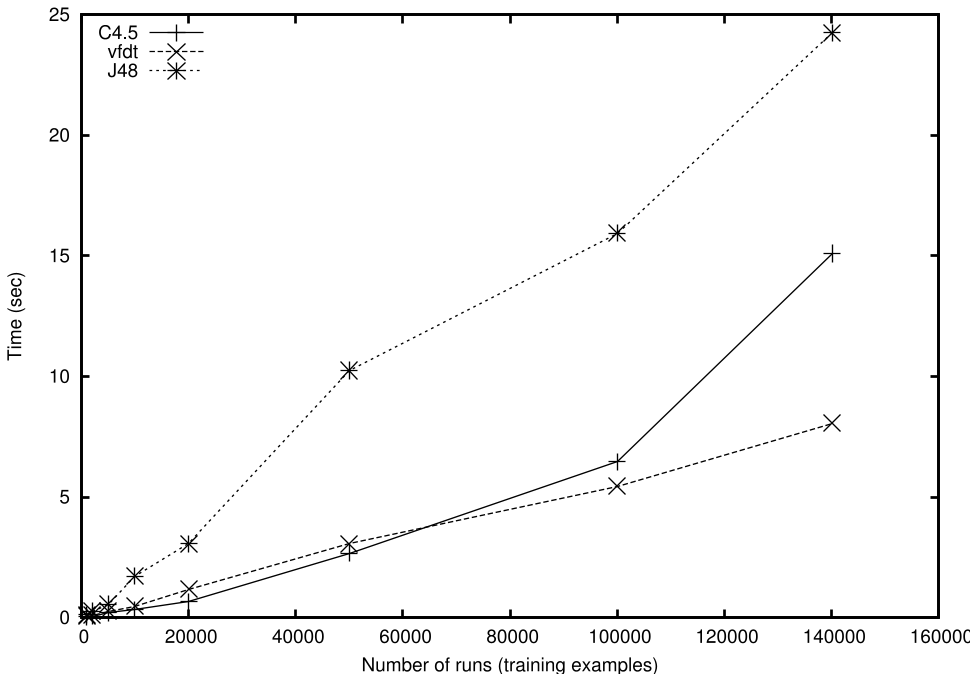
The researchers processed ~140,000 job runs over a 50-machine cluster. They compared three implementations: C4.5, J48, and VFDT (Very Fast Decision Tree).
Training Performance
A key finding was that training time scale more or less linearly. As shown in the figure below, processing 140,000 instances took less than 25 seconds. Given that even global-scale grids at the time handled ~100k jobs a day, the computational overhead of ML was virtually negligible compared to the resource waste of failed jobs.
Dual-Layer Classification
The authors discovered a vital trade-off:
- System-wide Classifiers: Best at catching "Infrastructure Issues" (e.g., "Jobs on Linux CentOS 4.5 always fail when using >2GB RAM").
- Per-user Classifiers: Best at catching "Logic Issues" (e.g., "This specific researcher's code always crashes when passed certain arguments").
Critical Analysis & Conclusion
Takeaways
- Data Mining is Cheap: The "cost" of AI in 2008 was already low enough to be a standard part of distributed system middleware.
- Feature Selection is Everything: Success in failure diagnosis is 10% algorithm choice and 90% ensuring your feature set is predictive, not retrospective.
Limitations & Future Work
While the paper proves feasibility, it assumes a relatively static environment. Modern distributed systems are more ephemeral (containers, serverless). A modern extension of this work would need to address Concept Drift—the phenomenon where failure patterns change over time as the system is patched or workload types shift.
In conclusion, this paper successfully moved the conversation of Grid failure diagnosis from "Can we do it?" to "Here is exactly how we should manage the data to make it work."