
Unlocking the Bio-Vault: How Data Mining is Revolutionizing Clinical Intelligence
Data Mining in Healthcare and Biomedicine: A Survey of the Literature
This paper provides a comprehensive survey of data mining applications in healthcare and biomedicine, detailing the transition from traditional statistics to inductive knowledge discovery. It categorizes core algorithms including SVM, Random Forest, and K-means, and demonstrates how these methods achieve SOTA results in fraud detection, disease prognosis, and clinical decision support.
TL;DR
This seminal survey explores the paradigm shift from traditional statistics to Data Mining (DM) in healthcare. By moving from testing hypotheses to inducing patterns, DM allows for the detection of health insurance fraud saving millions, the prediction of cancer survivability with >93% accuracy, and the clustering of unknown genes. It establishes a roadmap for navigating the unique ethical and technical complexities of medical "Big Data."
The "Data-Rich, Information-Poor" Crisis
For decades, healthcare has been drowning in records but starving for insights. The paper identifies a fundamental tension: hospital systems are often built for billing, not healing. Traditional statistics, while rigorous, is "hypothetico-deductive"—it can only confirm what you already suspect.
The authors argue that true medical breakthroughs require an inductive approach. They point to the "messiness" of medical data—missing timestamps, paper-based legacy records, and stringent HIPAA privacy laws—as the core obstacles that require data mining's heuristic and flexible nature to solve.
Methodology: The Taxonomy of Medical Intelligence
The survey bifurcates the field into two major streams:
- Predictive (Supervised): Classification and Regression.
- Descriptive (Unsupervised): Clustering and Association.
The Battle of Algorithms: How to Choose?
A key highlight is the critical comparison of algorithms. While Neural Networks (NN) mimic the brain, they are often "black boxes" that clinicians distrust. Decision Trees, however, are favored for their "transparency"—offering visual IF-THEN rules that a doctor can audit.
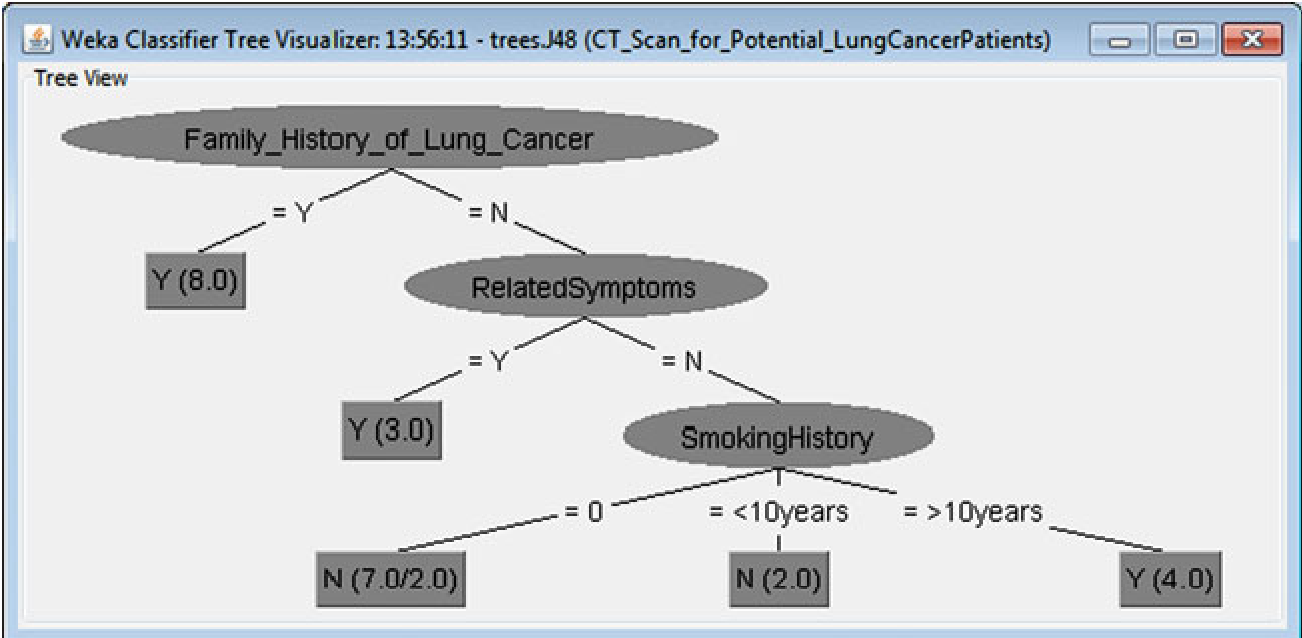 Figure 1: A flowchart-like Decision Tree structure for lung cancer diagnosis, prioritizing interpretability over raw complexity.
The authors also emphasize Support Vector Machines (SVM) for their superior margin-maximization, particularly in binary tasks like "benign vs. malignant" classification, though they note the high computational cost.
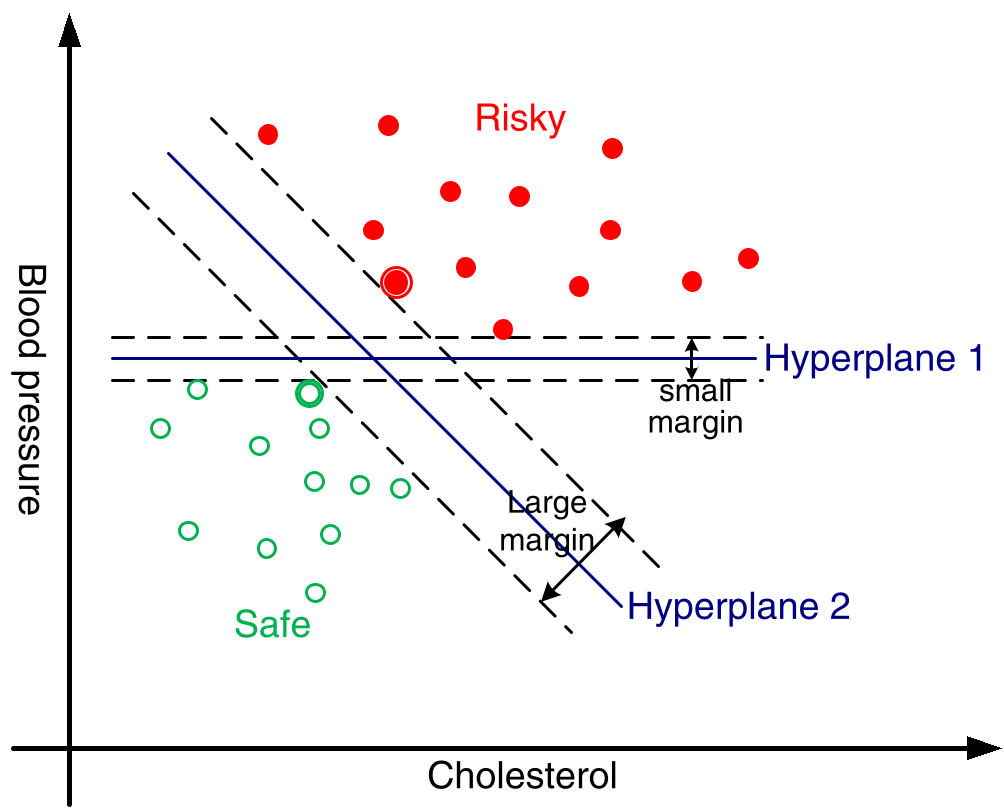 Figure 2: SVM searching for the optimal separating hyperplane between "safe" and "risky" patient profiles.
Experiments & Real-World Impact
The survey isn't just theoretical; it provides "war stories" from the industry:
- Fraud Detection (Highmark): By automating the identification of claim deviations, the company saved $11.5 million in a single year.
- Microarray Analysis: In distinguishing between AML and ALL (leukemias), data mining reached 100% accuracy where human experts struggled.
- Survival Factors: Using Rough Set Theory (RST), researchers identified that deviations in target weight and calcium levels were the most significant predictors of survival for ESRD (kidney dialysis) patients.
| Algorithm | Accuracy (Breast Cancer) | Model Transparency |
|---|---|---|
| Decision Tree (C5.0) | 93.6% | High |
| Neural Networks | 91.2% | Low |
| Logistic Regression | 89.2% | Medium |
Critical Insight: The Clinical Gap
Despite the algorithmic power, the authors remain grounded. They identify three major "blockers" to widespread clinical adoption:
- Parameter Sensitivity: Most algorithms require "fine-tuning" that doctors aren't trained to do.
- Quality of Entry: If the billing data is wrong, the medical prediction will be wrong (Garbage In, Garbage Out).
- Lack of Integrated Packages: There is a dire need for "all-in-one" tools that automate preprocessing while respecting domain knowledge.
Conclusion: Toward Evidence-Based Medicine
This survey serves as a historical and technical anchor. It suggests that the future of medicine isn't just in the lab, but in the server room. The takeaway is clear: Data Mining is not a replacement for medical expertise, but a force multiplier that turns latent data into life-saving evidence.