
Distilling Intelligence: Transforming Tabu Search into Real-Time Scheduling Rules
Data mining based job dispatching using hybrid simulation-optimization approach for shop scheduling problem
2012-05-29
Summary
Problem
Method
Results
Takeaways
Abstract
This paper proposes a hybrid simulation-optimization framework using Data Mining to discover novel Priority Dispatching Rules (PDRs) for the Job-Shop Scheduling Problem (JSSP). By applying the C4.5 decision tree algorithm to high-quality solutions generated by Tabu Search, the method extracts implicit scheduling knowledge to approximate optimal decisions in real-time, achieving performance superior or comparable to traditional rules like SLACK or SPT.
## TL;DR
This research introduces a hybrid framework that uses **Data Mining (C4.5)** to "capture" the decision-making logic of a powerful meta-heuristic (**Tabu Search**). The result is a set of transparent, high-performance dispatching rules that provide the speed of simple heuristics with the strategic depth of complex optimization, specifically targeting the reduction of **Maximum Lateness (Lmax)** in Job-Shop Scheduling.
## The Scheduling Paradox: Efficiency vs. Quality
In the world of manufacturing, shop-floor managers face a double-edged sword:
1. **Priority Dispatching Rules (PDRs)** like *Shortest Processing Time (SPT)* are lightning-fast but myopic. They often ignore the "big picture," leading to bottlenecks and late deliveries.
2. **Meta-heuristics** like *Tabu Search (TS)* or *Genetic Algorithms (GA)* find excellent solutions by exploring the global search space, but they are "Black Boxes." They take too long to run when a machine suddenly breaks down or a new high-priority order arrives.
The authors ask: *Can we extract the "hidden patterns" of why Tabu Search makes a particular decision and turn that into a simple, fast rule?*
## The Methodology: Optimization-Simulation-Learning
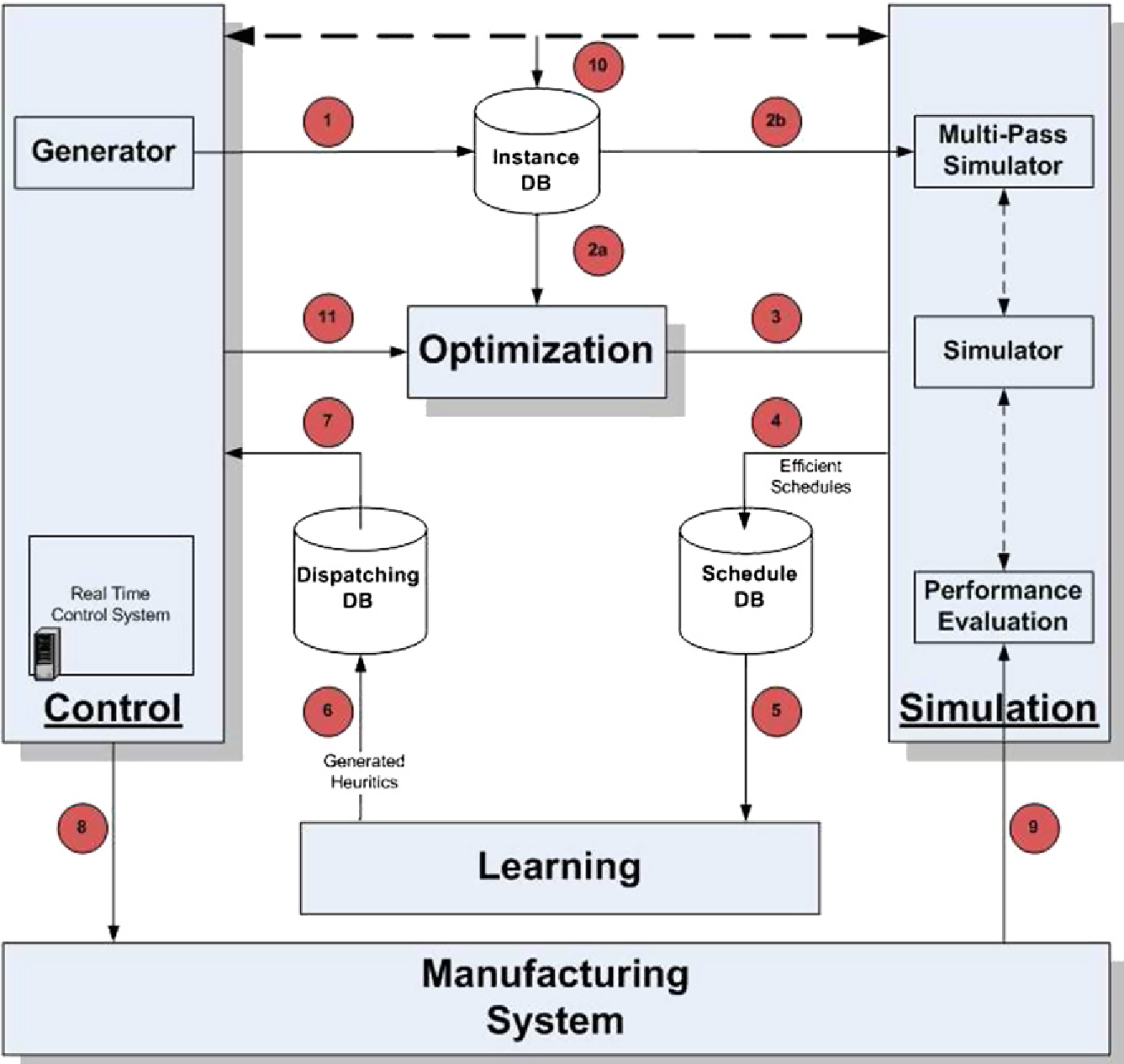
The proposed framework operates in four distinct stages, creating a pipeline from raw data to actionable intelligence:
### 1. The Optimization Anchor
The **Tabu Search** module acts as the "Teacher." It solves various problem instances to find near-optimal schedules. These schedules represent the "Gold Standard" of how jobs *should* be sequenced.
### 2. The Simulation Bridge
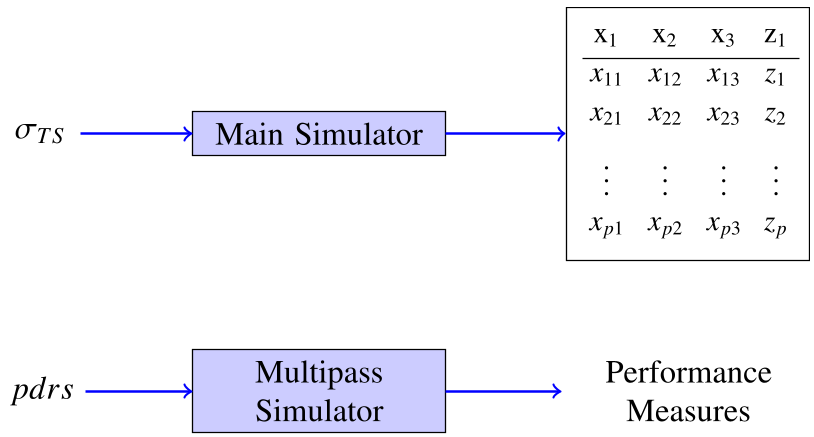
The **Simulation Module** acts as a translator. It breaks the optimal schedule down into individual "Dominance Decisions" (e.g., *Job A is processed before Job B on Machine 1*). It records the state of the shop at that exact moment using specific attributes.
### 3. Feature Extraction
The success of the model relies on **relative attributes** rather than absolute ones. Key features include:
- **Relative Tightness Ratio**: How close the due dates are compared to remaining work.
- **$np/nt$**: The percentage of long jobs currently in the system.
- **Expected Maximum Lateness**: A statistical forecast of the current path.
### 4. Knowledge Discovery (Decision Trees)
Using the **C4.5 algorithm**, the system builds a decision tree. Unlike a Neural Network, this "White Box" model tells the user exactly *why* a job was chosen.
## Performance Analysis
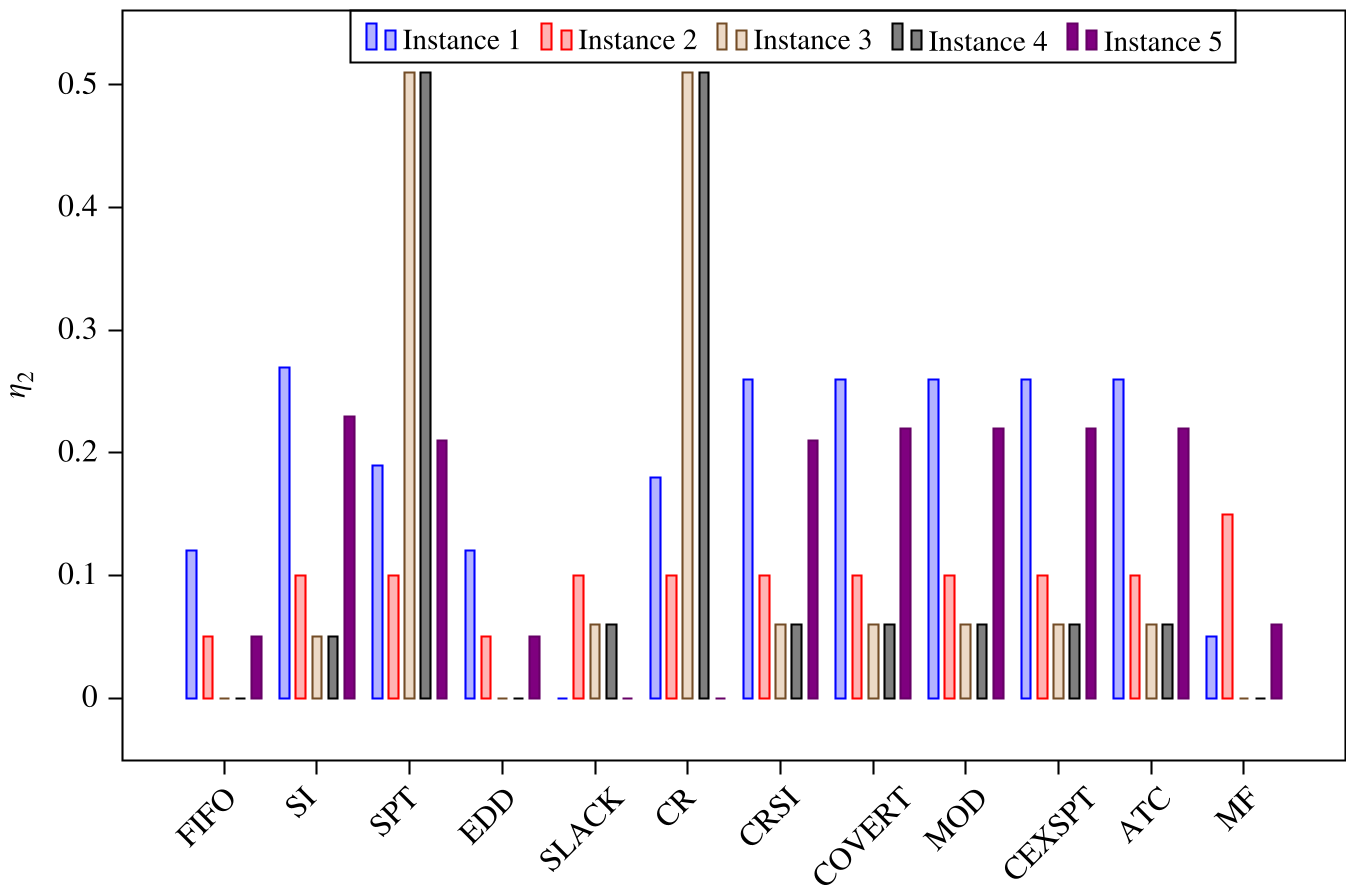
The researchers tested their mined rules against 12 classic PDRs (including FIFO, EDD, and ATC).
**Key Findings:**
- **Superiority**: The mined rules consistently outperformed traditional PDRs in minimizing $L_{max}$.
- **Competitive Edge**: The only rule that came close was the **SLACK** rule, but the mined rules still maintained a lead by adapting to specific system states (like "heavy-load" conditions).
- **Transparency**: The system generated 57 distinct rules, providing a "manual" for shop-floor logic that was previously buried in the Tabu Search code.
## Critical Insight: Why Does This Work?
The core "Insight" of this paper is that **scheduling is a pattern-recognition task.** A meta-heuristic like Tabu Search follows a trajectory in the solution space that "knows" when to prioritize a late job over a short one. By using Data Mining, we are essentially performing **Knowledge Distillation**—a concept now popular in AI (training a small student model from a large teacher model)—but applied to classical industrial operations research.
## Conclusion & Future Outlook
While limited to static environments in this study, the implications for **Dynamic Job-Shop Scheduling** are massive. The authors suggest that this framework could be used to "re-orient" Tabu Search itself, creating a feedback loop where the learning module helps the optimizer find better solutions faster.
**Limitations**: The performance is highly sensitive to the initial "Feature Selection." If the attributes don't capture the essence of a bottleneck, the decision tree will fail to generalize. Future work will likely involve using **Deep Feature Extraction** to automate this sensitive step.