
PDMA: Boosting JSSP Solvers by Mining the "DNA" of Optimal Schedules
A data mining approach for population-based methods to solve the JSSP
This paper introduces the Proposed Data Mining Approach (PDMA), a novel framework that combines Attribute-Oriented Induction (AOI) and Association Rule Mining (ARM) to optimize the initial populations of metaheuristics for the Job Shop Scheduling Problem (JSSP). By extracting high-quality scheduling patterns from near-optimal solutions, it significantly accelerates the convergence of Genetic Algorithms (GA) and Particle Swarm Optimization (PSO).
TL;DR
Metaheuristics like Genetic Algorithms (GA) are powerful but often "start from scratch" with random populations. This paper proposes PDMA (Proposed Data Mining Approach), which mines the patterns within optimal schedules to "warm-start" these algorithms. The result? A massive reduction in computational effort—saving millions of function evaluations—while achieving superior makespan results.
The "Blind Start" Problem in Scheduling
The Job Shop Scheduling Problem (JSSP) is a classic NP-hard challenge: how do you sequence jobs on machines to minimize the total completion time (makespan)?
Most state-of-the-art solvers use population-based metaheuristics (PSO, GA). However, these algorithms usually begin with a random population. Imagine trying to find the peak of a mountain range in the dark; starting at a random spot might leave you stuck in a small valley far from the summit. Previous attempts to use Data Mining (DM) in JSSP were limited to small instances or acted as standalone simple schedulers rather than enhancing the global search capability of metaheuristics.
Methodology: Extracting "Scheduling Intelligence"
The authors' insight is that high-quality schedules share common structural characteristics. They break their approach into two major phases:
1. The Mining Phase
Using a training instance (LA16), the authors generated 100 near-optimal solutions. They then applied:
- Attribute-Oriented Induction (AOI): Converting raw data (like exact processing times) into categorical concepts (Short, Middle, Long).
- Association Rule Mining (ARM): Finding the "if-then" logic. For example: If an operation is early in its job route and sits on a heavily loaded machine, it should probably be prioritized early in the sequence.
2. The Assignment Procedure
To apply these rules to new, unseen problems, the authors developed a novel Assignment Procedure. This isn't just simple matching; it handles conflicts where multiple operations vie for the same priority slot using a confidence-based ranking system.
 Figure 1: The architecture of the proposed data mining-based initial population generation.
Experimental Battleground: PDMA vs. Randomness
The authors tested PDMA on 35 classic benchmarks (Class I: 10x10; Class II: Larger/Varying sizes) against four variants:
- Generic Metaheuristics (GPSO/GGA): Random initialization.
- Data Mining Enhanced (DMPSO/DMGA): Population purely from PDMA.
- Mixed Populations (MPPSO/MPGA): 50/50 split.
Key Results
The statistical evidence (Friedman and Nemenyi tests) was overwhelming:
- Convergence Speed: DMGA saved over 1.75 million function evaluations on average to reach the same quality as a standard GA.
- Solution Quality: DMPSO consistently achieved lower relative errors (MRE) across almost all benchmark classes.
- Scalability: Surprisingly, the advantage of PDMA actually increased as the problem size grew, suggesting the mined rules capture universal features of efficient scheduling.
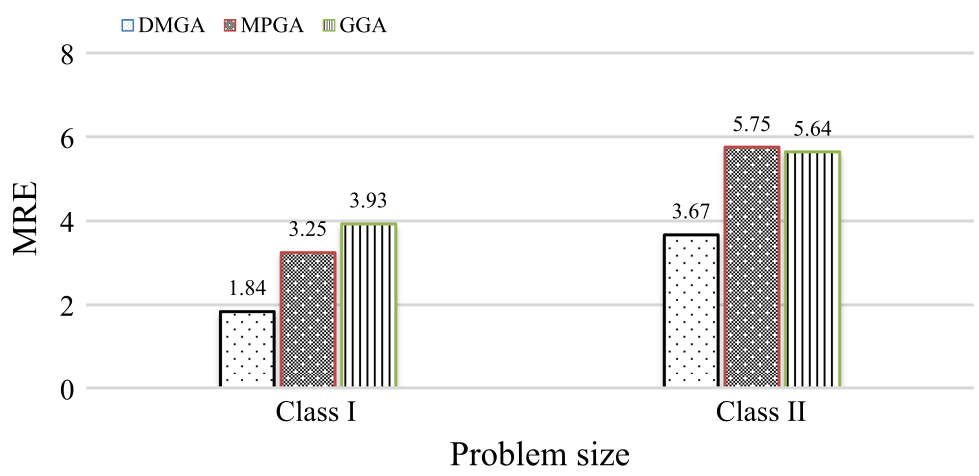 Table: Dramatic reduction in Function Evaluations (FEs) saved by using the data mining approach.
Critical Insight: Why Does It Work?
The brilliance of this work lies in the Generalization of Attributes. By categorizing values (e.g., Machine Loading as "Light" vs "Heavy"), the rules become invariant to the specific scale of the problem. This allows knowledge mined from a 10x10 problem to be effectively applied to a 20x15 problem. It transforms scheduling from a "search" problem into a "pattern-matching then search" problem.
Conclusion & Future Outlook
This paper proves that metaheuristics shouldn't be "tabula rasa" (blank slates). By seeding them with the structural DNA of good schedules, we can bypass the expensive, useless early stages of evolution.
Future directions might include:
- Dynamic Rule Mining: Updating rules during the metaheuristic run.
- Deep Discovery: Using Graph Neural Networks (GNNs) to automatically learn these concept hierarchies instead of manual definition.
For practitioners in industrial scheduling, the takeaway is clear: don't just throw more GPUs at your GA—spend time mining your historical data to start your solver on the right foot.