
Neural Data Mining in Legal Corpora: Navigating the Information Crisis with SOMs
En route to data mining in legal text corpora: clustering, neural computation, and international treaties
The paper presents a neural-computation approach to legal data mining using the KONTERM workstation. It utilizes Self-Organizing Maps (SOM) for unsupervised clustering of international law treaties, achieving a topologically ordered visualization of legal documents.
TL;DR
This paper introduces a neural-network-driven approach to organize massive legal text archives. By moving away from supervised labeling and manual indexing, the authors use Self-Organizing Maps (SOM) to automatically cluster international treaties, creating a "topographical map" of law that allows lawyers to browse by concept rather than just keywords.
The Motivation: Escaping the "Tight Corset" of Boolean Search
Legal research has long been trapped in two suboptimal paradigms:
- Manual Interpretation: Deeply accurate but impossible to scale as data floods in.
- Boolean Retrieval: Precise for specific terms but fails to uncover latent semantic similarities or structure between documents.
The authors identify a specific "information crisis" in law. Unlike structured data, legal text is "noisy" and lacks a central authority that knows the contents of every document. Furthermore, as archives are updated daily, Supervised Learning is deemed obsolete; re-mapping input-output pairs manually every time a new treaty is added is simply not feasible.
Methodology: Higher-Order Feature Extraction
The core innovation in the KONTERM Workstation project is how it bridges the gap between raw text and neural input. Instead of simple word counts, the model utilizes:
- Descriptors: Basic terms extracted from full text.
- Context-sensitive Rules: Linguistic templates that detect complex legal concepts.
- Meta-rules: Combinations of rules occurring within the same document section.
These are transformed into high-dimensional vectors (1625 components) where features are weighted based on their linguistic precision (Descriptors = 1, Meta-rules = 3).
The Engine: Self-Organizing Feature Maps (SOM)
The paper utilizes the unsupervised learning paradigm of Kohonen. Unlike K-means, which simply partitions data, SOMs provide a topological ordering. Similar documents are mapped to neighboring output units on a 2D grid, essentially creating a "spatial" representation of the legal domain.
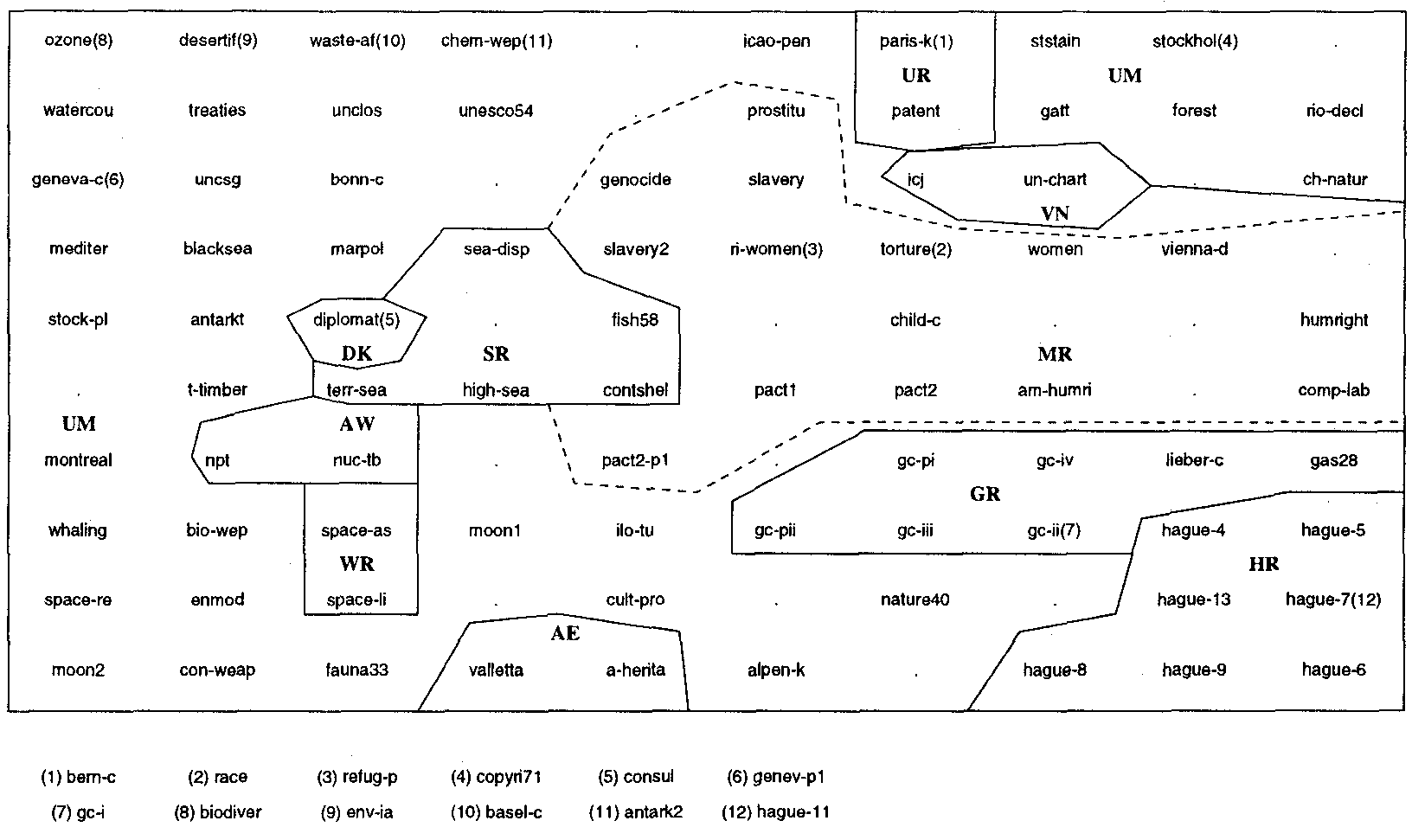 Figure 1: The resulting Self-Organizing Map, visualizing clusters of International Treaties.
Experiments: "Hills" and "Regions" of Law
The researchers tested their approach on 100 of the most significant treaties in public international law. The SOM output revealed:
- Hills: Strong concentrations of highly similar content (e.g., Geneva Conventions, Law of the Sea).
- Regions: Broader, more loosely related areas (e.g., Environmental Law, Human Rights).
The neural approach significantly outperformed traditional statistical cluster analysis, which often failed by creating too many "isolated" clusters consisting of single documents. The SOM provided a continuous, navigable space.
Critical Analysis & Conclusion
The Productivity vs. Performance Trade-off
The authors honestly note a critical limitation: Training Time. In their 1990s context, training a complex map took over 20 hours on a high-end workstation. While this is less of a concern with modern GPU acceleration, it highlights the early challenges of neural computation in specialized domains like law.
Future Outlook
This work is a precursor to modern "LegalTech" tools. By shifting the focus from "finding facts" to "explorative browsing," the authors paved the way for automated legal knowledge discovery. The ultimate takeaway is that unsupervised models are essential for domains where the ground truth is constantly shifting and expert labeling is a bottleneck.
The Future of Law is not just searchable—it is mapable.