
Predictive Learning Analytics: Transforming Big Data into Student Success
9998_Data Mining and Machine Learning Applications for Educational Big Data in the University.
This paper presents a comprehensive Learning Analytics (LA) framework designed to improve student retention and academic performance at a university level. By integrating internal educational "big data"—including GPA, attendance, and credit accumulation—the study employs various machine learning models (NN, LR, SVM, RF, NB) to predict student outcomes and recommend elective courses.
TL;DR
Higher education is entering a data-driven era where "Learning Analytics" (LA) acts as a GPS for student success. This paper details a university-wide system that utilizes machine learning—including Neural Networks and Random Forests—to predict student dropouts with up to 88.7% accuracy and recommend courses that best fit a student's academic profile.
Background & Motivation: Moving from Reactive to Proactive
The primary challenge in modern university administration is the "silent dropout"—students who slowly disengage and eventually leave the institution without warning. Traditional methods of intervention are usually too late. The authors argue that by the time a student fails a final exam, the opportunity for intervention has passed. The motivation behind this research is to mine the university's internal "Big Data" (attendance, GPA, and course history) to identify patterns of failure before they manifest as a withdrawal form.
Methodology: The Data-Driven Engine
The researchers built a robust framework centered on Database Construction and Learning Support Methods. They didn't just look at one algorithm; they benchmarked six different machine learning approaches:
- Neural Networks (NN)
- Logistic Regression (LR)
- Support Vector Machines (SVM)
- Random Forest (RF)
- Naive Bayes (NB)
- K-Nearest Neighbors (KNN)
The methodology split the task into two core functions: Status Prediction (Will the student graduate?) and Subject Recommendation (Which elective will this student excel in?).
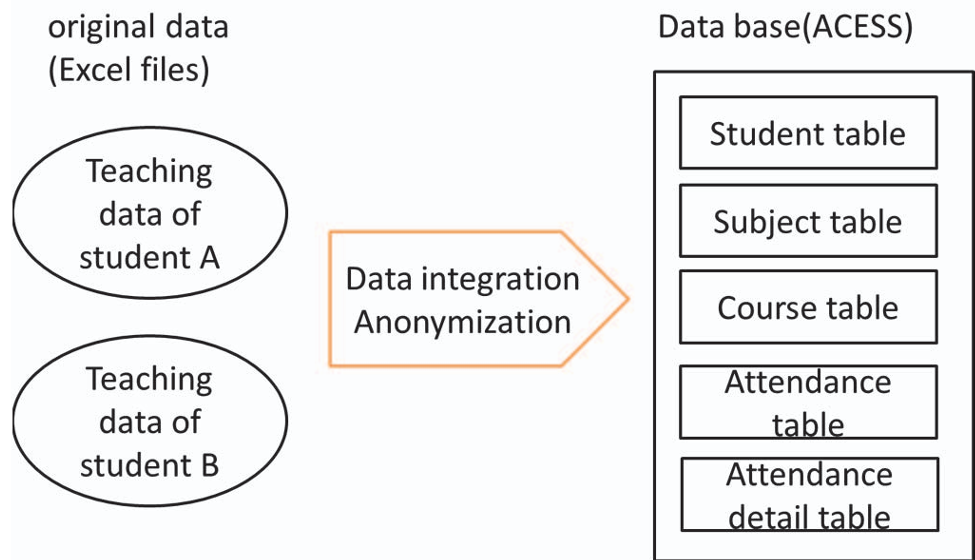 The image illustrates the flow from data collection to predictive modeling and final educational intervention.
Experimental Results: The 2-Year Critical Window
One of the most profound insights from the study is the correlation between time and predictive power. At the point of university entrance, the model’s accuracy is a mere 60%. However, as the student progresses and more data points (attendance, credits) are ingested, the accuracy climbs steadily.
| Period | Accuracy | Precision (Class 1) | F-score (Class 1) |
|---|---|---|---|
| Entrance | 0.604 | 0.637 | 0.717 |
| 1 Year Later | 0.814 | 0.833 | 0.851 |
| 2 Years Later | 0.887 | 0.870 | 0.915 |
This suggests that by the end of the second year, the university can identify potential dropouts with near-certainty, allowing for high-stakes counseling interventions.
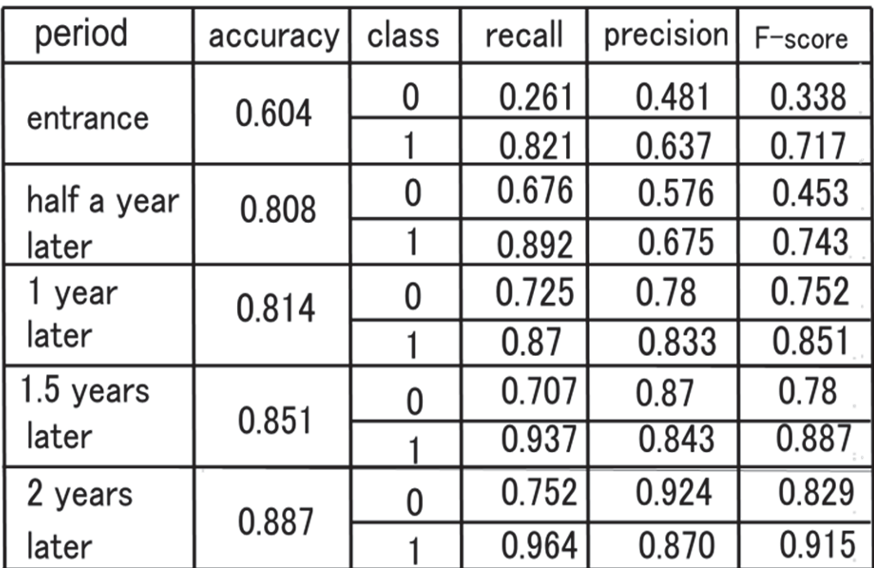 The table highlights how the model becomes significantly more reliable over the course of four semesters.
Deep Insight: Beyond Simple Predictions
The paper doesn't stop at binary "stay or leave" predictions. It utilizes Association Rule Mining (as seen in the {lhs} => {rhs} tables) to understand why certain students fail. For instance, it identifies specific clusters of subjects (e.g., specific math or logic courses) that serve as "gatekeeper" subjects—failing these subjects has a high lift (correlation) with overall academic postponement.
Furthermore, the Subject Recommendation system uses these historical patterns to suggest electives. For students struggling in Class II (middle-tier performance), the model achieves a precision of 0.569, which, while lower than the top-tier prediction, still provides a significant statistical advantage over random selection or manual advising.
Critical Analysis & Future Outlook
Takeaway: This work proves that internal university data, which is often siloed, is a goldmine for student retention. The transition from 60% to nearly 90% accuracy over two years provides a clear roadmap for when "Student Success Teams" should be most active.
Limitations: The model relies heavily on attendance and credit counts. In an era of increasing "flexible" or "online" learning, attendance might become a less reliable feature. Future research should integrate behavioral data from Learning Management Systems (LMS) such as clickstream data, forum participation, and time-spent-on-task.
Conclusion: By combining predictive modeling with elective recommendations, this framework offers a dual-benefit: it prevents failure and optimizes the path to success.