
Engineering Financial Intelligence: Lessons from a Large-Scale Banking Data Mining Deployment
Data mining at a major bank: Lessons from a large marketing application
This paper details the implementation of a large-scale Loyalty Based Customer Management (LBM) system at Credit Suisse. It integrates data warehousing, campaign management, and data mining, using parallelized Decision Trees (CART algorithm) to significantly improve target customer selection for marketing campaigns.
TL;DR
This seminal work from Credit Suisse outlines the transition from raw data collection to a productive Loyalty Based Customer Management (LBM) system. By integrating a 100GB data warehouse with parallelized Decision Trees, the bank moved beyond simple storage to active "knowledge discovery," enabling high-precision marketing campaigns within a staggering two-month implementation window.
Background & Positioning
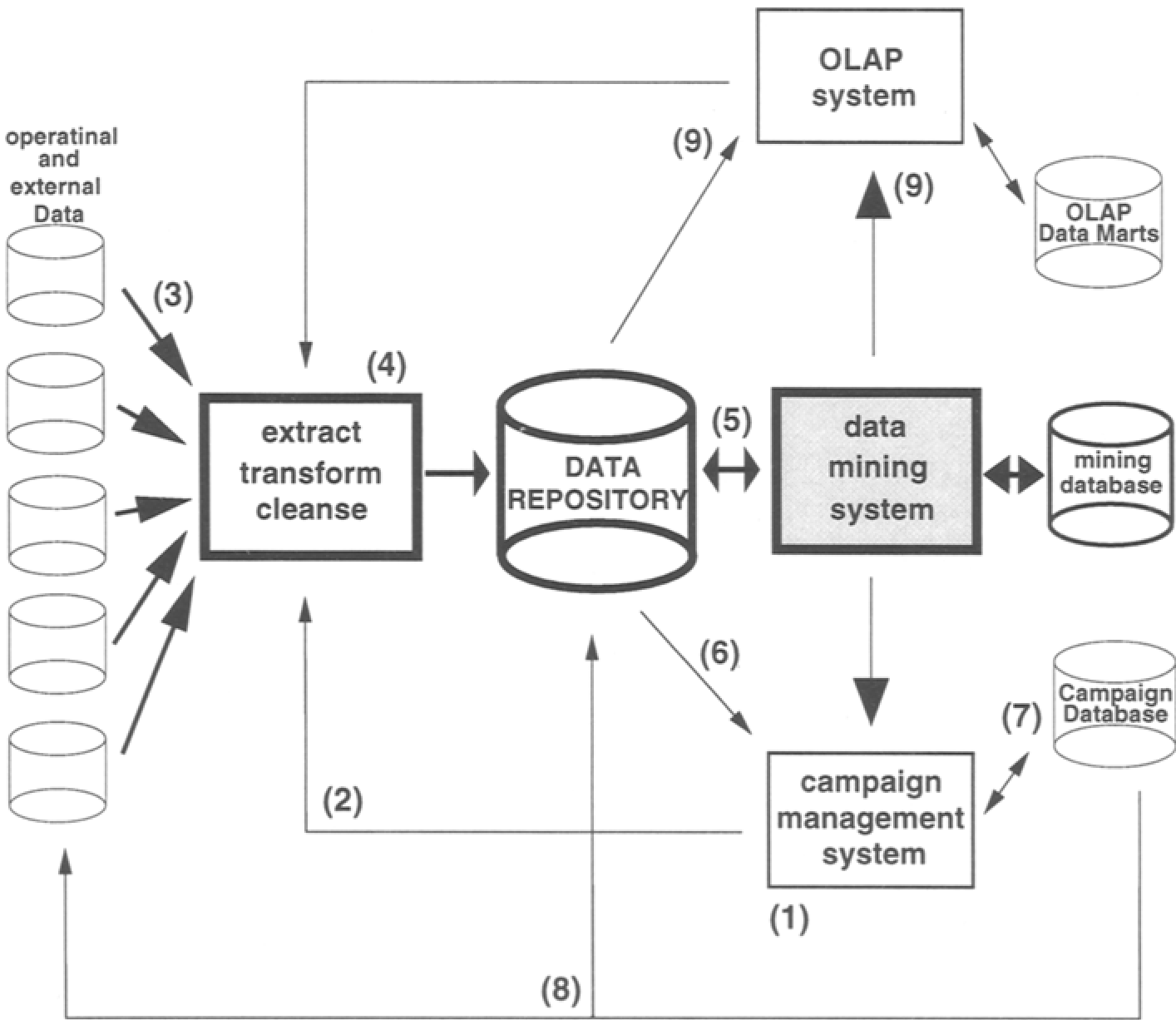
In the late 90s and early 2000s, banks were "data rich but information poor." This paper serves as a foundational blueprint for what we now call Predictive Analytics. It positions data mining not as a "stand-alone beauty" (theoretical research) but as a cog in a massive industrial machine involving feed systems, cleansing pipelines, and campaign execution.
The "Why": Beyond Raw Accuracy
The authors identify a critical friction point: The Interpretability Gap. While Neural Networks were available, they were rejected for this production phase. Why?
- Traceability: Business experts need to see the rules behind why a customer is being targeted.
- Information Leakers: Raw correlation often masks "leaks" (e.g., a variable that implies a customer already has a product). Decision trees allow experts to catch these logical fallacies quickly.
Methodology: The LBM Architecture
The core of the system is a highly dynamic data flow. The architecture focuses on a subject-oriented customer view, requiring robust de-duplication of records from disparate OLTP systems.
The Modeling Insight: Lift over Error
Most academic models optimize for Minimal Global Error. However, in a marketing context where only 1% of customers might buy a product, a model that predicts "nobody will buy" has 99% accuracy but 0% value.
- Lift-Based Pruning: Instead of standard cost-complexity pruning, the authors used lift. They pruned nodes to maximize the ratio of target customers in a specific segment compared to the average population.
- Parallelization: Using the Darwin suite on a Sun Microsystems Enterprise 10000 (8 CPUs), they performed rapid iterations, building 50–60 models to find the optimal balance of coverage and lift.
Challenges in the Trenches (The 80/20 Rule)
One of the paper's most honest takeaways is that 80% of the work was data preparation.
- Data Scarcity vs. Volume: While they had 100GB of total data, specific target variables (owners of a specific product) were often sparse, requiring Balanced Data Sets (1:1 ratio) for training to ensure the algorithm didn't ignore the minority class.
- Business Alignment: Success depended on "Mining Agents" being able to explain results. A "False Positive" in this context isn't a failure—it's a Potential Lead.
Critical Analysis & Future Outlook
The authors correctly predicted that data mining would move toward "Real-time relationship discovery." Interestingly, they forecasted the conversion of models into C++ code for deployment to advisor desktops—a precursor to modern Model-as-a-Service (MaaS) architectures.
Limitations: The paper reflects a time when "Data Cleansing" was manual and cumbersome. Today, Auto-ML and modern Feature Stores would automate many of the "cumbrous" SQL joins described. However, the core lesson remains: No business value exists without domain-expert validation.
Takeaway for Modern Architects
Even in the era of Deep Learning, the interpretability vs. performance trade-off is real. This paper reminds us that a robust Data Warehouse is the prerequisite for any AI success, and the best "model" is the one that the business can actually operationalize.