
CORAL: Uncovering Hidden Money Laundering Networks via Temporal Correlation
Applying data mining in investigating money laundering crimes
The paper introduces CORAL, an automated system for generating Money Laundering Crime (MLC) group models from unstructured text. It proposes a novel paradigm called Link Discovery based on Correlation Analysis (LDCA) to identify criminal communities within "uni-party" data—datasets lacking explicit relational links between entities.
TL;DR
Money laundering is a high-stakes "group crime" that is notoriously difficult to investigate because criminals rarely leave a "digital paper trail" that explicitly links them. This paper presents CORAL, a system that uses Link Discovery based on Correlation Analysis (LDCA) to automatically reconstruct criminal groups from unstructured text. By analyzing temporal patterns in financial transactions, the tool can filter out 97% of noise and pinpoint core syndicate members.
The Problem: Mining When There are No Links
Most data mining tools for community detection (like those for social networks) are designed for bi-party data—data where the relationship between Node A and Node B is explicit (e.g., "A follows B" or "A sent money to B").
However, financial crime data is often uni-party. A document might state: "John Doe withdrew $5,000," and another states: "Jane Smith bought a luxury car." There is no explicit link between them. Investigating these cases currently requires human agents to manually read thousands of pages to "connect the dots," a process that takes months.
Methodology: The Logic of LDCA and CORAL
The authors suggest that even if links aren't written down, they are etched in the temporal behavior of the actors. If two people are part of the same money-laundering cell, their transaction peaks should correlate along a timeline.
1. Data Structuring: The Event-driven 3D Nest
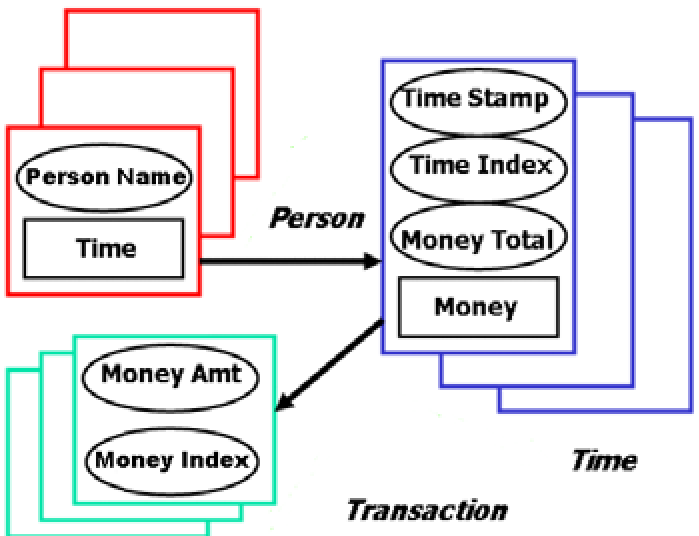
Because Information Extraction (IE) can be messy, CORAL uses a "One-Way Nearest Neighbor" principle: it assumes that money amounts mentioned near a person's name in a text are likely associated with that person. This data is organized into a 3D nested structure: Person → Time → Transaction.
2. Timeline Clustering
Rather than looking at every transaction in isolation, CORAL projects all activities onto a shared timeline. It uses Histogram Segmentation to identify "zones" of high activity. This "Focus Assumption" posits that crime-related transactions will cluster during specific periods rather than being randomly scattered.
3. Fuzzy Correlation Analysis
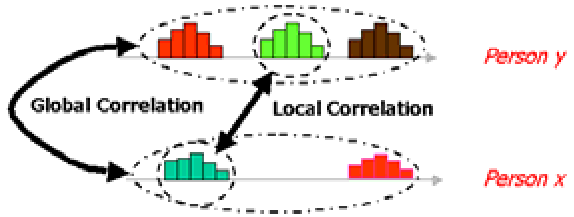
This is the "secret sauce" of the paper. Since criminals don't act at the exact same second, CORAL uses Gaussian Fuzzy Functions to calculate local and global correlations.
- Local Correlation: How similar are Two people's activities within a specific time cluster?
- Global Correlation: How do these clusters relate across the entire history of the case?
Experimental Results: A Real-World Victory
The authors tested CORAL on a real-world $45 million Ponzi scheme targeting religious and charitable groups.
- The Data: 7,668 physical documents (OCR'd and tagged).
- The Efficiency: The system processed 332 core documents in just 20 minutes.
- The Accuracy: Out of 252 extracted individuals, CORAL narrowed the list down to just 7 key suspects when the correlation threshold was set to 0.18.
Crucially, those 7 individuals were later verified to be the major convicted members of the crime group. The system achieved a 97% elimination rate, effectively removing the "haystack" so investigators could find the "needles."
Critical Analysis: Impact and Limitations
The Insight: The beauty of CORAL lies in its ability to treat time as the link. In the absence of a "smoking gun" memo linking two criminals, their synchronized signatures in the financial system become their undoing.
Limitations:
- Data Quality: The paper notes heavy reliance on manual cleaning due to poor OCR performance in 2003. Modern LLM-based OCR and IE would likely supercharge this method today.
- The Focus Assumption: The method assumes that the majority of documents relate to the crime. If a suspect's data is buried in a mountain of "normal" transaction noise, the histogram segmentation might struggle.
Final Takeaway
While written in 2003, this paper's core philosophy—inferring relationships via temporal behavioral correlation—remains a foundational concept for modern AML (Anti-Money Laundering) and fraud detection systems. It proves that in the world of data, silence about a relationship does not mean the relationship doesn't exist.