
CLOPE: Tackling the Layering Phase in Vietnamese Anti-Money Laundering
Applying Data Mining in Money Laundering Detection for the Vietnamese Banking Industry
This paper introduces an Anti-Money Laundering (AML) detection framework tailored for the Vietnamese banking sector using the CLOPE clustering algorithm. By converting raw transaction logs into account-behavioral profiles, the system identifies suspicious patterns such as circular transfers and money layering without requiring pre-labeled training data.
TL;DR
To combat the rising complexity of financial crimes in Vietnam, researchers have proposed a data mining framework that uses the CLOPE algorithm to detect money laundering. By focusing on the "Layering" phase of the laundering cycle—where illicit funds are shuffled to hide their origin—this system identifies suspicious accounts with high precision, significantly outperforming traditional methods like K-Means in unsupervised environments.
Context: This work bridges the gap between massive, unlabeled banking datasets and the need for actionable intelligence in a high-cash-flow economy.
The "Vietnam Problem": Why Supervised Learning Fails
Money laundering typically follows three steps: Placement, Layering, and Integration. While Placement often involves physical cash, Layering creates a digital paper trail within banking systems.
The Vietnamese banking industry faces a unique challenge: a lack of "Gold Standard" labeled data (records confirmed as fraud/non-fraud). This renders supervised learning models (like Random Forests or Neural Networks) impractical. Furthermore, traditional unsupervised methods like K-Means rely on Euclidean distance, which fails to capture the logic of transactional behavior where variables are often categorical or nominal.
Methodology: From Raw Logs to Behavioral Clusters
The core innovation lies in the transformation of raw transaction data into Behavioral Transactional Profiles. Instead of looking at a single transfer of $1,000, the system aggregates data per account over a period to calculate:
- Sum/Number of Sending & Receiving
- Relationship Count: Number of unique counterparties.
- |R - S|: The absolute difference between total funds in and out (crucial for detecting "pass-through" accounts).
The CLOPE Advantage
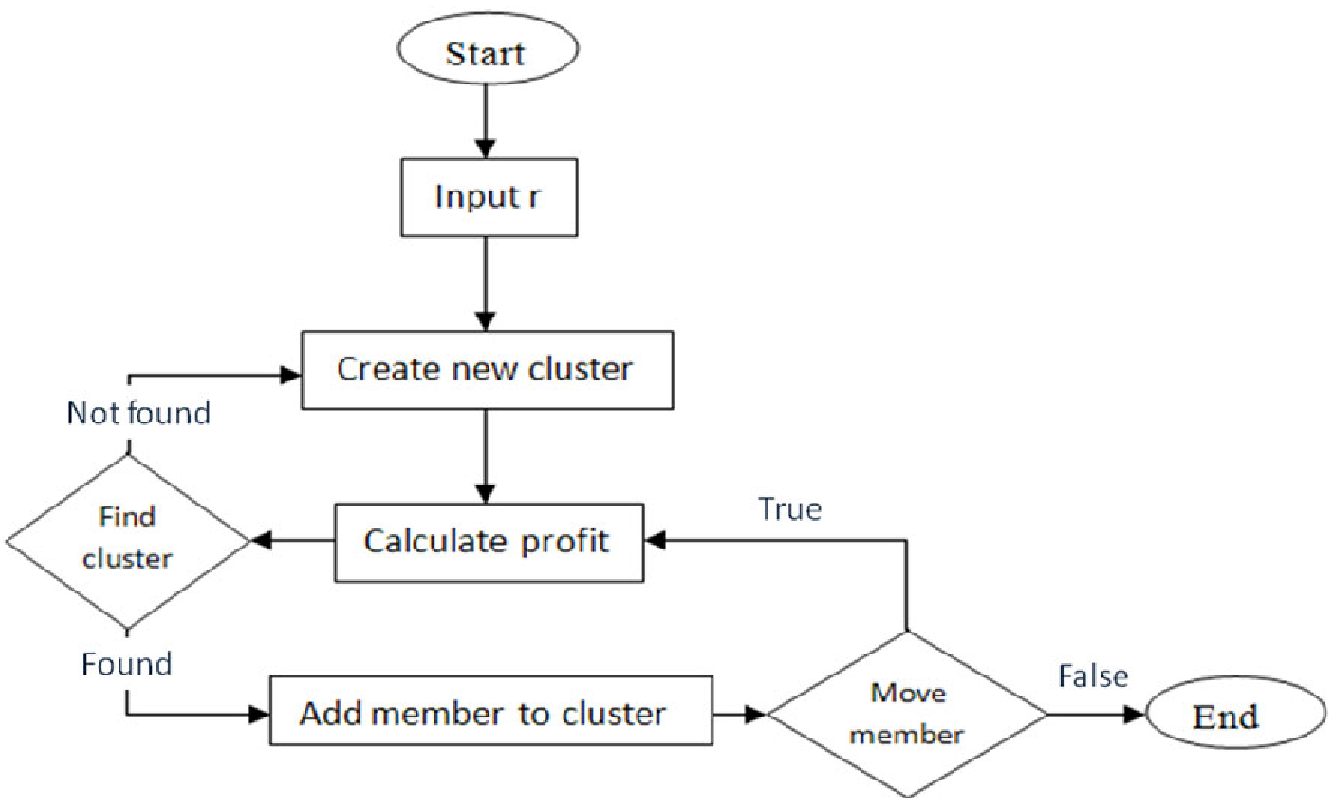
Unlike distance-based algorithms, CLOPE uses a global criterion function based on the "overlap" of attributes within a cluster. It models each cluster as a histogram.
The algorithm attempts to maximize the Profit(C), which balances the height and width of these histograms. A key parameter is Repulsion (r):
- High r: Forces clusters to be very similar (narrower, more specific).
- Low r: Allows for broader, more diverse clusters.
Tackling Three Archetypes of Fraud
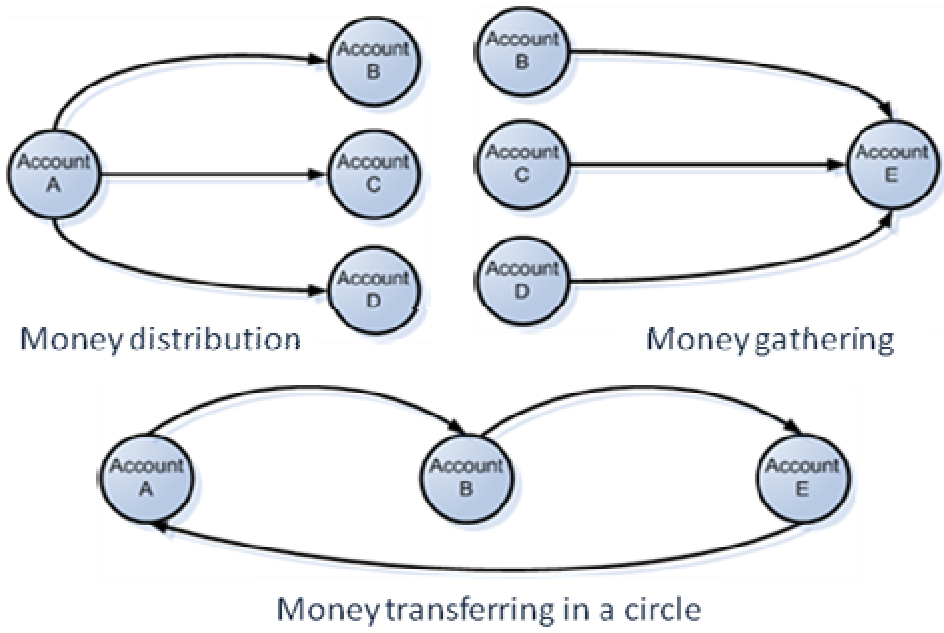
The paper categorizes laundering into three distinct patterns that CLOPE is tuned to detect:
- Circular Transfers: Accounts where
Sum_Received ≈ Sum_Sent. The system identifies clusters where theR_Sattribute is near zero. - Money Distribution: One account sending small amounts to many others to stay below alert thresholds.
- Money Gathering: Multiple sources funneling small amounts into one central "cleaner" account.
Experimental Showdown: CLOPE vs. K-Means
The researchers tested their implementation on 8,020 raw records from a Vietnamese bank. After behavioral conversion, they ended up with 12,350 transactional profiles and inserted 25 "synthetic" laundering cases to check detection rates.
| Scenario | CLOPE Results | K-Means Results |
|---|---|---|
| Circular Transfer | 13/13 detected (in small, pure clusters) | 13/13 detected (buried in 389 noise records) |
| Distribution | 6/6 detected (in clusters with 1,805 total) | 6/6 detected (diluted in 8,520 total) |
| Gathering | 6/6 detected (in clusters with 1,297 total) | 6/6 detected (diluted in 6,622 total) |
The results are clear: while both algorithms "found" the criminals, K-Means flagged so much "noise" (false positives) that a human analyst would be overwhelmed. CLOPE provided a much narrower, more accurate list of suspects.
Critical Insight & Conclusion
This paper proves that transactional logic (histograms of behavior) is more valuable than spatial logic (Euclidean distance) in financial fraud detection.
Takeaway for the Future: While CLOPE is powerful, it is not a silver bullet. The researchers note that it still requires a human analyst to set the "Rules of Engagement" (the nominal fragments). The future of AML likely lies in Hybrid Systems—using CLOPE to filter the noise and N-tree data structures or GNNs to map the social relationships between those suspicious clusters.
Note: The system's reliance on manual data fragmentation suggests that integrating automated feature engineering could be the next major leap for Vietnamese Fintech security.