
Data Mining in Healthcare Operations: From Predictive Insights to Operational Excellence
Data mining and predictive analytics applications for the delivery of healthcare services: a systematic literature review
This paper presents a systematic literature review (SLR) on the application of data mining and predictive analytics within Healthcare Operations and Supply Chain Management (HOSCM). By synthesizing 22 core studies using the CRISP-DM framework and a custom HOSCM taxonomy, it identifies SOTA achievements in clinical pathway discovery, capacity planning, and quality of care improvement.
Executive Summary
In the era of Electronic Health Records (EHR), the healthcare sector is sitting on a goldmine of data. However, while clinical data mining (diagnosis and prognosis) has flourished, the operational side—managing the "Care Supply Chain"—has historically been overlooked. This systematic literature review by Malik et al. serves as a critical mapping of how data science is currently being weaponized to optimize healthcare delivery. The paper identifies a shift from simple classification to complex process mining, though it highlights a sobering reality: most academic models still struggle to make it into the hospital ward.
The "Care Chain" Crisis: Why Analytics is the Only Cure
Healthcare policy makers face a "pincer movement": shrinking budgets and aging populations. The authors argue that hospitals must be viewed through a "process view"—transforming input resources into patient outcomes.
Traditional HOSCM (Healthcare Operations and Supply Chain Management) relied on static queuing models. The current research intuition suggests that Predictive Analytics can act as an anticipatory mechanism—similar to Amazon's "predictive shipping"—allowing hospitals to forecast patient arrivals, mitigate "no-shows," and dynamically adjust staffing levels before the bottleneck occurs.
Methodology: The CRISP-DM & HOSCM Intersect
To evaluate the literature, the authors didn't just look at "what" was done, but "how" it fits into the standard Data Mining lifecycle (CRISP-DM). They categorized papers into three heavy-hitting functional domains:
- Capacity Planning: Using historic arrival data to optimize outpatient scheduling.
- Workflow Analysis: Utilizing Process Mining to discover "Clinical Pathways"—the actual sequence of care events vs. the theoretical protocol.
- Quality of Care: Predicting readmission risks and patient safety incidents (e.g., falls).
Multi-Layered Analysis Framework
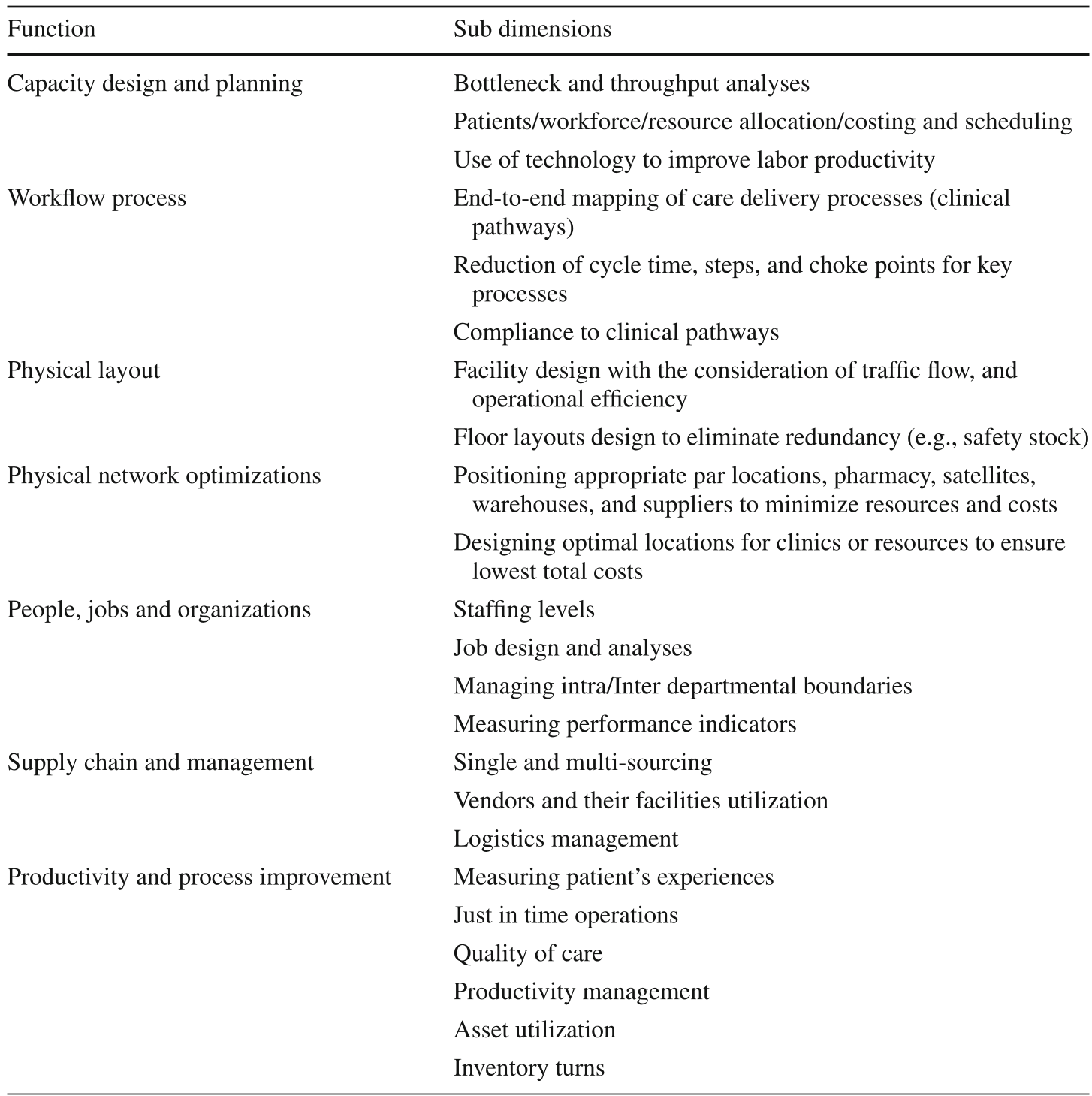 The table above highlights the taxonomy used to classify operational dimensions, ranging from physical network optimization to productivity management.
Technical Deep-Dive: Algorithms and Evaluation
The review notes a transition in the modeling landscape. While Support Vector Machines (SVM) and Neural Networks remain the workhorses, newer hybrid models—such as Swarm Intelligence Heuristics (Zheng et al., 2015) and Process Mining Algorithms (Caron et al., 2014)—are gaining ground.
A critical observation is the Evaluation Paradox. Many papers excel at "Internal Validation" (AUC, Sensitivity), but fail at "Field-Relative" measures. A model might be 95% accurate, but if it doesn't reduce "Doctor Idle Time" or "Patient Wait Time," its operational value is nil.
Algorithm and Software Distribution
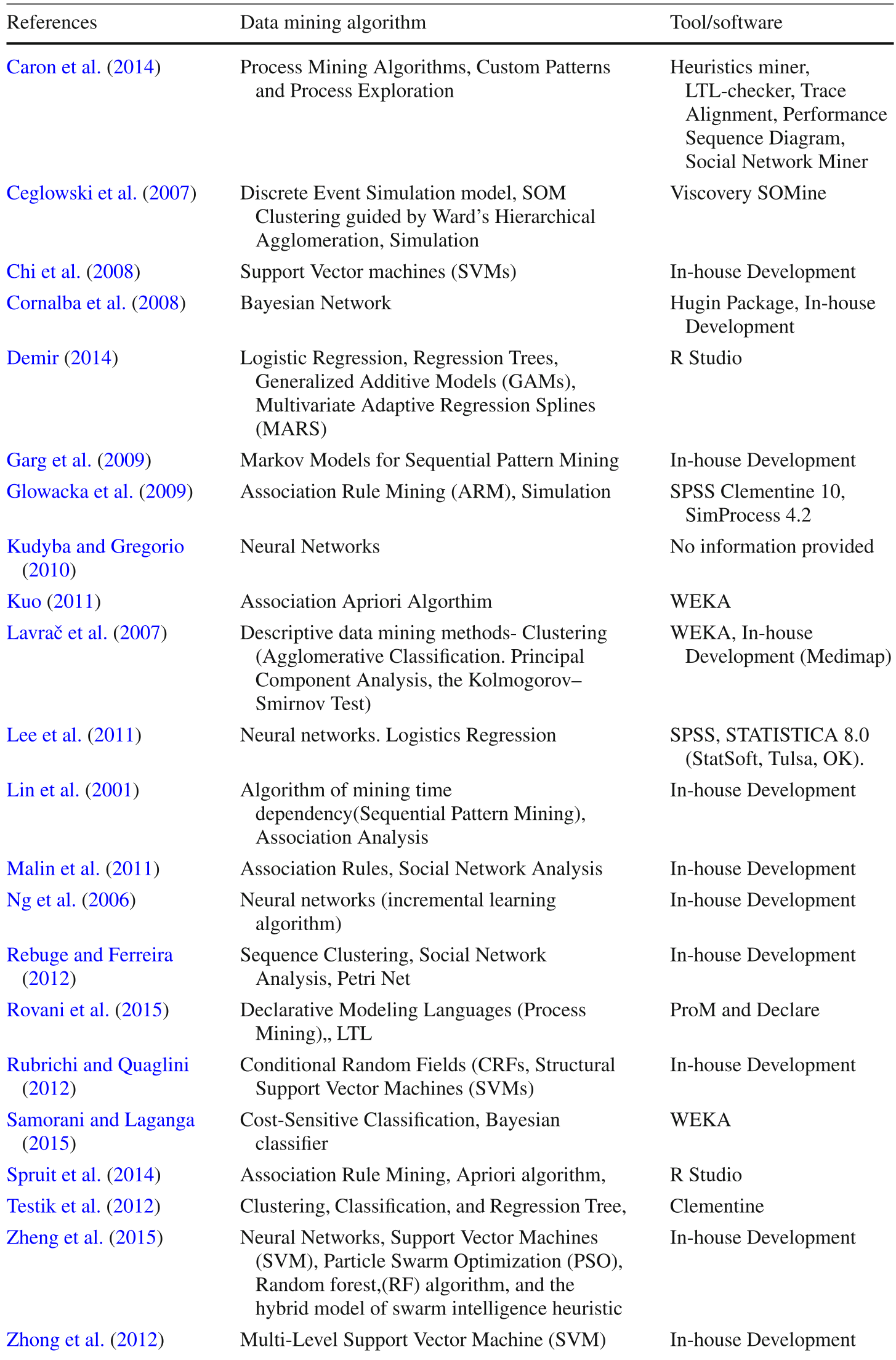 The mapping shows a healthy mix of in-house development and established platforms like R, WEKA, and ProM.
The Deployment Gap: The Final Frontier
The most striking finding of the review is the disparity between Concept Realization and Actual Deployment.
- The Problem: 64% of the studies reviewed were essentially "lab experiments." They proved that data could predict an outcome but didn't integrate that prediction into a live hospital Information System.
- The Successes: Studies like Ceglowski et al. (2007) and Rebuge & Ferreira (2012) stand out because their models were practically tested in Emergency Departments and urology wards, providing real-time decision support.
Geographical and Setting Distribution
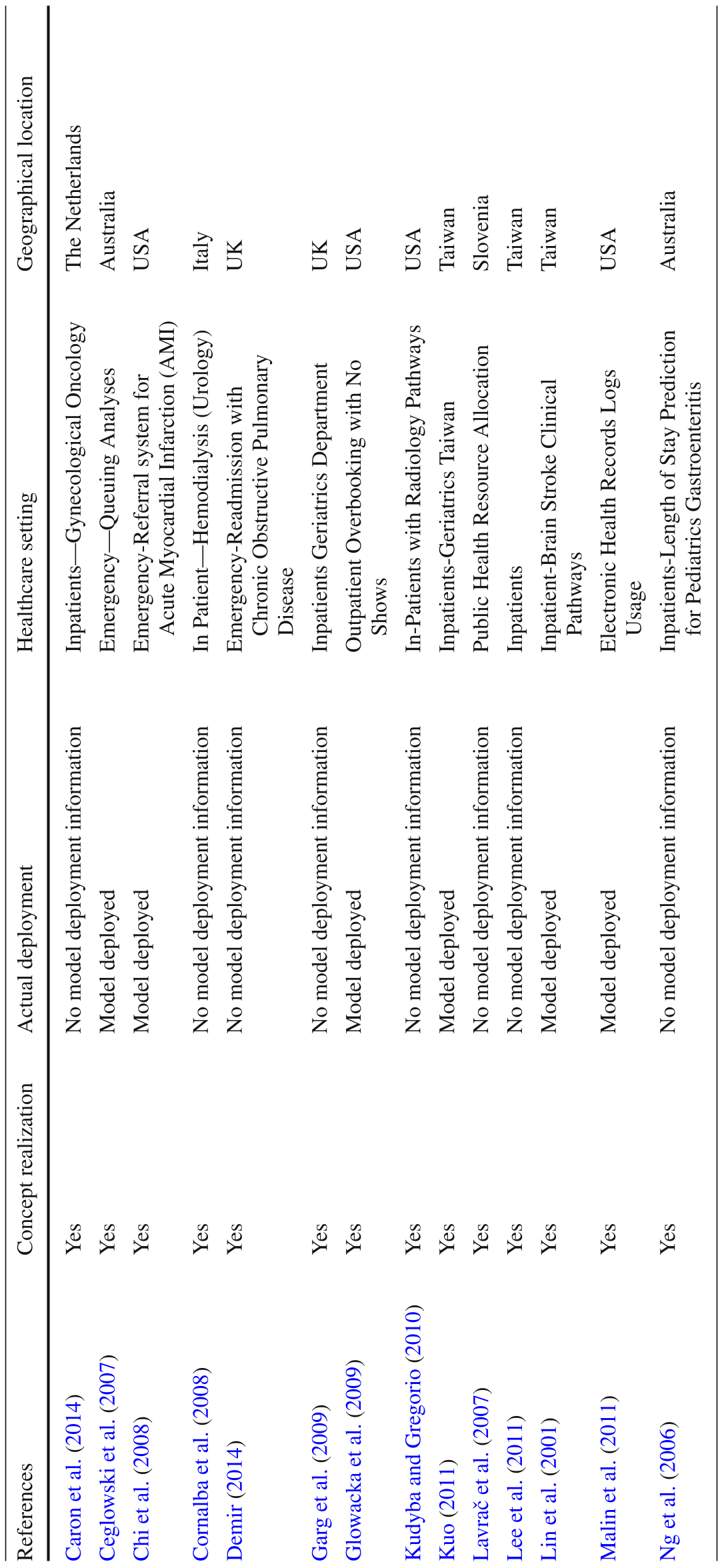 The data indicates that while the US and Australia lead in volume, European and Asian (Taiwan) institutions are rapidly adopting these frameworks.
Critical Insight & Future Outlook
The review concludes that we are in the "Emerging" phase of HOSCM Data Mining. The next logical evolution is End-to-End Care Integration. Instead of just mining the "Radiology pathway," future systems must mine the entire "Patient Journey" from admission to post-discharge care.
Key Limitations Identified:
- Lack of Physical Layout optimization via data mining.
- Insufficient use of External Validation (real-world cost/time impact).
- Low rate of Live System Integration.
Final Takeaway: For hospital administrators, big data is no longer a luxury—it is the bedrock of operational survival. The challenge for 2026 and beyond is not finding more data, but building the "last-mile" infrastructure to turn predictive models into clinical reality.