
URS: Leveraging Social Circles to Solve the Cold Start Dilemma
Data Mining Based Recommendation System Using Social Websites
The paper introduces a standalone Web-based User Recommendation System (URS) that leverages social networking data (Facebook) to provide personalized book recommendations. By integrating collaborative and content-based filtering, the system maps connections between users' social profiles and their preferred items to improve recommendation quality.
TL;DR
The User Recommendation System (URS) is a standalone framework designed to harvest social networking data (specifically from Facebook) to generate highly relevant item suggestions. By combining content-based filtering with a weighted collaborative approach focused on social proximity, URS solves the "Cold Start" problem for new users and significantly reduces the noise of "Over-personalization."
The Social Insight: Friends as Data Proxies
In the landscape of modern AI, recommendation engines are often caught in a paradox: they need massive amounts of historical data to be accurate, but they cannot collect that data without providing a good service first. Traditional Collaborative Filtering (CF) fails when a user is new—this is the Cold Start phenomenon.
The authors of this paper observe that our social circles—family, alumni, and colleagues—act as natural filters for our interests. Instead of relying on a user's own non-existent history, URS looks at the "Nearest Neighbors" in a user’s social graph to predict preferences.
Methodology: The URS Architecture
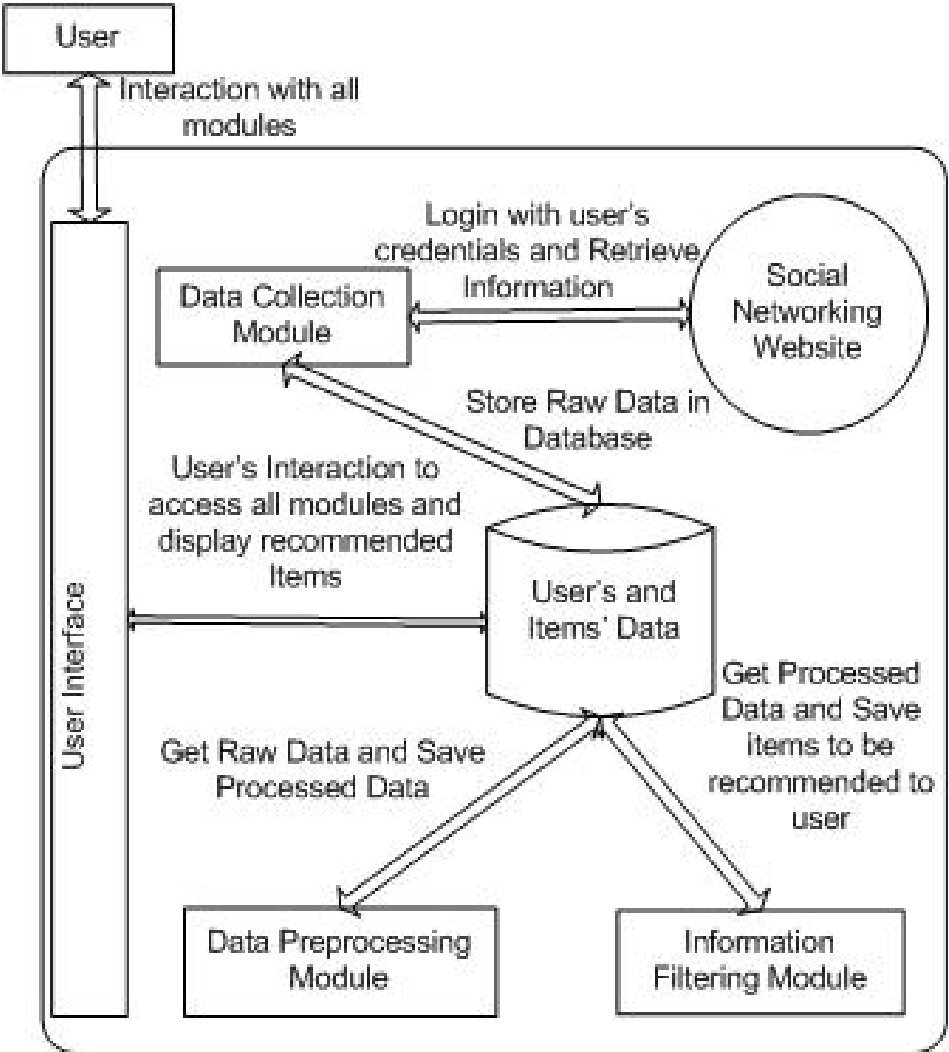
The system is divided into four distinct modules, creating a pipeline from raw social data to a refined recommendation list.
1. The Multi-Layered Filtering Engine
The core innovation lies in the Information Filtering Module (IFM). Unlike standard CF, which might treat all "neighbors" equally, URS categorizes friends into four groups (Close Friends, Family, Education/Job peers, and Hometown cohorts) and assigns weights () to each.
The logic is intuitive: an item liked by multiple people across these trusted categories has a much higher Probability of Likeness.
2. The Probability Mathematical Model
The system calculates the probability of a user liking an item based on the frequency of that item appearing in different neighbor groups. The formula scales these counts by the assigned weight of the social relationship:
This ensures that highly frequent items from "Close Friends" are prioritized over sporadic items from distant acquaintances.
Experiments & Real-World Validation
To test the theory, the authors targeted the "Books" category on Facebook. They processed data from two users (User A and User B) and their combined 342 friends.
Key Performance Metrics:
- High Precision: User A achieved a precision of 0.833, meaning the vast majority of recommendations were genuinely relevant.
- Low Fallout: The low fallout rate (0.045) proves the system rarely suggests "bad" or irrelevant data, a common pitfall of over-generalized algorithms.
- Cold Start Resilience: Because the system pulls from the social graph, it could generate 84 high-quality recommendations for User A immediately, even without a long-term internal purchase history.
Critical Analysis & Future Outlook
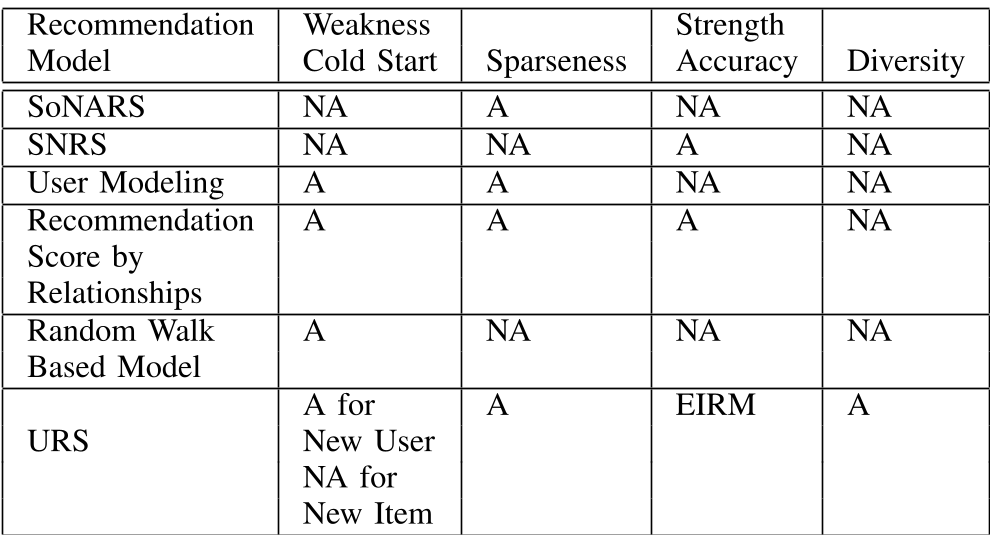
The URS approach is a testament to the power of Contextual Mining. By shifting the focus from "what the user did" to "who the user knows," the researchers bypassed the data sparsity issues that plague new platforms.
Limitations: While the system handles new users brilliantly, it still struggles with new items that haven't been liked by anyone in the social circle yet. Additionally, the reliance on SNS APIs (like Facebook's) makes the system vulnerable to changes in platform privacy policies.
The Takeaway: The future of recommendation lies in Social Trust. As users become more wary of "black-box" algorithms, systems that base suggestions on the verified likes of one's own community (URS style) will likely see higher adoption and user trust.