
Mining the Patient Voice: A Network-Based Approach to Pharmacovigilance
A Novel Data-Mining Approach Leveraging Social Media to Monitor Consumer Opinion of Sitagliptin
This paper presents a two-step data-mining framework using Self-Organizing Maps (SOM) and Network Analysis to monitor consumer opinions of the drug Sitagliptin on social media. The method successfully clusters user sentiments and identifies "information brokers" within diabetes-related forums.
TL;DR
Researchers have developed a sophisticated data-mining pipeline that moves beyond simple keyword matching to understand how patients feel about the diabetes drug Sitagliptin. By combining Self-Organizing Maps (SOM) for sentiment clustering and Network Analysis to find influential users, the study reveals how digital communities act as early-warning systems for drug side effects and information spread.
Background & Motivation
The pharmaceutical industry traditionally relies on structured clinical trials and physician reports to monitor drug safety. However, patients often discuss their real-world experiences—side effects, cost frustrations, and efficacy—on foras long before these issues reach official channels.
The challenge lies in the noise. Social media text is messy, filled with slang, and context-dependent. A user saying "I have no problems" uses the negative word "problems" in a positive sense. Previous studies struggled to deal with this context or failed to identify who was driving the conversation.
Methodology: The Two-Step Extraction
The authors propose a dual-layer approach to turn forum "small talk" into actionable insights.
1. Context-Aware Sentiment Tagging
Instead of a simple "bag-of-words" model, the team used a modified decision-making tree and the NLTK toolkit to tag words based on context.
- Negation Handling: "I do not feel great" results in
great__n(negative). - Positive Reinforcement: "No side effects" results in
No__p(positive).
2. Exploratory Clustering with SOM
The high-dimensional word frequency data (TF-IDF scores) was projected onto a 2D grid using Self-Organizing Maps. This allowed the researchers to visualize clusters of "satisfied" vs. "dissatisfied" users without losing the underlying complexity of the data.
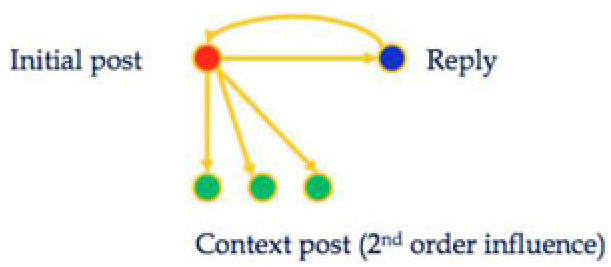 Fig 1: The modeling framework where nodes represent users and edges represent the flow of information.
Identifying the "Information Brokers"
The study’s most significant insight comes from Network Analysis. Not all posters are equal; some act as the "connective tissue" of the community.
The researchers defined Information Brokers based on two criteria:
- High Centrality: They have the highest number of incoming and outgoing connections (In/Out-Degree).
- Opinion Alignment: Their individual opinion (UAO) is highly representative of their local community (MAO).
By applying graph theory algorithms—specifically Strongly Connected Components—the study identified six "Carriers" who effectively moderated and disseminated medical knowledge across the forum.
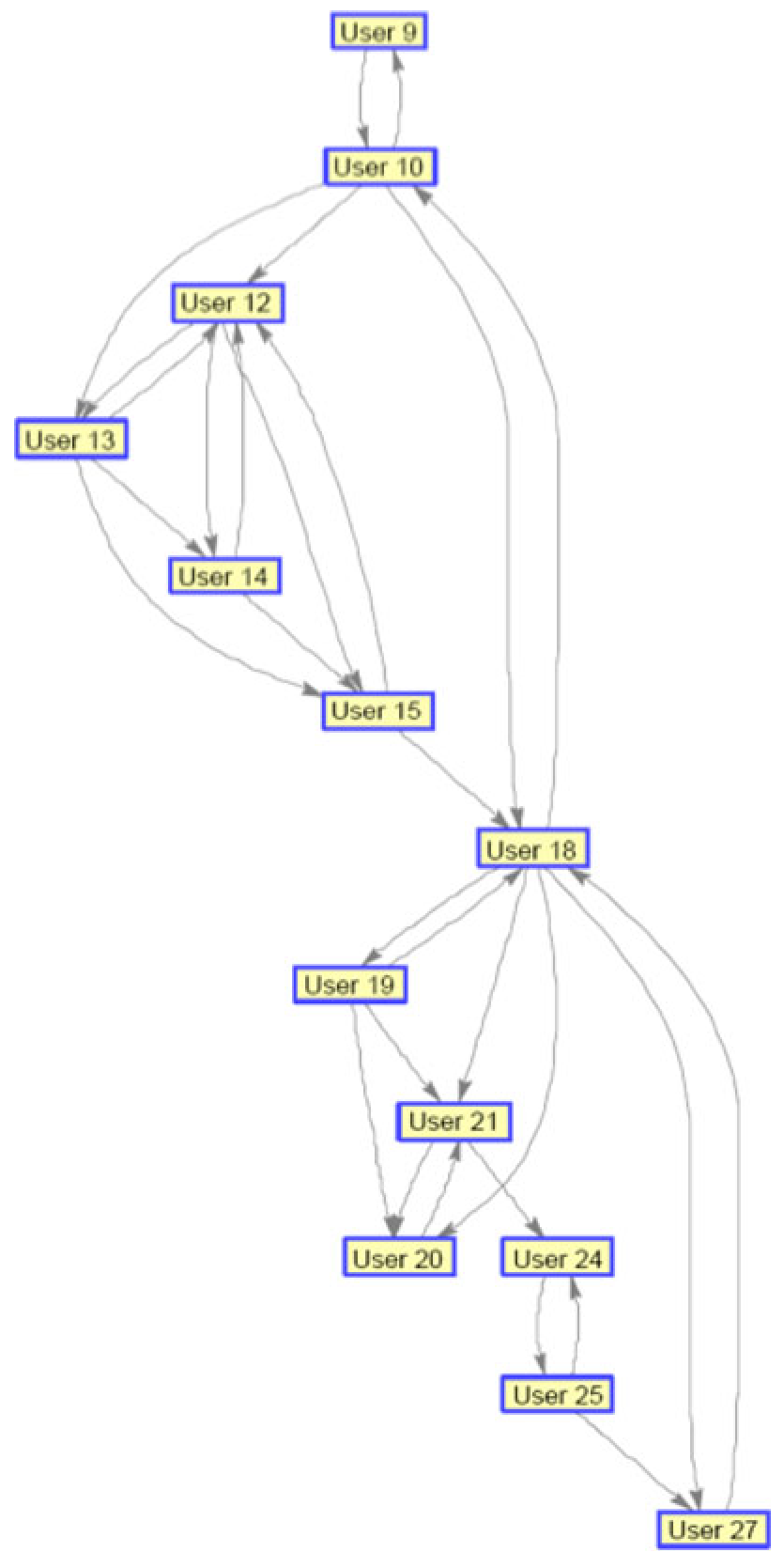 Fig 2: A subgraph showing a strongly connected information module where a broker dominates the information flow.
Key Findings & Results
- Sentiment Accuracy: The SOM clusters correlated strongly with clinical literature. Negative clusters frequently mentioned pancreatitis and thyroid issues—side effects that were later confirmed by medical researchers (e.g., Matveyenko et al., 2009).
- Network Density: The identified modules showed densities between 0.25 and 0.55, which is significantly higher than general social networks, indicating very tight-knit, influential patient communities.
- User Roles: Most information brokers were not just complaining; they were informative carriers combining personal experience with internet-sourced medical data.
Critical Insight & Future Outlook
This paper proves that social media is a "gold mine" for public health, but extracting that gold requires more than just sentiment analysis—it requires structural analysis.
Limitations: The study relies on manually predefined word lists for sentiment, which can be limited by the researchers' own biases. Future iterations should utilize Unsupervised Latent Dirichlet Allocation (LDA) or LLM-based embeddings to discover topics and sentiments dynamically.
Conclusion: As healthcare moves toward mobile health (mHealth), integrating these data-mining tools into patient monitoring devices could provide pharmaceutical companies with real-time feedback, potentially preventing public health crises before they scale.