
Hybrid Data Mining: A New Frontier in Anti-Money Laundering for Investment Banking
A data mining-based solution for detecting suspicious money laundering cases in an investment bank
This paper presents a hybrid data mining framework designed for an international investment bank to detect suspicious money laundering (ML) activities. It utilizes a combination of center-based clustering for outlier detection and back-propagation neural networks for pattern classification to identify high-risk investment behaviors.
TL;DR
Money laundering in investment banking is a multi-billion dollar problem that traditional rule-based systems struggle to solve. This paper introduces a specialized data mining framework that combines center-based clustering and neural networks. By focusing on the logical ratio between redemptions and subscriptions (Δ1 and Δ2) rather than just transaction frequency, the system can identify sophisticated "wash" patterns in seconds that previously took human experts over a week to detect.
Background: Beyond the "Cash World"
Most Anti-Money Laundering (AML) tools were built for retail banking—tracking large cash deposits or sudden bursts of activity. However, in an Investment Bank, high transaction frequency is often normal, driven by market volatility, currency shifts, or fund price changes. Traditional "one-way" comparisons (a customer’s current behavior vs. their past) fail here. We need a system that understands the relationship between moving money in and moving it out.
The Core Innovation: Δ1 and Δ2 Parameters
The researchers identified that the most suspicious ML cases in investments involve quick turnarounds where funds are redeemed shortly after subscription. To capture this, they defined two critical parameters:
- Δ1 (Value Ratio): The balance between redemption and subscription values within a specific time window (day, week, month).
- Δ2 (Share Ratio): The proportion of a specific redemption relative to the investor's total shareholdings.
To handle the "sophisticated" launderer who waits a few weeks between transactions, they refined Δ1 to look at maximum subscriptions over a sliding window (=3 to 5 periods), ensuring that staggered transactions are still linked.
Methodology: The Hybrid Architecture
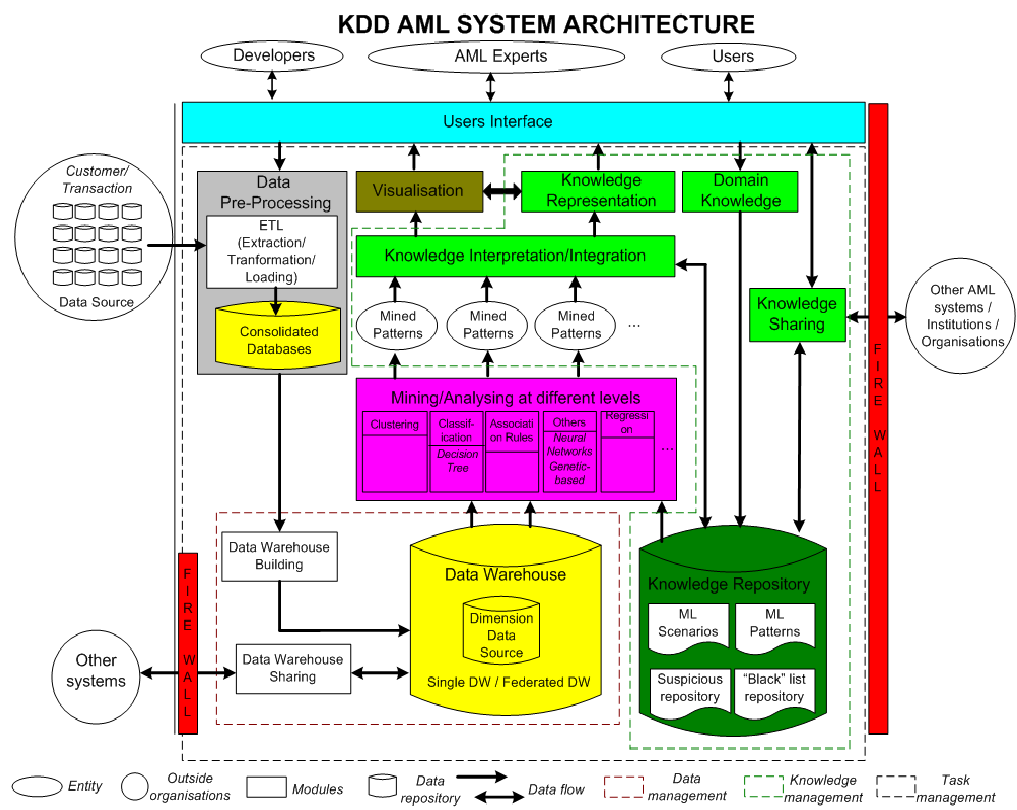
The framework operates through a multi-layered pipeline:
- Data Pre-processing: Cleaning "dummy" values and phonetic errors common in legacy bank databases.
- Suspicious Screening: A heuristic step that filters the dataset to focus on records where Δ1 and Δ2 are high, significantly reducing computational overhead.
- Clustering & Classification: Using center-based clustering to group similar behaviors. These clusters are then used to train a Back-propagation Neural Network, which assigns a "Suspicious Degree" to new transactions.
Experimental Results & Performance
Testing was conducted on real-world datasets from BEP bank containing 2 million transaction records.
- Speed: The system processed 45,000 records in just 0.51 seconds.
- Accuracy: It identified cases with a "Suspicious Degree" of 0.99 (where a customer redeemed 97% of a subscription within days, representing 80% of their total holdings).
- Efficiency: The approach matched the findings of manual investigations that took a full week, but did so almost instantaneously.
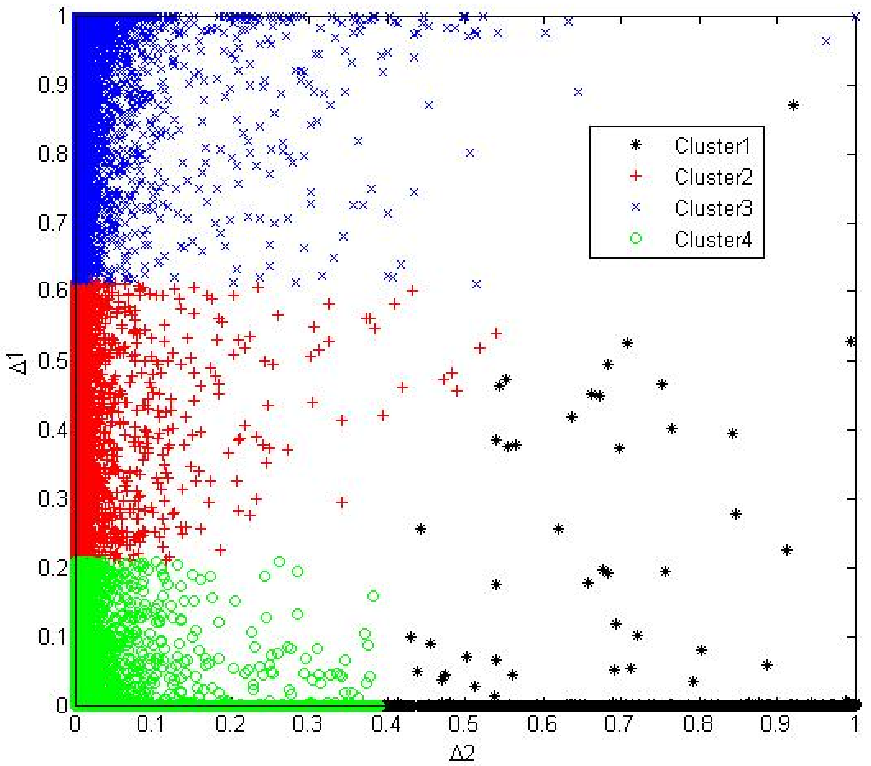 Figure: Clustering of investment fund data. Cluster 4 (top right) represents the high-risk "sweet spot" where both Δ1 and Δ2 are high.
Critical Insight: Why This Works
The brilliance of this method isn't in a complex new algorithm, but in domain-specific feature engineering. By reducing the dimensionality of the problem to Δ1 and Δ2, the neural network doesn't get "distracted" by market-driven fluctuations in trade volume. It focuses purely on the intent: Is this person trying to clean this specific pot of money?
Conclusion & Limitations
The paper proves that a hybrid approach—using unsupervised learning (clustering) to label potential outliers and supervised learning (neural networks) to refine the detection—is highly effective for AML.
Limitations: The system still requires initial parameter tuning by AML experts (deciding the window and screening thresholds ). Future work should look into Automated Machine Learning (AutoML) to dynamically adjust these thresholds as criminal tactics evolve.
As money laundering becomes the world's "third largest business," moving from simple drug trafficking to complex terrorism financing, tools like this are no longer optional—they are a requirement for global financial stability.